

7.9 Problems
Problem 7.1 Fig. P7.1 shows a model of a needle pointing instrument, mounted
on a structure that vibrates in direction w at small amplitude qL ( L and high
frequency X ) x ¼
ffiffiffiffiffiffiffiffiffiffiffiffiffiffiffiffiffiffiffi
3k=ðmL 2 Þ
p
. In the absence of imposed vibrations and other
Fig. 7.16 Clamped-free 0.5 Â 500 mm piano string excited by horizontal vibrations at the left
end. Two images overlaid: One with gravity as the only excitation (lower string image), and one
with the base vibrating at 62 Hz and 3.3 mm displacement amplitude (upper image). The string tip
is seen to lift about 2 cm. (Thomsen 2003b)
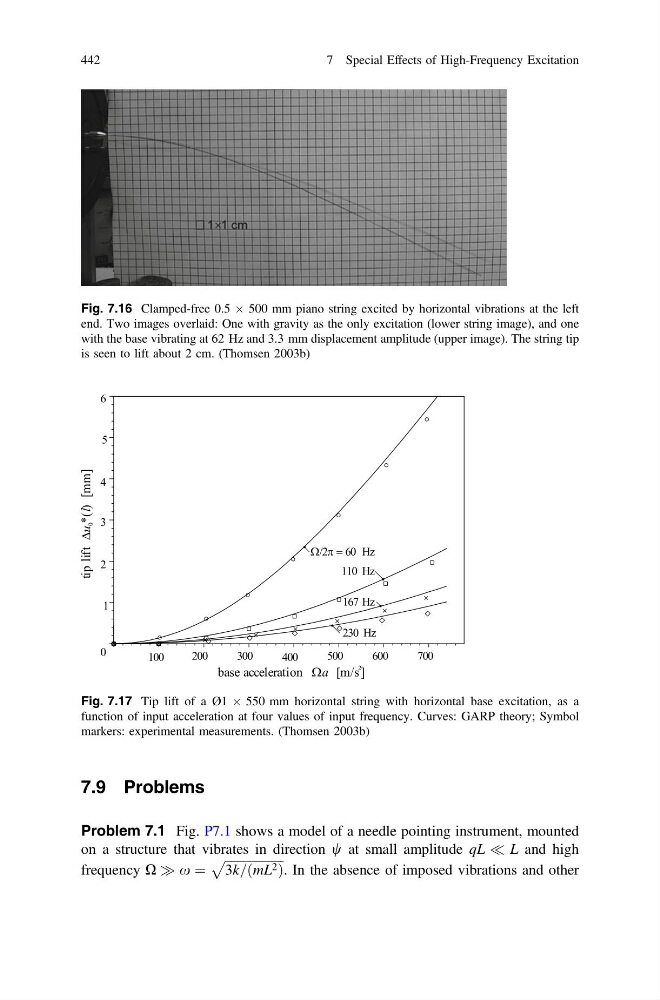
Fig. 7.17 Tip lift of a Ø1 Â 550 mm horizontal string with horizontal base excitation, as a
function of input acceleration at four values of input frequency. Curves: GARP theory; Symbol
markers: experimental measurements. (Thomsen 2003b)
442
7 Special Effects of High-Frequency Excitation
Problem 7.1 Fig. P7.1 shows a model of a needle pointing instrument, mounted
on a structure that vibrates in direction w at small amplitude qL ( L and high
frequency X ) x ¼
ffiffiffiffiffiffiffiffiffiffiffiffiffiffiffiffiffiffiffi
3k=ðmL 2 Þ
p
. In the absence of imposed vibrations and other
Fig. 7.16 Clamped-free 0.5 Â 500 mm piano string excited by horizontal vibrations at the left
end. Two images overlaid: One with gravity as the only excitation (lower string image), and one
with the base vibrating at 62 Hz and 3.3 mm displacement amplitude (upper image). The string tip
is seen to lift about 2 cm. (Thomsen 2003b)
Fig. 7.17 Tip lift of a Ø1 Â 550 mm horizontal string with horizontal base excitation, as a
function of input acceleration at four values of input frequency. Curves: GARP theory; Symbol
markers: experimental measurements. (Thomsen 2003b)
442
7 Special Effects of High-Frequency Excitation