

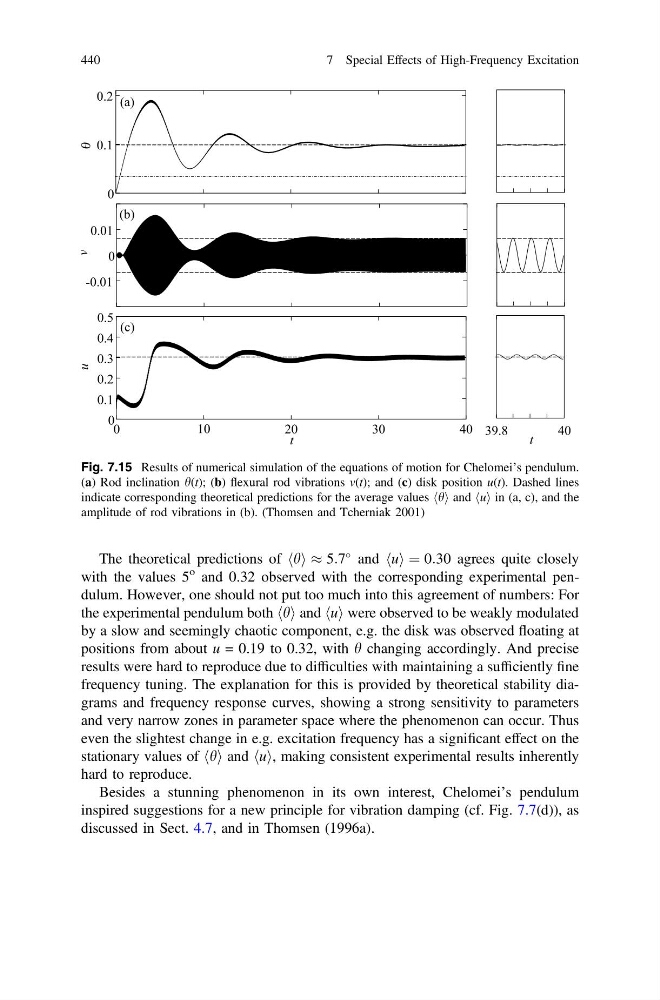
The theoretical predictions of h
h i % 5:7
and u
h i ¼ 0:30 agrees quite closely
with the values 5
o and 0.32 observed with the corresponding experimental pendulum. However, one should not put too much into this agreement of numbers: For
the experimental pendulum both h
h i and u
h i were observed to be weakly modulated
by a slow and seemingly chaotic component, e.g. the disk was observed floating at
positions from about u = 0.19 to 0.32, with h changing accordingly. And precise
results were hard to reproduce due to difficulties with maintaining a sufficiently fine
frequency tuning. The explanation for this is provided by theoretical stability diagrams and frequency response curves, showing a strong sensitivity to parameters
and very narrow zones in parameter space where the phenomenon can occur. Thus
even the slightest change in e.g. excitation frequency has a significant effect on the
stationary values of h
h i and u
h i, making consistent experimental results inherently
hard to reproduce.
Besides a stunning phenomenon in its own interest, Chelomei’s pendulum
inspired suggestions for a new principle for vibration damping (cf. Fig. 7.7(d)), as
discussed in Sect. 4.7, and in Thomsen (1996a).
Fig. 7.15 Results of numerical simulation of the equations of motion for Chelomei’s pendulum.
(a) Rod inclination h(t); (b) flexural rod vibrations v(t); and (c) disk position u(t). Dashed lines
indicate corresponding theoretical predictions for the average values h
h i and u
h i in (a, c), and the
amplitude of rod vibrations in (b). (Thomsen and Tcherniak 2001)
440
7 Special Effects of High-Frequency Excitation
h i % 5:7
and u
h i ¼ 0:30 agrees quite closely
with the values 5
o and 0.32 observed with the corresponding experimental pendulum. However, one should not put too much into this agreement of numbers: For
the experimental pendulum both h
h i and u
h i were observed to be weakly modulated
by a slow and seemingly chaotic component, e.g. the disk was observed floating at
positions from about u = 0.19 to 0.32, with h changing accordingly. And precise
results were hard to reproduce due to difficulties with maintaining a sufficiently fine
frequency tuning. The explanation for this is provided by theoretical stability diagrams and frequency response curves, showing a strong sensitivity to parameters
and very narrow zones in parameter space where the phenomenon can occur. Thus
even the slightest change in e.g. excitation frequency has a significant effect on the
stationary values of h
h i and u
h i, making consistent experimental results inherently
hard to reproduce.
Besides a stunning phenomenon in its own interest, Chelomei’s pendulum
inspired suggestions for a new principle for vibration damping (cf. Fig. 7.7(d)), as
discussed in Sect. 4.7, and in Thomsen (1996a).
Fig. 7.15 Results of numerical simulation of the equations of motion for Chelomei’s pendulum.
(a) Rod inclination h(t); (b) flexural rod vibrations v(t); and (c) disk position u(t). Dashed lines
indicate corresponding theoretical predictions for the average values h
h i and u
h i in (a, c), and the
amplitude of rod vibrations in (b). (Thomsen and Tcherniak 2001)
440
7 Special Effects of High-Frequency Excitation