

Analytical expressions for the average sliding speed as a function of system
parameters are derived, that generally agree well with numerical simulation results.
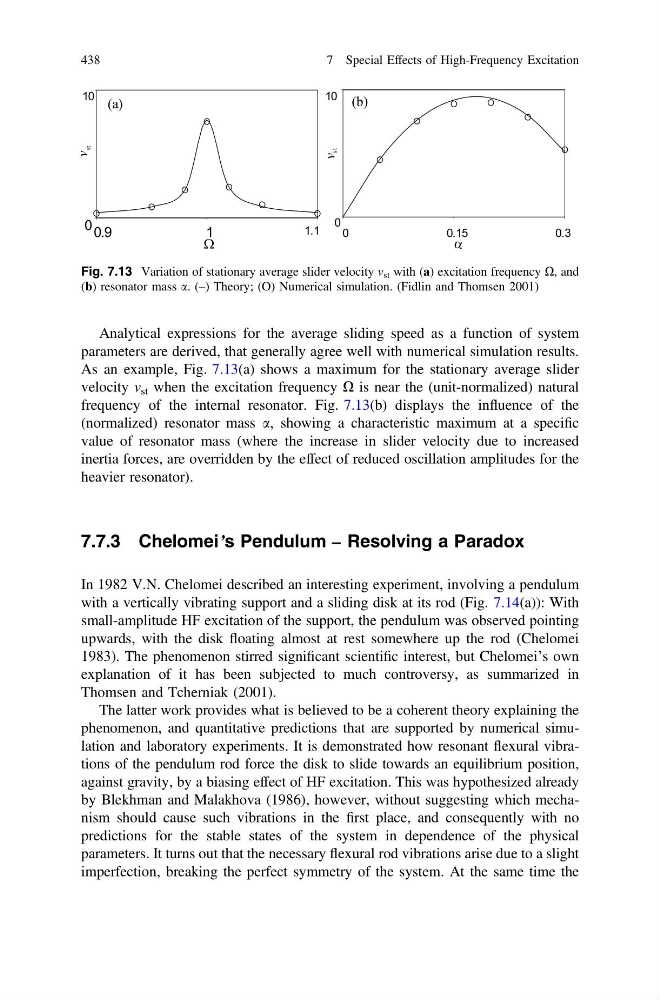
As an example, Fig. 7.13(a) shows a maximum for the stationary average slider
velocity v st when the excitation frequency X is near the (unit-normalized) natural
frequency of the internal resonator. Fig. 7.13(b) displays the influence of the
(normalized) resonator mass a, showing a characteristic maximum at a specific
value of resonator mass (where the increase in slider velocity due to increased
inertia forces, are overridden by the effect of reduced oscillation amplitudes for the
heavier resonator).
7.7.3 Chelomei’s Pendulum – Resolving a Paradox
In 1982 V.N. Chelomei described an interesting experiment, involving a pendulum
with a vertically vibrating support and a sliding disk at its rod (Fig. 7.14(a)): With
small-amplitude HF excitation of the support, the pendulum was observed pointing
upwards, with the disk floating almost at rest somewhere up the rod (Chelomei
1983). The phenomenon stirred significant scientific interest, but Chelomei’s own
explanation of it has been subjected to much controversy, as summarized in
Thomsen and Tcherniak (2001).
The latter work provides what is believed to be a coherent theory explaining the
phenomenon, and quantitative predictions that are supported by numerical simulation and laboratory experiments. It is demonstrated how resonant flexural vibrations of the pendulum rod force the disk to slide towards an equilibrium position,
against gravity, by a biasing effect of HF excitation. This was hypothesized already
by Blekhman and Malakhova (1986), however, without suggesting which mechanism should cause such vibrations in the first place, and consequently with no
predictions for the stable states of the system in dependence of the physical
parameters. It turns out that the necessary flexural rod vibrations arise due to a slight
imperfection, breaking the perfect symmetry of the system. At the same time the
Fig. 7.13 Variation of stationary average slider velocity v st with (a) excitation frequency X, and
(b) resonator mass a. (–) Theory; (O) Numerical simulation. (Fidlin and Thomsen 2001)
438
7 Special Effects of High-Frequency Excitation
parameters are derived, that generally agree well with numerical simulation results.
As an example, Fig. 7.13(a) shows a maximum for the stationary average slider
velocity v st when the excitation frequency X is near the (unit-normalized) natural
frequency of the internal resonator. Fig. 7.13(b) displays the influence of the
(normalized) resonator mass a, showing a characteristic maximum at a specific
value of resonator mass (where the increase in slider velocity due to increased
inertia forces, are overridden by the effect of reduced oscillation amplitudes for the
heavier resonator).
7.7.3 Chelomei’s Pendulum – Resolving a Paradox
In 1982 V.N. Chelomei described an interesting experiment, involving a pendulum
with a vertically vibrating support and a sliding disk at its rod (Fig. 7.14(a)): With
small-amplitude HF excitation of the support, the pendulum was observed pointing
upwards, with the disk floating almost at rest somewhere up the rod (Chelomei
1983). The phenomenon stirred significant scientific interest, but Chelomei’s own
explanation of it has been subjected to much controversy, as summarized in
Thomsen and Tcherniak (2001).
The latter work provides what is believed to be a coherent theory explaining the
phenomenon, and quantitative predictions that are supported by numerical simulation and laboratory experiments. It is demonstrated how resonant flexural vibrations of the pendulum rod force the disk to slide towards an equilibrium position,
against gravity, by a biasing effect of HF excitation. This was hypothesized already
by Blekhman and Malakhova (1986), however, without suggesting which mechanism should cause such vibrations in the first place, and consequently with no
predictions for the stable states of the system in dependence of the physical
parameters. It turns out that the necessary flexural rod vibrations arise due to a slight
imperfection, breaking the perfect symmetry of the system. At the same time the
Fig. 7.13 Variation of stationary average slider velocity v st with (a) excitation frequency X, and
(b) resonator mass a. (–) Theory; (O) Numerical simulation. (Fidlin and Thomsen 2001)
438
7 Special Effects of High-Frequency Excitation