

dH ¼
Z t 2
t 1
Z l
0
ÀPðtÞ ~ dðx À x 0 Þ À qA þ m ~ dðx À x 0 Þ
€ u À EIu
0000
dudxdt:
ð1:82Þ
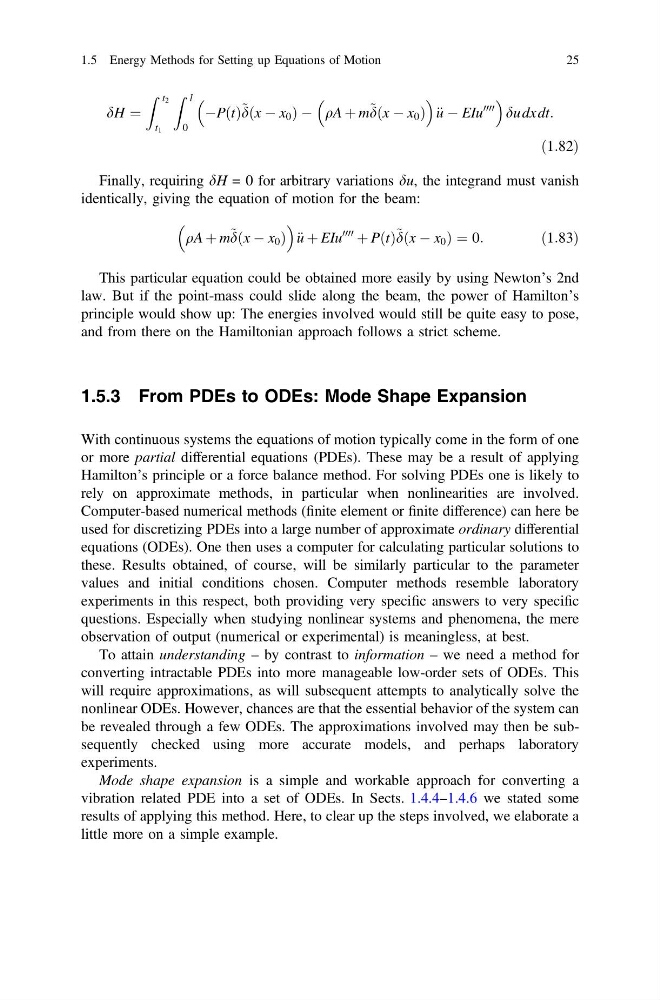
Finally, requiring dH = 0 for arbitrary variations du, the integrand must vanish
identically, giving the equation of motion for the beam:
qA þ m ~ dðx À x 0 Þ
€ u þ EIu
0000
þ PðtÞ ~ dðx À x 0 Þ ¼ 0:
ð1:83Þ
This particular equation could be obtained more easily by using Newton’s 2nd
law. But if the point-mass could slide along the beam, the power of Hamilton’s
principle would show up: The energies involved would still be quite easy to pose,
and from there on the Hamiltonian approach follows a strict scheme.
1.5.3 From PDEs to ODEs: Mode Shape Expansion
With continuous systems the equations of motion typically come in the form of one
or more partial differential equations (PDEs). These may be a result of applying
Hamilton’s principle or a force balance method. For solving PDEs one is likely to
rely on approximate methods, in particular when nonlinearities are involved.
Computer-based numerical methods (finite element or finite difference) can here be
used for discretizing PDEs into a large number of approximate ordinary differential
equations (ODEs). One then uses a computer for calculating particular solutions to
these. Results obtained, of course, will be similarly particular to the parameter
values and initial conditions chosen. Computer methods resemble laboratory
experiments in this respect, both providing very specific answers to very specific
questions. Especially when studying nonlinear systems and phenomena, the mere
observation of output (numerical or experimental) is meaningless, at best.
To attain understanding – by contrast to information – we need a method for
converting intractable PDEs into more manageable low-order sets of ODEs. This
will require approximations, as will subsequent attempts to analytically solve the
nonlinear ODEs. However, chances are that the essential behavior of the system can
be revealed through a few ODEs. The approximations involved may then be subsequently checked using more accurate models, and perhaps laboratory
experiments.
Mode shape expansion is a simple and workable approach for converting a
vibration related PDE into a set of ODEs. In Sects. 1.4.4–1.4.6 we stated some
results of applying this method. Here, to clear up the steps involved, we elaborate a
little more on a simple example.
1.5 Energy Methods for Setting up Equations of Motion
25
Z t 2
t 1
Z l
0
ÀPðtÞ ~ dðx À x 0 Þ À qA þ m ~ dðx À x 0 Þ
€ u À EIu
0000
dudxdt:
ð1:82Þ
Finally, requiring dH = 0 for arbitrary variations du, the integrand must vanish
identically, giving the equation of motion for the beam:
qA þ m ~ dðx À x 0 Þ
€ u þ EIu
0000
þ PðtÞ ~ dðx À x 0 Þ ¼ 0:
ð1:83Þ
This particular equation could be obtained more easily by using Newton’s 2nd
law. But if the point-mass could slide along the beam, the power of Hamilton’s
principle would show up: The energies involved would still be quite easy to pose,
and from there on the Hamiltonian approach follows a strict scheme.
1.5.3 From PDEs to ODEs: Mode Shape Expansion
With continuous systems the equations of motion typically come in the form of one
or more partial differential equations (PDEs). These may be a result of applying
Hamilton’s principle or a force balance method. For solving PDEs one is likely to
rely on approximate methods, in particular when nonlinearities are involved.
Computer-based numerical methods (finite element or finite difference) can here be
used for discretizing PDEs into a large number of approximate ordinary differential
equations (ODEs). One then uses a computer for calculating particular solutions to
these. Results obtained, of course, will be similarly particular to the parameter
values and initial conditions chosen. Computer methods resemble laboratory
experiments in this respect, both providing very specific answers to very specific
questions. Especially when studying nonlinear systems and phenomena, the mere
observation of output (numerical or experimental) is meaningless, at best.
To attain understanding – by contrast to information – we need a method for
converting intractable PDEs into more manageable low-order sets of ODEs. This
will require approximations, as will subsequent attempts to analytically solve the
nonlinear ODEs. However, chances are that the essential behavior of the system can
be revealed through a few ODEs. The approximations involved may then be subsequently checked using more accurate models, and perhaps laboratory
experiments.
Mode shape expansion is a simple and workable approach for converting a
vibration related PDE into a set of ODEs. In Sects. 1.4.4–1.4.6 we stated some
results of applying this method. Here, to clear up the steps involved, we elaborate a
little more on a simple example.
1.5 Energy Methods for Setting up Equations of Motion
25