

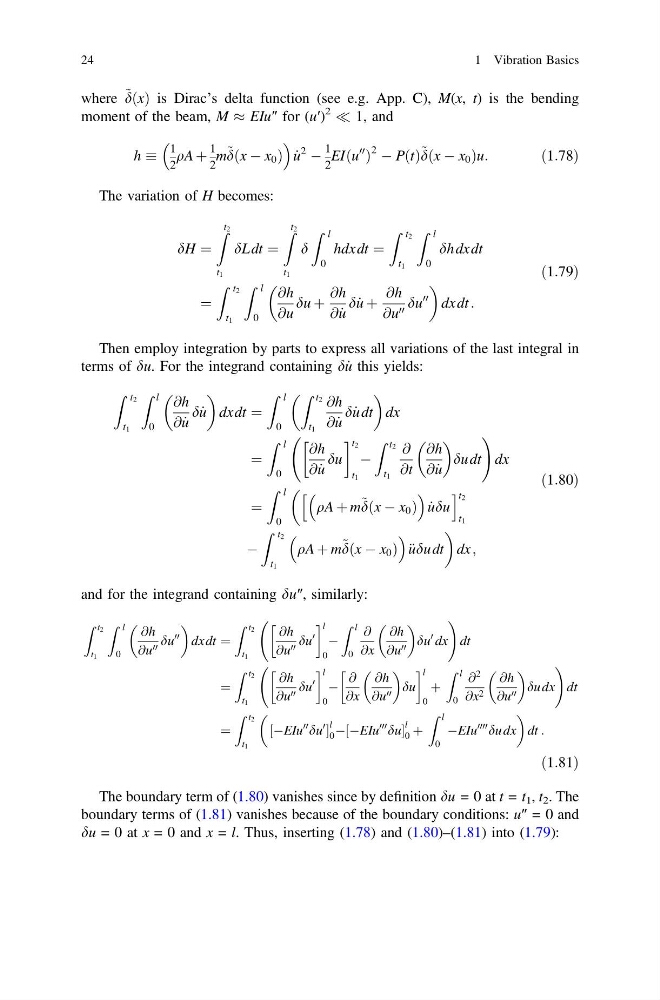
where ~ dðxÞ is Dirac’s delta function (see e.g. App. C), M(x, t) is the bending
moment of the beam, M % EIu″ for (u′)
2
( 1, and
h
1
2
qA þ
1
2
m ~ dðx À x 0 Þ
_
u
2
À
1
2
EIðu
00
Þ
2 À PðtÞ ~ dðx À x 0 Þu:
ð1:78Þ
The variation of H becomes:
dH ¼
Z t 2
t 1
dLdt ¼
Z t 2
t 1
d
Z l
0
hdx dt ¼
Z t 2
t 1
Z l
0
dhdxdt
¼
Z t 2
t 1
Z l
0
@h
@u
du þ
@h
@ _
u
d _
u þ
@h
@u 00 du
00
dx dt :
ð1:79Þ
Then employ integration by parts to express all variations of the last integral in
terms of du. For the integrand containing d _
u this yields:
Z t 2
t 1
Z l
0
@h
@ _
u
d _
u
dxdt ¼
Z l
0
Z t 2
t 1
@h
@ _
u
d _
udt
dx
¼
Z l
0
@h
@ _
u
du
! t 2
t 1
À
Z t 2
t 1
@
@t
@h
@ _
u
dudt
!
dx
¼
Z l
0
qA þ m ~ dðx À x 0 Þ
_
udu
h
i t 2
t 1
À
Z t 2
t 1
qA þ m ~ dðx À x 0 Þ
€ ududt
dx;
ð1:80Þ
and for the integrand containing du″, similarly:
Z t2
t1
Z l
0
@h
@u 00 du
00
dx dt ¼
Z t2
t1
@h
@u 00 du
0
! l
0
À
Z l
0
@
@x
@h
@u 00
du
0 dx
!
dt
¼
Z t2
t1
@h
@u 00 du
0
! l
0
À
@
@x
@h
@u 00
du
! l
0
þ
Z l
0
@
2
@x 2
@h
@u 00
dudx
!
dt
¼
Z t2
t1
ÀEIu
00 du
0
½
l
0 À ÀEIu
000 du
½
l
0 þ
Z l
0
ÀEIu
0000 dudx
dt :
ð1:81Þ
The boundary term of (1.80) vanishes since by definition du = 0 at t = t 1 , t 2 . The
boundary terms of (1.81) vanishes because of the boundary conditions: u″ = 0 and
du = 0 at x = 0 and x = l. Thus, inserting (1.78) and (1.80)–(1.81) into (1.79):
24
1 Vibration Basics
moment of the beam, M % EIu″ for (u′)
2
( 1, and
h
1
2
qA þ
1
2
m ~ dðx À x 0 Þ
_
u
2
À
1
2
EIðu
00
Þ
2 À PðtÞ ~ dðx À x 0 Þu:
ð1:78Þ
The variation of H becomes:
dH ¼
Z t 2
t 1
dLdt ¼
Z t 2
t 1
d
Z l
0
hdx dt ¼
Z t 2
t 1
Z l
0
dhdxdt
¼
Z t 2
t 1
Z l
0
@h
@u
du þ
@h
@ _
u
d _
u þ
@h
@u 00 du
00
dx dt :
ð1:79Þ
Then employ integration by parts to express all variations of the last integral in
terms of du. For the integrand containing d _
u this yields:
Z t 2
t 1
Z l
0
@h
@ _
u
d _
u
dxdt ¼
Z l
0
Z t 2
t 1
@h
@ _
u
d _
udt
dx
¼
Z l
0
@h
@ _
u
du
! t 2
t 1
À
Z t 2
t 1
@
@t
@h
@ _
u
dudt
!
dx
¼
Z l
0
qA þ m ~ dðx À x 0 Þ
_
udu
h
i t 2
t 1
À
Z t 2
t 1
qA þ m ~ dðx À x 0 Þ
€ ududt
dx;
ð1:80Þ
and for the integrand containing du″, similarly:
Z t2
t1
Z l
0
@h
@u 00 du
00
dx dt ¼
Z t2
t1
@h
@u 00 du
0
! l
0
À
Z l
0
@
@x
@h
@u 00
du
0 dx
!
dt
¼
Z t2
t1
@h
@u 00 du
0
! l
0
À
@
@x
@h
@u 00
du
! l
0
þ
Z l
0
@
2
@x 2
@h
@u 00
dudx
!
dt
¼
Z t2
t1
ÀEIu
00 du
0
½
l
0 À ÀEIu
000 du
½
l
0 þ
Z l
0
ÀEIu
0000 dudx
dt :
ð1:81Þ
The boundary term of (1.80) vanishes since by definition du = 0 at t = t 1 , t 2 . The
boundary terms of (1.81) vanishes because of the boundary conditions: u″ = 0 and
du = 0 at x = 0 and x = l. Thus, inserting (1.78) and (1.80)–(1.81) into (1.79):
24
1 Vibration Basics