

relatively easy application and interpretation, when the forces of excitation are
rapidly changing as compared to the natural frequencies.
Originating from Kapitza’s heuristic approach for a specific problem (Kapitza
1951, 1965; Landau and Lifshitz 1976), the MDSM was formalized, generalized,
named, and applied to a wide variety of physical systems and phenomena by
I. I. Blekhman (e.g. Blekhman 1976, 1994, 2000, 2004). Below we present an
outline of the method; for rigorous derivations and theorems and extensive
examples of application Blekhman (2000) should be consulted.
7.2.1 Outline of the MDSM
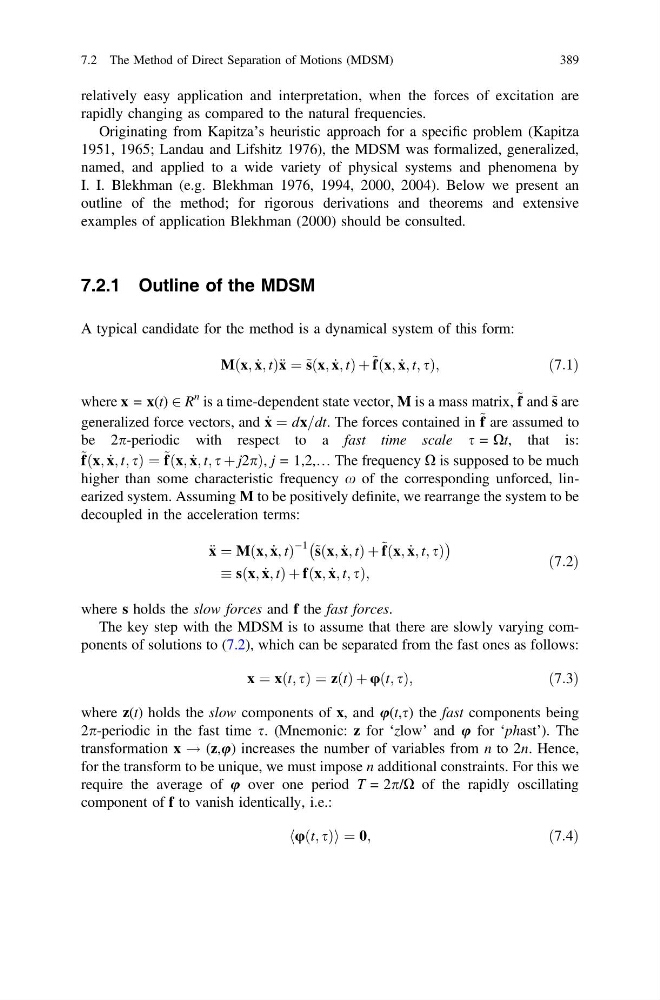
A typical candidate for the method is a dynamical system of this form:
Mðx; _
x; tÞ€ x ¼ ~ sðx; _
x; tÞ þ ~ fðx; _
x; t; sÞ;
ð7:1Þ
where x = x(t) 2 R
n is a time-dependent state vector, M is a mass matrix, ~ f and ~ s are
generalized force vectors, and _
x ¼ dx=dt. The forces contained in ~ f are assumed to
be 2p-periodic with respect to a fast time scale s = Xt, that is:
~ fðx; _
x; t; sÞ ¼ ~ fðx; _
x; t; s þ j2pÞ, j = 1,2,… The frequency X is supposed to be much
higher than some characteristic frequency x of the corresponding unforced, linearized system. Assuming M to be positively definite, we rearrange the system to be
decoupled in the acceleration terms:
€ x ¼ Mðx; _
x; tÞ
À1
~ sðx; _
x; tÞ þ ~ fðx; _
x; t; sÞ
À
Á
sðx; _
x; tÞ þ fðx; _
x; t; sÞ;
ð7:2Þ
where s holds the slow forces and f the fast forces.
The key step with the MDSM is to assume that there are slowly varying components of solutions to (7.2), which can be separated from the fast ones as follows:
x ¼ xðt; sÞ ¼ zðtÞ þ uðt; sÞ;
ð7:3Þ
where z(t) holds the slow components of x, and u(t,s) the fast components being
2p-periodic in the fast time s. (Mnemonic: z for ‘zlow’ and u for ‘phast’). The
transformation x ! (z,u) increases the number of variables from n to 2n. Hence,
for the transform to be unique, we must impose n additional constraints. For this we
require the average of u over one period T = 2p/X of the rapidly oscillating
component of f to vanish identically, i.e.:
uðt; sÞ
h
i¼ 0;
ð7:4Þ
7.2 The Method of Direct Separation of Motions (MDSM)
389
rapidly changing as compared to the natural frequencies.
Originating from Kapitza’s heuristic approach for a specific problem (Kapitza
1951, 1965; Landau and Lifshitz 1976), the MDSM was formalized, generalized,
named, and applied to a wide variety of physical systems and phenomena by
I. I. Blekhman (e.g. Blekhman 1976, 1994, 2000, 2004). Below we present an
outline of the method; for rigorous derivations and theorems and extensive
examples of application Blekhman (2000) should be consulted.
7.2.1 Outline of the MDSM
A typical candidate for the method is a dynamical system of this form:
Mðx; _
x; tÞ€ x ¼ ~ sðx; _
x; tÞ þ ~ fðx; _
x; t; sÞ;
ð7:1Þ
where x = x(t) 2 R
n is a time-dependent state vector, M is a mass matrix, ~ f and ~ s are
generalized force vectors, and _
x ¼ dx=dt. The forces contained in ~ f are assumed to
be 2p-periodic with respect to a fast time scale s = Xt, that is:
~ fðx; _
x; t; sÞ ¼ ~ fðx; _
x; t; s þ j2pÞ, j = 1,2,… The frequency X is supposed to be much
higher than some characteristic frequency x of the corresponding unforced, linearized system. Assuming M to be positively definite, we rearrange the system to be
decoupled in the acceleration terms:
€ x ¼ Mðx; _
x; tÞ
À1
~ sðx; _
x; tÞ þ ~ fðx; _
x; t; sÞ
À
Á
sðx; _
x; tÞ þ fðx; _
x; t; sÞ;
ð7:2Þ
where s holds the slow forces and f the fast forces.
The key step with the MDSM is to assume that there are slowly varying components of solutions to (7.2), which can be separated from the fast ones as follows:
x ¼ xðt; sÞ ¼ zðtÞ þ uðt; sÞ;
ð7:3Þ
where z(t) holds the slow components of x, and u(t,s) the fast components being
2p-periodic in the fast time s. (Mnemonic: z for ‘zlow’ and u for ‘phast’). The
transformation x ! (z,u) increases the number of variables from n to 2n. Hence,
for the transform to be unique, we must impose n additional constraints. For this we
require the average of u over one period T = 2p/X of the rapidly oscillating
component of f to vanish identically, i.e.:
uðt; sÞ
h
i¼ 0;
ð7:4Þ
7.2 The Method of Direct Separation of Motions (MDSM)
389