

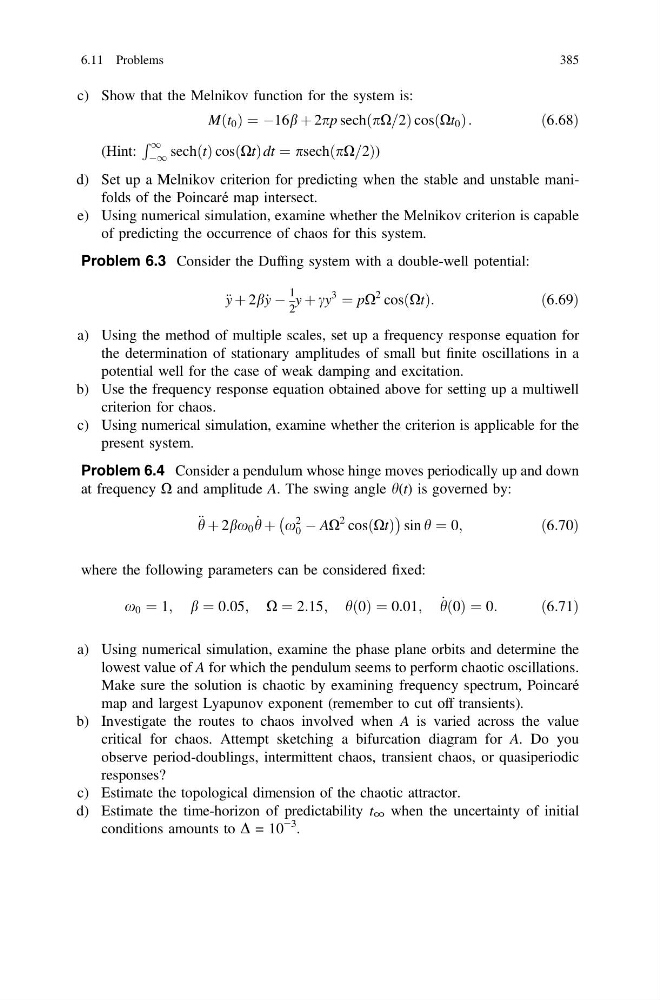
c) Show that the Melnikov function for the system is:
Mðt 0 Þ ¼ À16b þ 2pp sechðpX=2Þ cosðXt 0 Þ:
ð6:68Þ
(Hint:
R 1
À1 sechðtÞ cosðXtÞdt ¼ psechðpX=2Þ)
d) Set up a Melnikov criterion for predicting when the stable and unstable manifolds of the Poincaré map intersect.
e) Using numerical simulation, examine whether the Melnikov criterion is capable
of predicting the occurrence of chaos for this system.
Problem 6.3 Consider the Duffing system with a double-well potential:
€ y þ 2b_ y À
1
2
y þ cy
3
¼ pX
2 cosðXtÞ:
ð6:69Þ
a) Using the method of multiple scales, set up a frequency response equation for
the determination of stationary amplitudes of small but finite oscillations in a
potential well for the case of weak damping and excitation.
b) Use the frequency response equation obtained above for setting up a multiwell
criterion for chaos.
c) Using numerical simulation, examine whether the criterion is applicable for the
present system.
Problem 6.4 Consider a pendulum whose hinge moves periodically up and down
at frequency X and amplitude A. The swing angle h(t) is governed by:
€ h þ 2bx 0 _
h þ x
2
0 À AX
2 cosðXtÞ
À
Á
sin h ¼ 0;
ð6:70Þ
where the following parameters can be considered fixed:
x 0 ¼ 1; b ¼ 0:05; X ¼ 2:15; hð0Þ ¼ 0:01; _
hð0Þ ¼ 0:
ð6:71Þ
a) Using numerical simulation, examine the phase plane orbits and determine the
lowest value of A for which the pendulum seems to perform chaotic oscillations.
Make sure the solution is chaotic by examining frequency spectrum, Poincaré
map and largest Lyapunov exponent (remember to cut off transients).
b) Investigate the routes to chaos involved when A is varied across the value
critical for chaos. Attempt sketching a bifurcation diagram for A. Do you
observe period-doublings, intermittent chaos, transient chaos, or quasiperiodic
responses?
c) Estimate the topological dimension of the chaotic attractor.
d) Estimate the time-horizon of predictability t ∞ when the uncertainty of initial
conditions amounts to D = 10
−3 .
6.11 Problems
385
Mðt 0 Þ ¼ À16b þ 2pp sechðpX=2Þ cosðXt 0 Þ:
ð6:68Þ
(Hint:
R 1
À1 sechðtÞ cosðXtÞdt ¼ psechðpX=2Þ)
d) Set up a Melnikov criterion for predicting when the stable and unstable manifolds of the Poincaré map intersect.
e) Using numerical simulation, examine whether the Melnikov criterion is capable
of predicting the occurrence of chaos for this system.
Problem 6.3 Consider the Duffing system with a double-well potential:
€ y þ 2b_ y À
1
2
y þ cy
3
¼ pX
2 cosðXtÞ:
ð6:69Þ
a) Using the method of multiple scales, set up a frequency response equation for
the determination of stationary amplitudes of small but finite oscillations in a
potential well for the case of weak damping and excitation.
b) Use the frequency response equation obtained above for setting up a multiwell
criterion for chaos.
c) Using numerical simulation, examine whether the criterion is applicable for the
present system.
Problem 6.4 Consider a pendulum whose hinge moves periodically up and down
at frequency X and amplitude A. The swing angle h(t) is governed by:
€ h þ 2bx 0 _
h þ x
2
0 À AX
2 cosðXtÞ
À
Á
sin h ¼ 0;
ð6:70Þ
where the following parameters can be considered fixed:
x 0 ¼ 1; b ¼ 0:05; X ¼ 2:15; hð0Þ ¼ 0:01; _
hð0Þ ¼ 0:
ð6:71Þ
a) Using numerical simulation, examine the phase plane orbits and determine the
lowest value of A for which the pendulum seems to perform chaotic oscillations.
Make sure the solution is chaotic by examining frequency spectrum, Poincaré
map and largest Lyapunov exponent (remember to cut off transients).
b) Investigate the routes to chaos involved when A is varied across the value
critical for chaos. Attempt sketching a bifurcation diagram for A. Do you
observe period-doublings, intermittent chaos, transient chaos, or quasiperiodic
responses?
c) Estimate the topological dimension of the chaotic attractor.
d) Estimate the time-horizon of predictability t ∞ when the uncertainty of initial
conditions amounts to D = 10
−3 .
6.11 Problems
385