

6.11 Problems
Problem 6.1 A large truss structure to be put into space is to carry test modules in
which vibrations must be minimized. The designers experience vibration problems
during ground tests of the structure. Your assistance is required.
a) An experimental vibration test is performed using broadband frequency excitation. The output frequency spectrum has a continuous appearance. Designer
A claims this is due to the huge amount of excited degrees of freedom, whereas
designer B suggests the possibility of chaotic vibrations due to loose joints.
Does it matter whether A or B is right?
b) To examine the possibility of chaotic motions the designers employ a finite
element model of the truss. Harmonic excitation at frequency X is assumed. At
X = X 1 a Poincaré map of the numerical solution shows two dots. At X 2 the
dots fill out a closed curve, and at X 3 the dots fill out some strange creature in
the plane. Which kinds of motions are indicated at X 1,2,3 , respectively?
c) The designers decide to reduce the model to order five. With the reduced model
they find no qualitative changes at X = X 1,2,3 , as compared to the full model. At
X 3 the full spectrum of Lyapunov-exponents turns out to be (0.30, 0.00, −0.05,
−0.10, −0.20). Which kind of motion is indicated by this spectrum? Compute
the Lyapunov dimension d L , and assess whether the model of the truss can be
further reduced, say, to order three.
d) The designers discuss whether the vibration problems at excitation frequency X 3
could be solved by adding adaptive control to the truss members. For this they
intend to use a controller that requires positions of the truss to be predictable 1 s
ahead. Feedback is provided by truss positions measured with 8 bits of accuracy
(%0.4%). Do you see any obstacles for this kind of control?
e) One designer re-tests the real truss at a constant excitation frequency X 4 . Within
the first minute he notices a few chaotic bursts. During the second test minute
the motion becomes regular. The designer decides that the first chaotic bursts
were merely transients, and shuts off the experiment. Can he be right? Can he be
wrong?
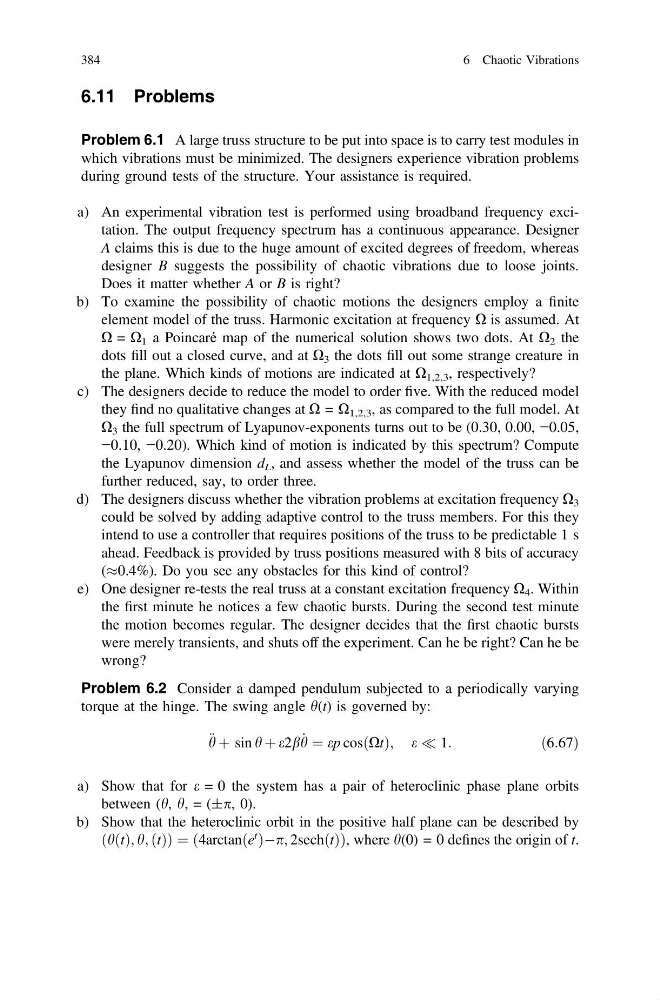
Problem 6.2 Consider a damped pendulum subjected to a periodically varying
torque at the hinge. The swing angle h(t) is governed by:
€ h þ sin h þ e2b _
h ¼ ep cosðXtÞ; e ( 1:
ð6:67Þ
a) Show that for e = 0 the system has a pair of heteroclinic phase plane orbits
between (h, h, = (±p, 0).
b) Show that the heteroclinic orbit in the positive half plane can be described by
ðh t
ð Þ; h; t
ð ÞÞ ¼ ð4arctan e
t
ð ÞÀp; 2sech t
ð ÞÞ, where h(0) = 0 defines the origin of t.
384
6 Chaotic Vibrations
Problem 6.1 A large truss structure to be put into space is to carry test modules in
which vibrations must be minimized. The designers experience vibration problems
during ground tests of the structure. Your assistance is required.
a) An experimental vibration test is performed using broadband frequency excitation. The output frequency spectrum has a continuous appearance. Designer
A claims this is due to the huge amount of excited degrees of freedom, whereas
designer B suggests the possibility of chaotic vibrations due to loose joints.
Does it matter whether A or B is right?
b) To examine the possibility of chaotic motions the designers employ a finite
element model of the truss. Harmonic excitation at frequency X is assumed. At
X = X 1 a Poincaré map of the numerical solution shows two dots. At X 2 the
dots fill out a closed curve, and at X 3 the dots fill out some strange creature in
the plane. Which kinds of motions are indicated at X 1,2,3 , respectively?
c) The designers decide to reduce the model to order five. With the reduced model
they find no qualitative changes at X = X 1,2,3 , as compared to the full model. At
X 3 the full spectrum of Lyapunov-exponents turns out to be (0.30, 0.00, −0.05,
−0.10, −0.20). Which kind of motion is indicated by this spectrum? Compute
the Lyapunov dimension d L , and assess whether the model of the truss can be
further reduced, say, to order three.
d) The designers discuss whether the vibration problems at excitation frequency X 3
could be solved by adding adaptive control to the truss members. For this they
intend to use a controller that requires positions of the truss to be predictable 1 s
ahead. Feedback is provided by truss positions measured with 8 bits of accuracy
(%0.4%). Do you see any obstacles for this kind of control?
e) One designer re-tests the real truss at a constant excitation frequency X 4 . Within
the first minute he notices a few chaotic bursts. During the second test minute
the motion becomes regular. The designer decides that the first chaotic bursts
were merely transients, and shuts off the experiment. Can he be right? Can he be
wrong?
Problem 6.2 Consider a damped pendulum subjected to a periodically varying
torque at the hinge. The swing angle h(t) is governed by:
€ h þ sin h þ e2b _
h ¼ ep cosðXtÞ; e ( 1:
ð6:67Þ
a) Show that for e = 0 the system has a pair of heteroclinic phase plane orbits
between (h, h, = (±p, 0).
b) Show that the heteroclinic orbit in the positive half plane can be described by
ðh t
ð Þ; h; t
ð ÞÞ ¼ ð4arctan e
t
ð ÞÀp; 2sech t
ð ÞÞ, where h(0) = 0 defines the origin of t.
384
6 Chaotic Vibrations