

As appears from Sects. 6.6.4 and 6.6.7, structures having flexible joints may
perform chaotically, as may be the case when the joints are subjected to dry friction
(e.g. Feeny et al. 1998; Feeny and Moon 2000; Ibrahim 1992a, b; Popp 1992). This
may be relevant, e.g., for large space structures that are only lightly damped. For
example, the large truss-structures planned to be put into space will contain test
modules, inside which vibrations should be kept to a minimum. Since no rocket will
carry a truss having a length comparable to several football grounds, these structures will have to be taken up in parts and assembled on location, probably with
flexible joints. If welding was used the structure would essentially be linear;
Vibrations would be predictable, and therefore controllable. Controlling chaotic
structures is more difficult.
Pick-and-place robots typically have to be rather heavy, in order to minimize
vibrations when their path includes sudden changes of motion. A fast, lightweight
robot may display all kinds of unwanted vibrations, including chaos.
Impact printers may turn chaotic when driven at high speeds. Just beyond a
critical speed the printer starts skipping single letters. At higher speeds it may print
letters at random (Hendriks 1983).
If dynamic control is added to a system an unpleasant side effect may be chaotic
vibrations of the controlled system, if the controller is not properly tuned. Keep in
mind that even a linear structure controlled by a linear controller may combine into
a nonlinear system. Then complicated motions may arise, including chaos. (An
example: applying linear tension-control to a linear beam system causes the controlled system to be influenced by quadratic nonlinearities).
Vibration induced sliding can be accompanied by chaotic vibrations. For
example, chaos was observed for the string with a sliding point mass dealt with in
Sect. 4.7 (Thomsen 1996a).
Flow-induced vibrations may turn chaotic, as we have already seen. For
example, in nuclear reactors there are fuel rods that are cooled by surrounding
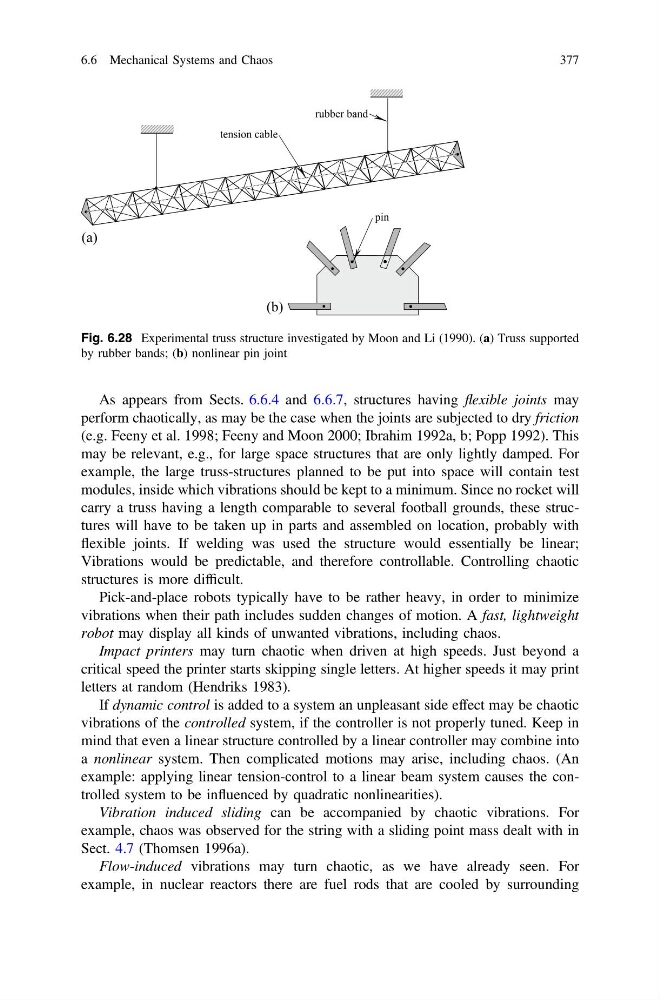
Fig. 6.28 Experimental truss structure investigated by Moon and Li (1990). (a) Truss supported
by rubber bands; (b) nonlinear pin joint
6.6 Mechanical Systems and Chaos
377
perform chaotically, as may be the case when the joints are subjected to dry friction
(e.g. Feeny et al. 1998; Feeny and Moon 2000; Ibrahim 1992a, b; Popp 1992). This
may be relevant, e.g., for large space structures that are only lightly damped. For
example, the large truss-structures planned to be put into space will contain test
modules, inside which vibrations should be kept to a minimum. Since no rocket will
carry a truss having a length comparable to several football grounds, these structures will have to be taken up in parts and assembled on location, probably with
flexible joints. If welding was used the structure would essentially be linear;
Vibrations would be predictable, and therefore controllable. Controlling chaotic
structures is more difficult.
Pick-and-place robots typically have to be rather heavy, in order to minimize
vibrations when their path includes sudden changes of motion. A fast, lightweight
robot may display all kinds of unwanted vibrations, including chaos.
Impact printers may turn chaotic when driven at high speeds. Just beyond a
critical speed the printer starts skipping single letters. At higher speeds it may print
letters at random (Hendriks 1983).
If dynamic control is added to a system an unpleasant side effect may be chaotic
vibrations of the controlled system, if the controller is not properly tuned. Keep in
mind that even a linear structure controlled by a linear controller may combine into
a nonlinear system. Then complicated motions may arise, including chaos. (An
example: applying linear tension-control to a linear beam system causes the controlled system to be influenced by quadratic nonlinearities).
Vibration induced sliding can be accompanied by chaotic vibrations. For
example, chaos was observed for the string with a sliding point mass dealt with in
Sect. 4.7 (Thomsen 1996a).
Flow-induced vibrations may turn chaotic, as we have already seen. For
example, in nuclear reactors there are fuel rods that are cooled by surrounding
Fig. 6.28 Experimental truss structure investigated by Moon and Li (1990). (a) Truss supported
by rubber bands; (b) nonlinear pin joint
6.6 Mechanical Systems and Chaos
377