

resonance have been studied analytically and experimentally in a number of papers
(e.g., Nayfeh 1989; Nayfeh and Balachandran 1989; Nayfeh et al. 1989;
Balachandran and Nayfeh 1991). Chaotic vibrations of cylindrical shells, also
possessing internal resonance, were described in Nayfeh and Raouf (1987). The
rolling of ships in regular sea waves (Nayfeh and Khdeir 1986) is governed by
coupled equations having quadratic nonlinearities, and thus chaos should be considered a possibility (though this would require an unlucky combination of a badly
designed ship and resonant sea waves); see also Hatwal et al. (1983a, b).
6.6.7 High-Order Systems (D > 5)
There seems to be few studies dealing with chaotic vibrations of structures having
many degrees of freedom. As an example, Moon and Li (1990) performed a
numerical and experimental study of a pin-jointed truss structure with 153 degrees
of freedom (Fig. 6.28). Broadband chaotic-like vibrations were observed, and
conjectured to be associated with free play in the connecting joints (see also Li et al.
1990).
6.6.8 Other Systems
We here mention a few more cases of chaos for mechanical systems. See also Moon
(1987), and the interview with Moon published in Goldstein (1990).
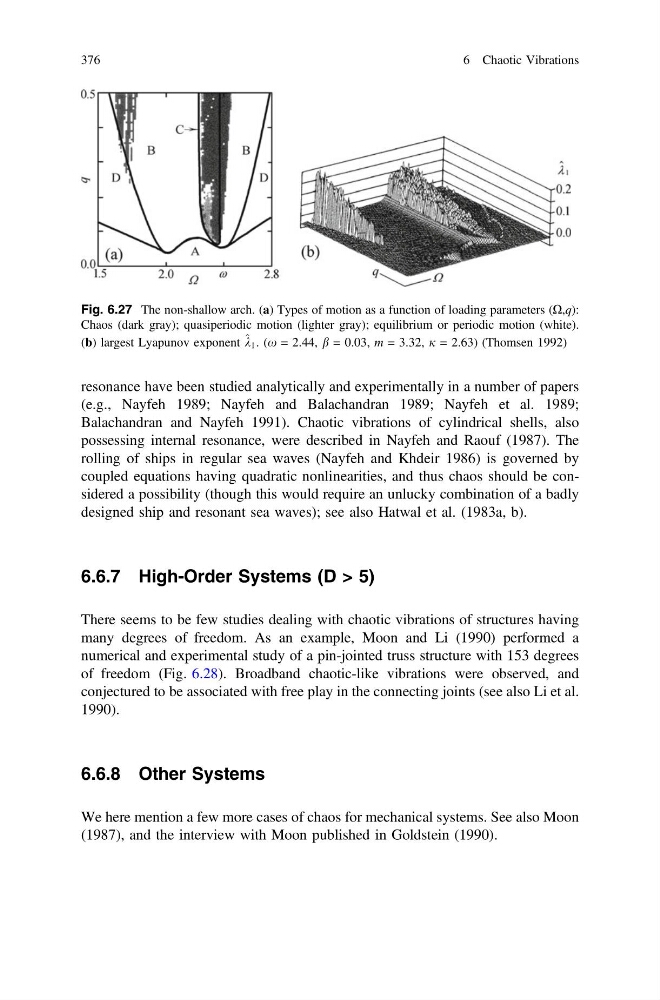
Fig. 6.27 The non-shallow arch. (a) Types of motion as a function of loading parameters (X,q):
Chaos (dark gray); quasiperiodic motion (lighter gray); equilibrium or periodic motion (white).
(b) largest Lyapunov exponent ^ k 1 . (x = 2.44, b = 0.03, m = 3.32, j = 2.63) (Thomsen 1992)
376
6 Chaotic Vibrations
(e.g., Nayfeh 1989; Nayfeh and Balachandran 1989; Nayfeh et al. 1989;
Balachandran and Nayfeh 1991). Chaotic vibrations of cylindrical shells, also
possessing internal resonance, were described in Nayfeh and Raouf (1987). The
rolling of ships in regular sea waves (Nayfeh and Khdeir 1986) is governed by
coupled equations having quadratic nonlinearities, and thus chaos should be considered a possibility (though this would require an unlucky combination of a badly
designed ship and resonant sea waves); see also Hatwal et al. (1983a, b).
6.6.7 High-Order Systems (D > 5)
There seems to be few studies dealing with chaotic vibrations of structures having
many degrees of freedom. As an example, Moon and Li (1990) performed a
numerical and experimental study of a pin-jointed truss structure with 153 degrees
of freedom (Fig. 6.28). Broadband chaotic-like vibrations were observed, and
conjectured to be associated with free play in the connecting joints (see also Li et al.
1990).
6.6.8 Other Systems
We here mention a few more cases of chaos for mechanical systems. See also Moon
(1987), and the interview with Moon published in Goldstein (1990).
Fig. 6.27 The non-shallow arch. (a) Types of motion as a function of loading parameters (X,q):
Chaos (dark gray); quasiperiodic motion (lighter gray); equilibrium or periodic motion (white).
(b) largest Lyapunov exponent ^ k 1 . (x = 2.44, b = 0.03, m = 3.32, j = 2.63) (Thomsen 1992)
376
6 Chaotic Vibrations