

6.6.5 Coupled Autonomous Systems (D ! 4)
Coupled autonomous systems are governed by two or more second order autonomous ODEs, corresponding to four or more first-order ODEs. Most systems with
follower-type loading belong to this class. With follower systems we often
encounter the terms divergence and flutter, which relate to destabilizations of
equilibriums by pitchfork and Hopf bifurcations, respectively. Since
follower-loaded systems are truly autonomous, with no explicit time dependence
even for the underlying second-order ODEs, there is no natural time period to
choose for Poincaré maps. Instead one can choose a hyperplane in phase space and
plot the points of intersections of orbits with that plane (cf. Sect. 6.3.3).
The Follower-loaded Double Pendulum This system, shown in Fig. 4.11, may
serve to illustrate some fundamental properties of coupled autonomous systems.
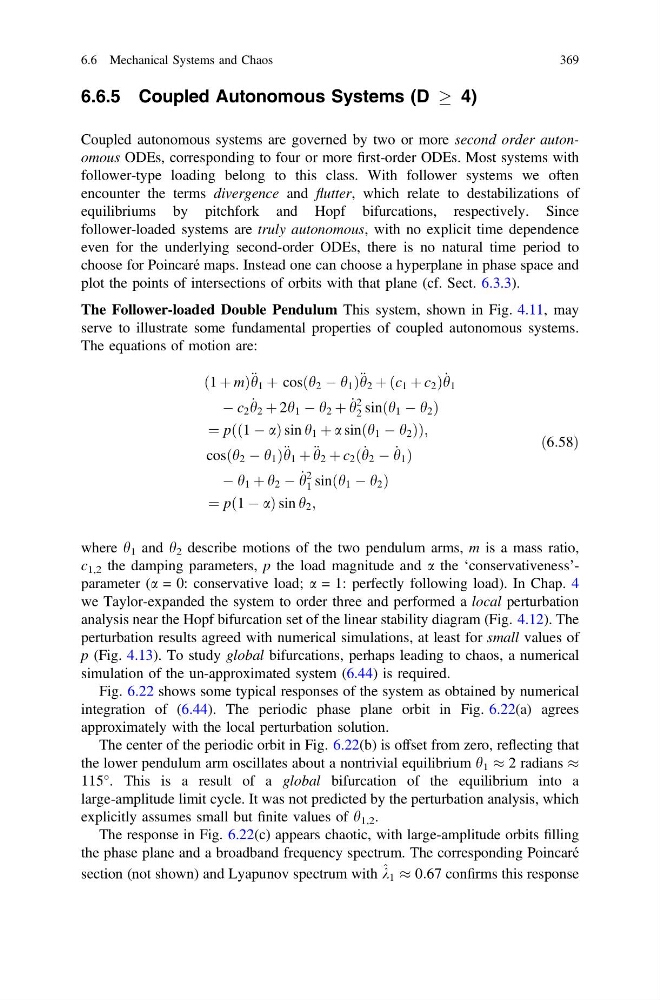
The equations of motion are:
ð1 þ mÞ € h 1 þ cosðh 2 À h 1 Þ € h 2 þ ðc 1 þ c 2 Þ _
h 1
À c 2 _
h 2 þ 2h 1 À h 2 þ _
h
2
2 sinðh 1 À h 2 Þ
¼ p ð1 À aÞ sin h 1 þ a sinðh 1 À h 2 Þ
ð
Þ ;
cosðh 2 À h 1 Þ € h 1 þ € h 2 þ c 2 ð _
h 2 À _
h 1 Þ
À h 1 þ h 2 À _
h
2
1 sinðh 1 À h 2 Þ
¼ pð1 À aÞ sin h 2 ;
ð6:58Þ
where h 1 and h 2 describe motions of the two pendulum arms, m is a mass ratio,
c 1,2 the damping parameters, p the load magnitude and a the ‘conservativeness’parameter (a = 0: conservative load; a = 1: perfectly following load). In Chap. 4
we Taylor-expanded the system to order three and performed a local perturbation
analysis near the Hopf bifurcation set of the linear stability diagram (Fig. 4.12). The
perturbation results agreed with numerical simulations, at least for small values of
p (Fig. 4.13). To study global bifurcations, perhaps leading to chaos, a numerical
simulation of the un-approximated system (6.44) is required.
Fig. 6.22 shows some typical responses of the system as obtained by numerical
integration of (6.44). The periodic phase plane orbit in Fig. 6.22(a) agrees
approximately with the local perturbation solution.
The center of the periodic orbit in Fig. 6.22(b) is offset from zero, reflecting that
the lower pendulum arm oscillates about a nontrivial equilibrium h 1 % 2 radians %
115°. This is a result of a global bifurcation of the equilibrium into a
large-amplitude limit cycle. It was not predicted by the perturbation analysis, which
explicitly assumes small but finite values of h 1,2 .
The response in Fig. 6.22(c) appears chaotic, with large-amplitude orbits filling
the phase plane and a broadband frequency spectrum. The corresponding Poincaré
section (not shown) and Lyapunov spectrum with ^ k 1 % 0:67 confirms this response
6.6 Mechanical Systems and Chaos
369
Coupled autonomous systems are governed by two or more second order autonomous ODEs, corresponding to four or more first-order ODEs. Most systems with
follower-type loading belong to this class. With follower systems we often
encounter the terms divergence and flutter, which relate to destabilizations of
equilibriums by pitchfork and Hopf bifurcations, respectively. Since
follower-loaded systems are truly autonomous, with no explicit time dependence
even for the underlying second-order ODEs, there is no natural time period to
choose for Poincaré maps. Instead one can choose a hyperplane in phase space and
plot the points of intersections of orbits with that plane (cf. Sect. 6.3.3).
The Follower-loaded Double Pendulum This system, shown in Fig. 4.11, may
serve to illustrate some fundamental properties of coupled autonomous systems.
The equations of motion are:
ð1 þ mÞ € h 1 þ cosðh 2 À h 1 Þ € h 2 þ ðc 1 þ c 2 Þ _
h 1
À c 2 _
h 2 þ 2h 1 À h 2 þ _
h
2
2 sinðh 1 À h 2 Þ
¼ p ð1 À aÞ sin h 1 þ a sinðh 1 À h 2 Þ
ð
Þ ;
cosðh 2 À h 1 Þ € h 1 þ € h 2 þ c 2 ð _
h 2 À _
h 1 Þ
À h 1 þ h 2 À _
h
2
1 sinðh 1 À h 2 Þ
¼ pð1 À aÞ sin h 2 ;
ð6:58Þ
where h 1 and h 2 describe motions of the two pendulum arms, m is a mass ratio,
c 1,2 the damping parameters, p the load magnitude and a the ‘conservativeness’parameter (a = 0: conservative load; a = 1: perfectly following load). In Chap. 4
we Taylor-expanded the system to order three and performed a local perturbation
analysis near the Hopf bifurcation set of the linear stability diagram (Fig. 4.12). The
perturbation results agreed with numerical simulations, at least for small values of
p (Fig. 4.13). To study global bifurcations, perhaps leading to chaos, a numerical
simulation of the un-approximated system (6.44) is required.
Fig. 6.22 shows some typical responses of the system as obtained by numerical
integration of (6.44). The periodic phase plane orbit in Fig. 6.22(a) agrees
approximately with the local perturbation solution.
The center of the periodic orbit in Fig. 6.22(b) is offset from zero, reflecting that
the lower pendulum arm oscillates about a nontrivial equilibrium h 1 % 2 radians %
115°. This is a result of a global bifurcation of the equilibrium into a
large-amplitude limit cycle. It was not predicted by the perturbation analysis, which
explicitly assumes small but finite values of h 1,2 .
The response in Fig. 6.22(c) appears chaotic, with large-amplitude orbits filling
the phase plane and a broadband frequency spectrum. The corresponding Poincaré
section (not shown) and Lyapunov spectrum with ^ k 1 % 0:67 confirms this response
6.6 Mechanical Systems and Chaos
369