

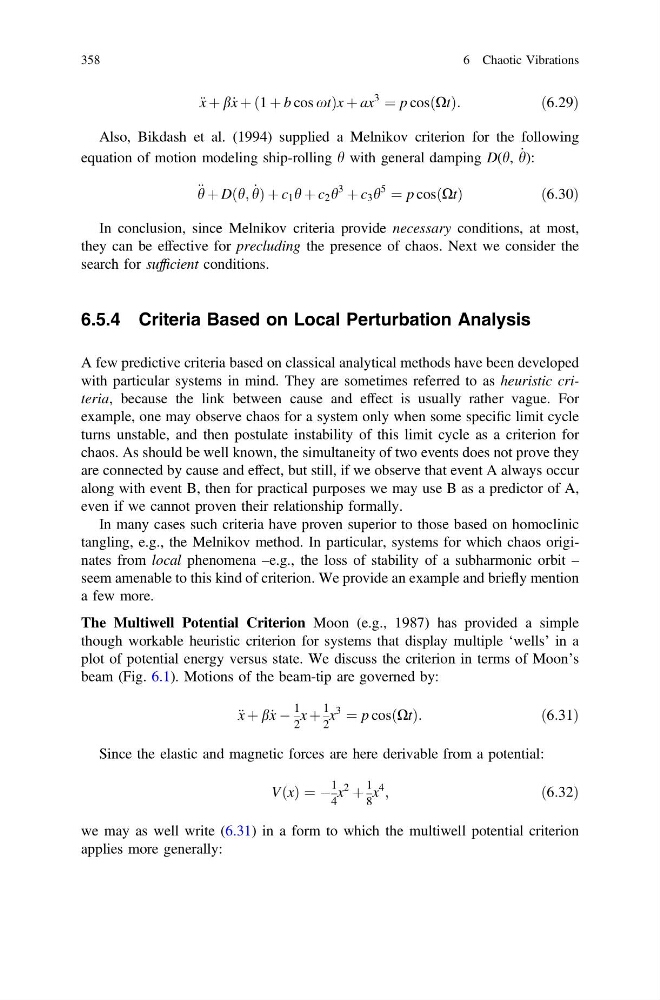
€ x þ b_ x þ ð1 þ b cos xtÞx þ ax
3
¼ p cosðXtÞ:
ð6:29Þ
Also, Bikdash et al. (1994) supplied a Melnikov criterion for the following
equation of motion modeling ship-rolling h with general damping D(h, _
h):
€ h þ Dðh; _
hÞ þ c 1 h þ c 2 h
3
þ c 3 h
5
¼ p cosðXtÞ
ð 6:30Þ
In conclusion, since Melnikov criteria provide necessary conditions, at most,
they can be effective for precluding the presence of chaos. Next we consider the
search for sufficient conditions.
6.5.4 Criteria Based on Local Perturbation Analysis
A few predictive criteria based on classical analytical methods have been developed
with particular systems in mind. They are sometimes referred to as heuristic criteria, because the link between cause and effect is usually rather vague. For
example, one may observe chaos for a system only when some specific limit cycle
turns unstable, and then postulate instability of this limit cycle as a criterion for
chaos. As should be well known, the simultaneity of two events does not prove they
are connected by cause and effect, but still, if we observe that event A always occur
along with event B, then for practical purposes we may use B as a predictor of A,
even if we cannot proven their relationship formally.
In many cases such criteria have proven superior to those based on homoclinic
tangling, e.g., the Melnikov method. In particular, systems for which chaos originates from local phenomena –e.g., the loss of stability of a subharmonic orbit –
seem amenable to this kind of criterion. We provide an example and briefly mention
a few more.
The Multiwell Potential Criterion Moon (e.g., 1987) has provided a simple
though workable heuristic criterion for systems that display multiple ‘wells’ in a
plot of potential energy versus state. We discuss the criterion in terms of Moon’s
beam (Fig. 6.1). Motions of the beam-tip are governed by:
€ x þ b_ x À
1
2
x þ
1
2
x
3
¼ p cosðXtÞ:
ð6:31Þ
Since the elastic and magnetic forces are here derivable from a potential:
VðxÞ ¼ À
1
4
x
2
þ
1
8
x
4
;
ð6:32Þ
we may as well write (6.31) in a form to which the multiwell potential criterion
applies more generally:
358
6 Chaotic Vibrations
3
¼ p cosðXtÞ:
ð6:29Þ
Also, Bikdash et al. (1994) supplied a Melnikov criterion for the following
equation of motion modeling ship-rolling h with general damping D(h, _
h):
€ h þ Dðh; _
hÞ þ c 1 h þ c 2 h
3
þ c 3 h
5
¼ p cosðXtÞ
ð 6:30Þ
In conclusion, since Melnikov criteria provide necessary conditions, at most,
they can be effective for precluding the presence of chaos. Next we consider the
search for sufficient conditions.
6.5.4 Criteria Based on Local Perturbation Analysis
A few predictive criteria based on classical analytical methods have been developed
with particular systems in mind. They are sometimes referred to as heuristic criteria, because the link between cause and effect is usually rather vague. For
example, one may observe chaos for a system only when some specific limit cycle
turns unstable, and then postulate instability of this limit cycle as a criterion for
chaos. As should be well known, the simultaneity of two events does not prove they
are connected by cause and effect, but still, if we observe that event A always occur
along with event B, then for practical purposes we may use B as a predictor of A,
even if we cannot proven their relationship formally.
In many cases such criteria have proven superior to those based on homoclinic
tangling, e.g., the Melnikov method. In particular, systems for which chaos originates from local phenomena –e.g., the loss of stability of a subharmonic orbit –
seem amenable to this kind of criterion. We provide an example and briefly mention
a few more.
The Multiwell Potential Criterion Moon (e.g., 1987) has provided a simple
though workable heuristic criterion for systems that display multiple ‘wells’ in a
plot of potential energy versus state. We discuss the criterion in terms of Moon’s
beam (Fig. 6.1). Motions of the beam-tip are governed by:
€ x þ b_ x À
1
2
x þ
1
2
x
3
¼ p cosðXtÞ:
ð6:31Þ
Since the elastic and magnetic forces are here derivable from a potential:
VðxÞ ¼ À
1
4
x
2
þ
1
8
x
4
;
ð6:32Þ
we may as well write (6.31) in a form to which the multiwell potential criterion
applies more generally:
358
6 Chaotic Vibrations