

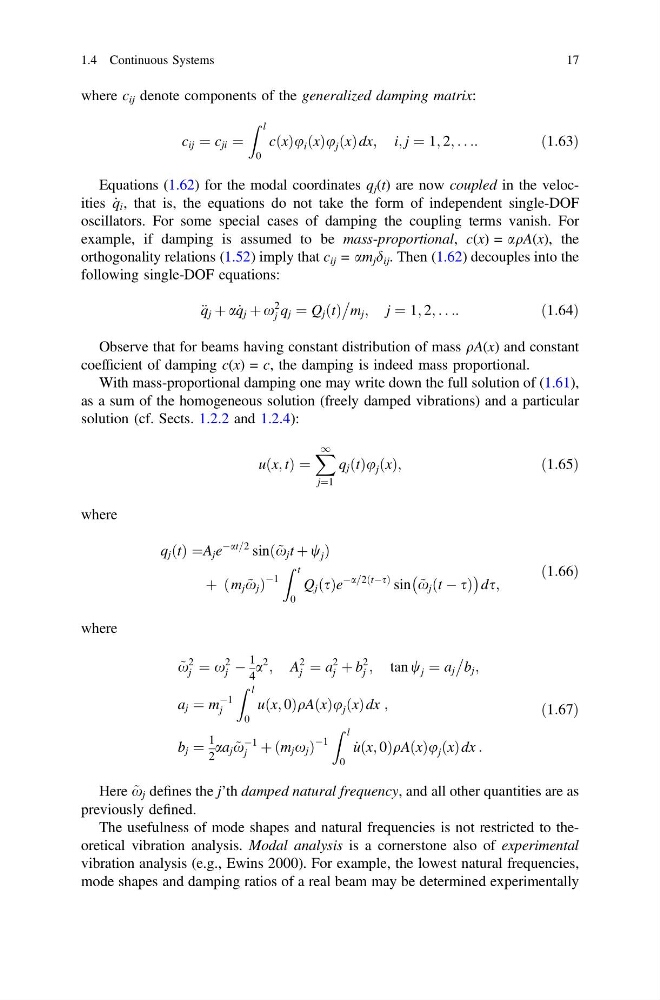
where c ij denote components of the generalized damping matrix:
c ij ¼ c ji ¼
Z l
0
cðxÞu i ðxÞu j ðxÞ dx; i; j ¼ 1; 2; . . .:
ð1:63Þ
Equations (1.62) for the modal coordinates q j (t) are now coupled in the velocities _
q i , that is, the equations do not take the form of independent single-DOF
oscillators. For some special cases of damping the coupling terms vanish. For
example, if damping is assumed to be mass-proportional, c(x) = aqA(x), the
orthogonality relations (1.52) imply that c ij = am j d ij . Then (1.62) decouples into the
following single-DOF equations:
€ q j þ a _
q j þ x
2
j q j ¼ Q j ðtÞ
m j ; j ¼ 1; 2; . . .:
ð1:64Þ
Observe that for beams having constant distribution of mass qA(x) and constant
coefficient of damping c(x) = c, the damping is indeed mass proportional.
With mass-proportional damping one may write down the full solution of (1.61),
as a sum of the homogeneous solution (freely damped vibrations) and a particular
solution (cf. Sects. 1.2.2 and 1.2.4):
uðx; tÞ ¼
X 1
j¼1
q j ðtÞu j ðxÞ;
ð1:65Þ
where
q j ðtÞ ¼A j e
Àat=2 sinð ~
x j t þ w j Þ
þ ðm j ~
x j Þ
À1
Z t
0
Q j ðsÞe
Àa=2ðtÀsÞ sin ~
x j ðt À sÞ
À
Á
ds;
ð1:66Þ
where
~
x
2
j ¼ x
2
j À
1
4
a
2
; A
2
j ¼ a
2
j þ b
2
j ; tan w j ¼ a j
b j ;
a j ¼ m
À1
j
Z l
0
uðx; 0ÞqAðxÞu j ðxÞdx ;
b j ¼
1
2
aa j ~
x
À1
j þ ðm j x j Þ
À1
Z l
0
_
uðx; 0ÞqAðxÞu j ðxÞdx :
ð1:67Þ
Here ~
x j defines the j’th damped natural frequency, and all other quantities are as
previously defined.
The usefulness of mode shapes and natural frequencies is not restricted to theoretical vibration analysis. Modal analysis is a cornerstone also of experimental
vibration analysis (e.g., Ewins 2000). For example, the lowest natural frequencies,
mode shapes and damping ratios of a real beam may be determined experimentally
1.4 Continuous Systems
17
c ij ¼ c ji ¼
Z l
0
cðxÞu i ðxÞu j ðxÞ dx; i; j ¼ 1; 2; . . .:
ð1:63Þ
Equations (1.62) for the modal coordinates q j (t) are now coupled in the velocities _
q i , that is, the equations do not take the form of independent single-DOF
oscillators. For some special cases of damping the coupling terms vanish. For
example, if damping is assumed to be mass-proportional, c(x) = aqA(x), the
orthogonality relations (1.52) imply that c ij = am j d ij . Then (1.62) decouples into the
following single-DOF equations:
€ q j þ a _
q j þ x
2
j q j ¼ Q j ðtÞ
m j ; j ¼ 1; 2; . . .:
ð1:64Þ
Observe that for beams having constant distribution of mass qA(x) and constant
coefficient of damping c(x) = c, the damping is indeed mass proportional.
With mass-proportional damping one may write down the full solution of (1.61),
as a sum of the homogeneous solution (freely damped vibrations) and a particular
solution (cf. Sects. 1.2.2 and 1.2.4):
uðx; tÞ ¼
X 1
j¼1
q j ðtÞu j ðxÞ;
ð1:65Þ
where
q j ðtÞ ¼A j e
Àat=2 sinð ~
x j t þ w j Þ
þ ðm j ~
x j Þ
À1
Z t
0
Q j ðsÞe
Àa=2ðtÀsÞ sin ~
x j ðt À sÞ
À
Á
ds;
ð1:66Þ
where
~
x
2
j ¼ x
2
j À
1
4
a
2
; A
2
j ¼ a
2
j þ b
2
j ; tan w j ¼ a j
b j ;
a j ¼ m
À1
j
Z l
0
uðx; 0ÞqAðxÞu j ðxÞdx ;
b j ¼
1
2
aa j ~
x
À1
j þ ðm j x j Þ
À1
Z l
0
_
uðx; 0ÞqAðxÞu j ðxÞdx :
ð1:67Þ
Here ~
x j defines the j’th damped natural frequency, and all other quantities are as
previously defined.
The usefulness of mode shapes and natural frequencies is not restricted to theoretical vibration analysis. Modal analysis is a cornerstone also of experimental
vibration analysis (e.g., Ewins 2000). For example, the lowest natural frequencies,
mode shapes and damping ratios of a real beam may be determined experimentally
1.4 Continuous Systems
17