

equilibrium point in favor of a stable limit cycle, that is, a supercritical Hopf
bifurcation may occur. Further parameter changes may cause the system to experience yet another Hopf bifurcation, inducing a second fundamental frequency into
the motion. If these two frequencies are incommensurate the motion will be
quasiperiodic, i.e. the solution rides on a two-torus. Now, should a third Hopf
bifurcation occur, then motion on the corresponding three-torus will typically be
highly unstable (Newhouse et al. 1978). With finite probability (as the mathematicians put it) the unstable three-torus will decay into a strange attractor. Thus, as
the precursor to this type of chaos, one first observes periodic and then
quasiperiodic motion as a system parameter is varied.
As an example of a system displaying the quasiperiodic route to chaos we
reconsider the periodically forced non-shallow arch (dealt with analytically in
Sect. 4.3). Fig. 6.11 shows a numerically obtained bifurcation map for the system.
Values of the antisymmetric vibration amplitude f (cf. Fig. 4.6) at a particular
phasing of the driving force have been plotted against the nondimensional
excitation-frequency X for a constant level of forcing, q = 0.2. For each value of the
bifurcation parameter X you may perceive the dots as a projection of an ordinary
(f n ; _
f n ) Poincaré map onto the _
f n -axis. In the Poincaré map, as we have seen,
quasiperiodic motion reveals itself as points on a closed curve. Projecting the map
onto one axis, a line filled with points appears, just as for chaotic motion. In
Fig. 6.11 the largest Lyapunov exponent has been plotted on top of the diagram to
help distinguish quasiperiodic from chaotic motion.
Fig. 6.11(a) reveals that regular period-2 motion exists for X2[X 1 ; X 3 ]. Dots fill
out the Poincaré lines between X 3 and X 5 . Though, since ^ k 1 % 0 the motion is not
chaotic, but quasiperiodic. Beyond X 5 dots continue to fill out the lines, but since ^ k 1
is now positive the motion is chaotic.
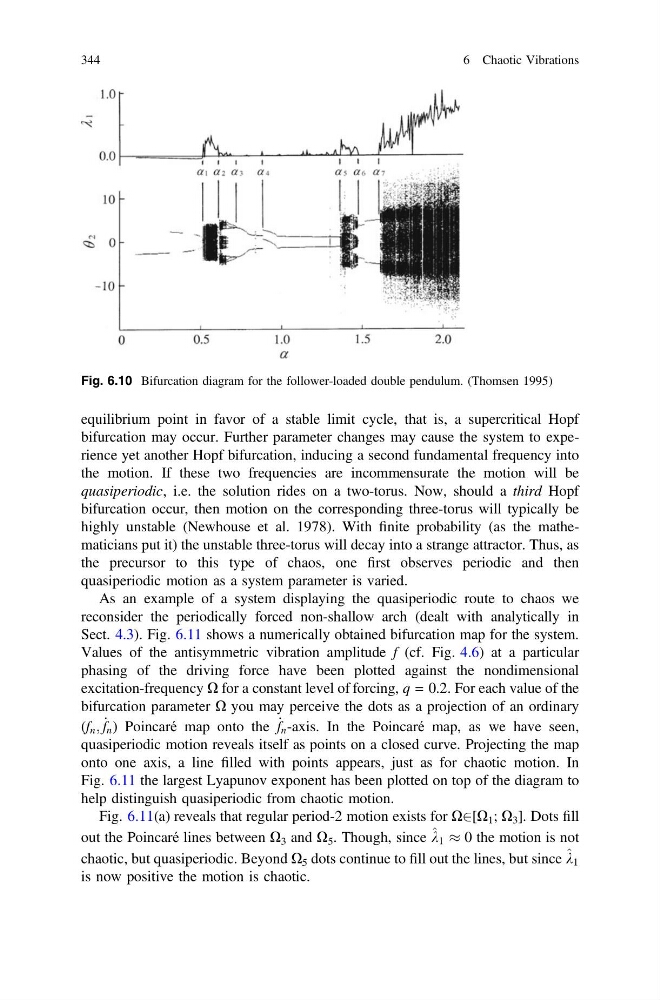
Fig. 6.10 Bifurcation diagram for the follower-loaded double pendulum. (Thomsen 1995)
344
6 Chaotic Vibrations
bifurcation may occur. Further parameter changes may cause the system to experience yet another Hopf bifurcation, inducing a second fundamental frequency into
the motion. If these two frequencies are incommensurate the motion will be
quasiperiodic, i.e. the solution rides on a two-torus. Now, should a third Hopf
bifurcation occur, then motion on the corresponding three-torus will typically be
highly unstable (Newhouse et al. 1978). With finite probability (as the mathematicians put it) the unstable three-torus will decay into a strange attractor. Thus, as
the precursor to this type of chaos, one first observes periodic and then
quasiperiodic motion as a system parameter is varied.
As an example of a system displaying the quasiperiodic route to chaos we
reconsider the periodically forced non-shallow arch (dealt with analytically in
Sect. 4.3). Fig. 6.11 shows a numerically obtained bifurcation map for the system.
Values of the antisymmetric vibration amplitude f (cf. Fig. 4.6) at a particular
phasing of the driving force have been plotted against the nondimensional
excitation-frequency X for a constant level of forcing, q = 0.2. For each value of the
bifurcation parameter X you may perceive the dots as a projection of an ordinary
(f n ; _
f n ) Poincaré map onto the _
f n -axis. In the Poincaré map, as we have seen,
quasiperiodic motion reveals itself as points on a closed curve. Projecting the map
onto one axis, a line filled with points appears, just as for chaotic motion. In
Fig. 6.11 the largest Lyapunov exponent has been plotted on top of the diagram to
help distinguish quasiperiodic from chaotic motion.
Fig. 6.11(a) reveals that regular period-2 motion exists for X2[X 1 ; X 3 ]. Dots fill
out the Poincaré lines between X 3 and X 5 . Though, since ^ k 1 % 0 the motion is not
chaotic, but quasiperiodic. Beyond X 5 dots continue to fill out the lines, but since ^ k 1
is now positive the motion is chaotic.
Fig. 6.10 Bifurcation diagram for the follower-loaded double pendulum. (Thomsen 1995)
344
6 Chaotic Vibrations