

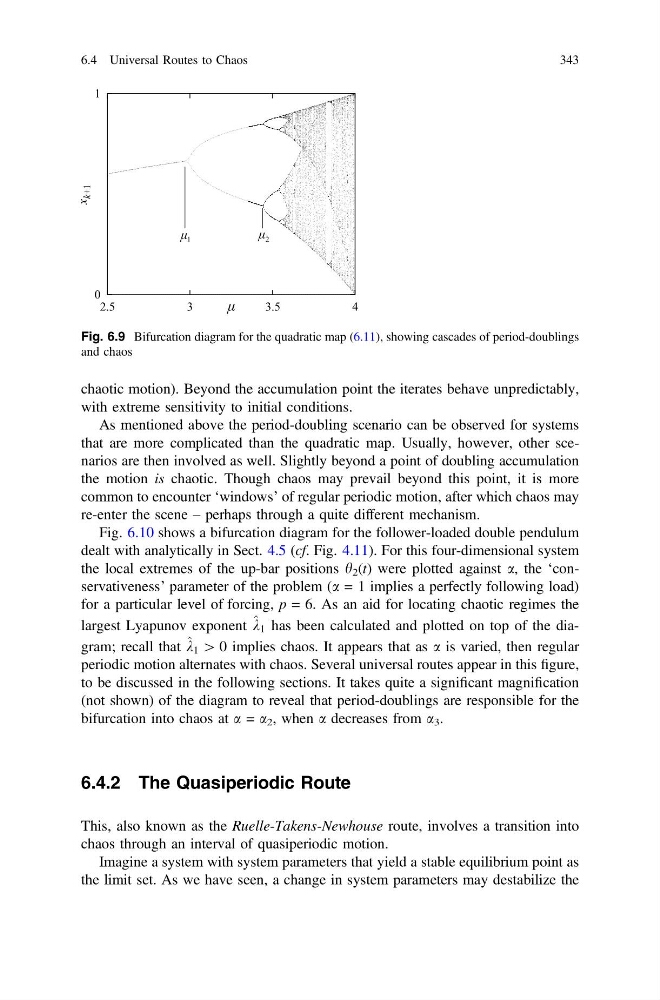
chaotic motion). Beyond the accumulation point the iterates behave unpredictably,
with extreme sensitivity to initial conditions.
As mentioned above the period-doubling scenario can be observed for systems
that are more complicated than the quadratic map. Usually, however, other scenarios are then involved as well. Slightly beyond a point of doubling accumulation
the motion is chaotic. Though chaos may prevail beyond this point, it is more
common to encounter ‘windows’ of regular periodic motion, after which chaos may
re-enter the scene – perhaps through a quite different mechanism.
Fig. 6.10 shows a bifurcation diagram for the follower-loaded double pendulum
dealt with analytically in Sect. 4.5 (cf. Fig. 4.11). For this four-dimensional system
the local extremes of the up-bar positions h 2 (t) were plotted against a, the ‘conservativeness’ parameter of the problem (a = 1 implies a perfectly following load)
for a particular level of forcing, p = 6. As an aid for locating chaotic regimes the
largest Lyapunov exponent ^ k 1 has been calculated and plotted on top of the diagram; recall that ^ k 1 [ 0 implies chaos. It appears that as a is varied, then regular
periodic motion alternates with chaos. Several universal routes appear in this figure,
to be discussed in the following sections. It takes quite a significant magnification
(not shown) of the diagram to reveal that period-doublings are responsible for the
bifurcation into chaos at a = a 2 , when a decreases from a 3 .
6.4.2 The Quasiperiodic Route
This, also known as the Ruelle-Takens-Newhouse route, involves a transition into
chaos through an interval of quasiperiodic motion.
Imagine a system with system parameters that yield a stable equilibrium point as
the limit set. As we have seen, a change in system parameters may destabilize the
Fig. 6.9 Bifurcation diagram for the quadratic map (6.11), showing cascades of period-doublings
and chaos
6.4 Universal Routes to Chaos
343
with extreme sensitivity to initial conditions.
As mentioned above the period-doubling scenario can be observed for systems
that are more complicated than the quadratic map. Usually, however, other scenarios are then involved as well. Slightly beyond a point of doubling accumulation
the motion is chaotic. Though chaos may prevail beyond this point, it is more
common to encounter ‘windows’ of regular periodic motion, after which chaos may
re-enter the scene – perhaps through a quite different mechanism.
Fig. 6.10 shows a bifurcation diagram for the follower-loaded double pendulum
dealt with analytically in Sect. 4.5 (cf. Fig. 4.11). For this four-dimensional system
the local extremes of the up-bar positions h 2 (t) were plotted against a, the ‘conservativeness’ parameter of the problem (a = 1 implies a perfectly following load)
for a particular level of forcing, p = 6. As an aid for locating chaotic regimes the
largest Lyapunov exponent ^ k 1 has been calculated and plotted on top of the diagram; recall that ^ k 1 [ 0 implies chaos. It appears that as a is varied, then regular
periodic motion alternates with chaos. Several universal routes appear in this figure,
to be discussed in the following sections. It takes quite a significant magnification
(not shown) of the diagram to reveal that period-doublings are responsible for the
bifurcation into chaos at a = a 2 , when a decreases from a 3 .
6.4.2 The Quasiperiodic Route
This, also known as the Ruelle-Takens-Newhouse route, involves a transition into
chaos through an interval of quasiperiodic motion.
Imagine a system with system parameters that yield a stable equilibrium point as
the limit set. As we have seen, a change in system parameters may destabilize the
Fig. 6.9 Bifurcation diagram for the quadratic map (6.11), showing cascades of period-doublings
and chaos
6.4 Universal Routes to Chaos
343