

W
c
¼ ðx; yÞjy ¼ hðxÞ
f
g ; hð0Þ ¼ 0; h
0
ð0Þ ¼ 0;
ð5:18Þ
where h maps R
n c on R
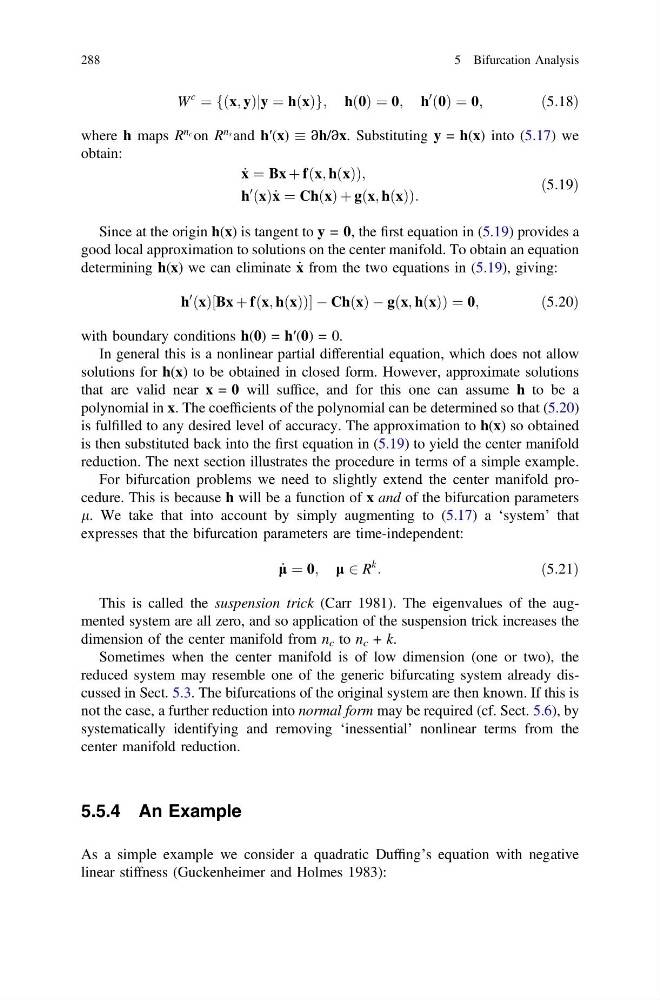
n s and h′(x) ∂h/∂x. Substituting y = h(x) into (5.17) we
obtain:
_
x ¼ Bx þ fðx; hðxÞÞ;
h
0
ðxÞ _
x ¼ ChðxÞ þ gðx; hðxÞÞ:
ð5:19Þ
Since at the origin h(x) is tangent to y = 0, the first equation in (5.19) provides a
good local approximation to solutions on the center manifold. To obtain an equation
determining h(x) we can eliminate _
x from the two equations in (5.19), giving:
h
0
ðxÞ Bx þ fðx; hðxÞÞ
½
À ChðxÞ À gðx; hðxÞÞ ¼ 0;
ð5:20Þ
with boundary conditions h(0) = h′(0) = 0.
In general this is a nonlinear partial differential equation, which does not allow
solutions for h(x) to be obtained in closed form. However, approximate solutions
that are valid near x = 0 will suffice, and for this one can assume h to be a
polynomial in x. The coefficients of the polynomial can be determined so that (5.20)
is fulfilled to any desired level of accuracy. The approximation to h(x) so obtained
is then substituted back into the first equation in (5.19) to yield the center manifold
reduction. The next section illustrates the procedure in terms of a simple example.
For bifurcation problems we need to slightly extend the center manifold procedure. This is because h will be a function of x and of the bifurcation parameters
l. We take that into account by simply augmenting to (5.17) a ‘system’ that
expresses that the bifurcation parameters are time-independent:
_
l ¼ 0; l 2 R
k
:
ð5:21Þ
This is called the suspension trick (Carr 1981). The eigenvalues of the augmented system are all zero, and so application of the suspension trick increases the
dimension of the center manifold from n c to n c + k.
Sometimes when the center manifold is of low dimension (one or two), the
reduced system may resemble one of the generic bifurcating system already discussed in Sect. 5.3. The bifurcations of the original system are then known. If this is
not the case, a further reduction into normal form may be required (cf. Sect. 5.6), by
systematically identifying and removing ‘inessential’ nonlinear terms from the
center manifold reduction.
5.5.4 An Example
As a simple example we consider a quadratic Duffing’s equation with negative
linear stiffness (Guckenheimer and Holmes 1983):
288
5 Bifurcation Analysis
c
¼ ðx; yÞjy ¼ hðxÞ
f
g ; hð0Þ ¼ 0; h
0
ð0Þ ¼ 0;
ð5:18Þ
where h maps R
n c on R
n s and h′(x) ∂h/∂x. Substituting y = h(x) into (5.17) we
obtain:
_
x ¼ Bx þ fðx; hðxÞÞ;
h
0
ðxÞ _
x ¼ ChðxÞ þ gðx; hðxÞÞ:
ð5:19Þ
Since at the origin h(x) is tangent to y = 0, the first equation in (5.19) provides a
good local approximation to solutions on the center manifold. To obtain an equation
determining h(x) we can eliminate _
x from the two equations in (5.19), giving:
h
0
ðxÞ Bx þ fðx; hðxÞÞ
½
À ChðxÞ À gðx; hðxÞÞ ¼ 0;
ð5:20Þ
with boundary conditions h(0) = h′(0) = 0.
In general this is a nonlinear partial differential equation, which does not allow
solutions for h(x) to be obtained in closed form. However, approximate solutions
that are valid near x = 0 will suffice, and for this one can assume h to be a
polynomial in x. The coefficients of the polynomial can be determined so that (5.20)
is fulfilled to any desired level of accuracy. The approximation to h(x) so obtained
is then substituted back into the first equation in (5.19) to yield the center manifold
reduction. The next section illustrates the procedure in terms of a simple example.
For bifurcation problems we need to slightly extend the center manifold procedure. This is because h will be a function of x and of the bifurcation parameters
l. We take that into account by simply augmenting to (5.17) a ‘system’ that
expresses that the bifurcation parameters are time-independent:
_
l ¼ 0; l 2 R
k
:
ð5:21Þ
This is called the suspension trick (Carr 1981). The eigenvalues of the augmented system are all zero, and so application of the suspension trick increases the
dimension of the center manifold from n c to n c + k.
Sometimes when the center manifold is of low dimension (one or two), the
reduced system may resemble one of the generic bifurcating system already discussed in Sect. 5.3. The bifurcations of the original system are then known. If this is
not the case, a further reduction into normal form may be required (cf. Sect. 5.6), by
systematically identifying and removing ‘inessential’ nonlinear terms from the
center manifold reduction.
5.5.4 An Example
As a simple example we consider a quadratic Duffing’s equation with negative
linear stiffness (Guckenheimer and Holmes 1983):
288
5 Bifurcation Analysis