

The submanifolds W
s , W
c and W
u being invariant for the flow, means that a
solution which is initiated on one of the manifolds stays on that particular manifold
at all times.
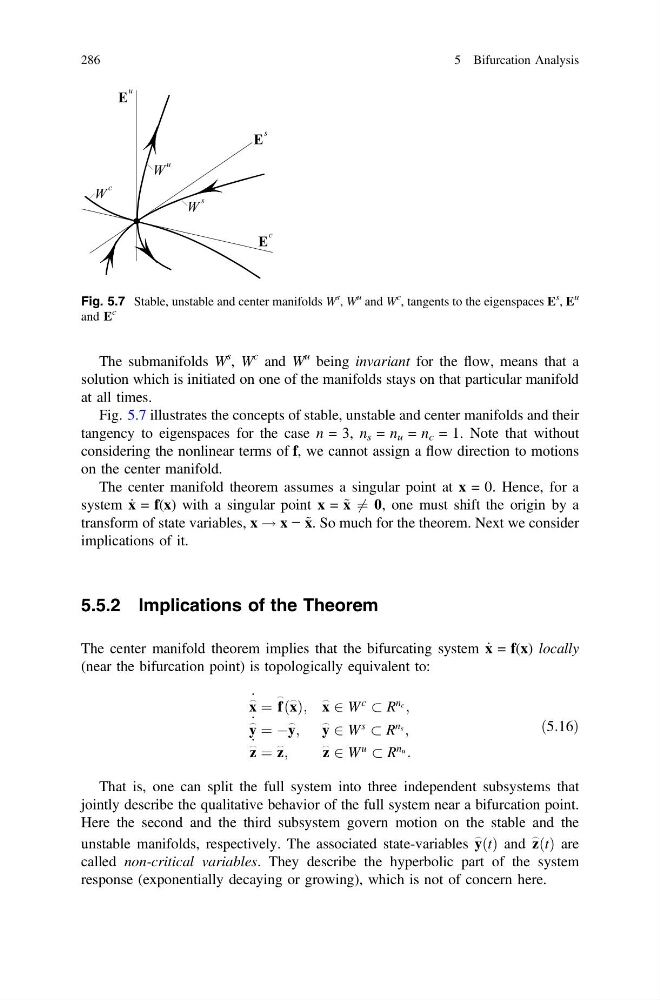
Fig. 5.7 illustrates the concepts of stable, unstable and center manifolds and their
tangency to eigenspaces for the case n = 3, n s = n u = n c = 1. Note that without
considering the nonlinear terms of f, we cannot assign a flow direction to motions
on the center manifold.
The center manifold theorem assumes a singular point at x = 0. Hence, for a
system _
x = f(x) with a singular point x = ~ x 6 ¼ 0, one must shift the origin by a
transform of state variables, x ! x − ~ x. So much for the theorem. Next we consider
implications of it.
5.5.2 Implications of the Theorem
The center manifold theorem implies that the bifurcating system _
x = f(x) locally
(near the bifurcation point) is topologically equivalent to:
_
x
_ ¼ f
_ ðx
_ Þ; x
_ 2 W
c
& R
n c ;
_
y
_ ¼ Ày
_ ;
y
_ 2 W
s
& R
n s ;
_
z
_ ¼ z
_ ;
z
_ 2 W
u
& R
n u :
ð5:16Þ
That is, one can split the full system into three independent subsystems that
jointly describe the qualitative behavior of the full system near a bifurcation point.
Here the second and the third subsystem govern motion on the stable and the
unstable manifolds, respectively. The associated state-variables y
_ ðtÞ and z
_ ðtÞ are
called non-critical variables. They describe the hyperbolic part of the system
response (exponentially decaying or growing), which is not of concern here.
Fig. 5.7 Stable, unstable and center manifolds W
s
, W
u and W
c , tangents to the eigenspaces E
s , E
u
and E
c
286
5 Bifurcation Analysis
s , W
c and W
u being invariant for the flow, means that a
solution which is initiated on one of the manifolds stays on that particular manifold
at all times.
Fig. 5.7 illustrates the concepts of stable, unstable and center manifolds and their
tangency to eigenspaces for the case n = 3, n s = n u = n c = 1. Note that without
considering the nonlinear terms of f, we cannot assign a flow direction to motions
on the center manifold.
The center manifold theorem assumes a singular point at x = 0. Hence, for a
system _
x = f(x) with a singular point x = ~ x 6 ¼ 0, one must shift the origin by a
transform of state variables, x ! x − ~ x. So much for the theorem. Next we consider
implications of it.
5.5.2 Implications of the Theorem
The center manifold theorem implies that the bifurcating system _
x = f(x) locally
(near the bifurcation point) is topologically equivalent to:
_
x
_ ¼ f
_ ðx
_ Þ; x
_ 2 W
c
& R
n c ;
_
y
_ ¼ Ày
_ ;
y
_ 2 W
s
& R
n s ;
_
z
_ ¼ z
_ ;
z
_ 2 W
u
& R
n u :
ð5:16Þ
That is, one can split the full system into three independent subsystems that
jointly describe the qualitative behavior of the full system near a bifurcation point.
Here the second and the third subsystem govern motion on the stable and the
unstable manifolds, respectively. The associated state-variables y
_ ðtÞ and z
_ ðtÞ are
called non-critical variables. They describe the hyperbolic part of the system
response (exponentially decaying or growing), which is not of concern here.
Fig. 5.7 Stable, unstable and center manifolds W
s
, W
u and W
c , tangents to the eigenspaces E
s , E
u
and E
c
286
5 Bifurcation Analysis