

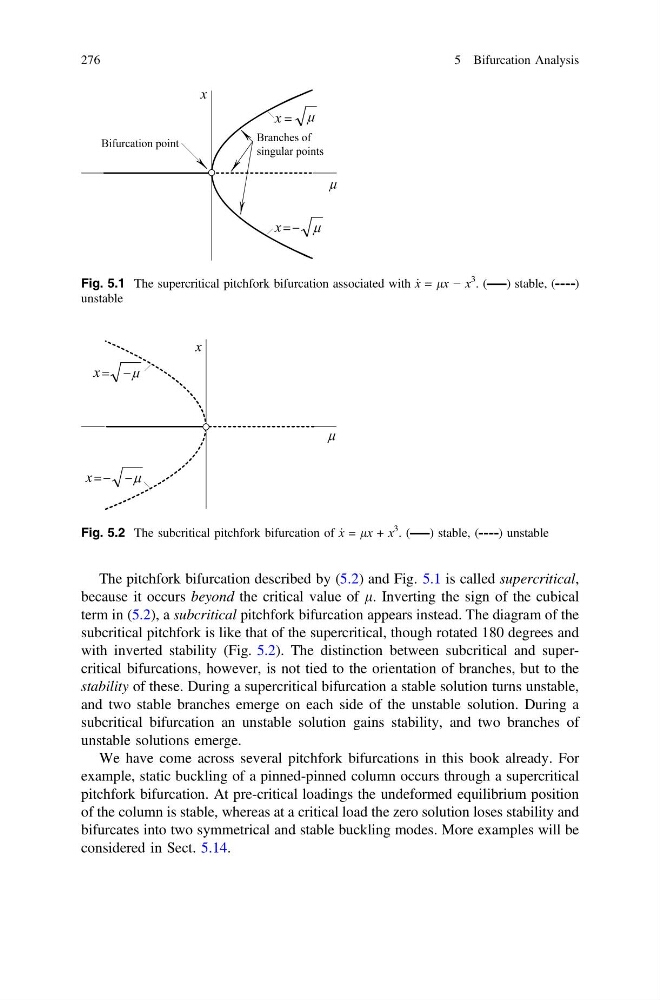
The pitchfork bifurcation described by (5.2) and Fig. 5.1 is called supercritical,
because it occurs beyond the critical value of l. Inverting the sign of the cubical
term in (5.2), a subcritical pitchfork bifurcation appears instead. The diagram of the
subcritical pitchfork is like that of the supercritical, though rotated 180 degrees and
with inverted stability (Fig. 5.2). The distinction between subcritical and supercritical bifurcations, however, is not tied to the orientation of branches, but to the
stability of these. During a supercritical bifurcation a stable solution turns unstable,
and two stable branches emerge on each side of the unstable solution. During a
subcritical bifurcation an unstable solution gains stability, and two branches of
unstable solutions emerge.
We have come across several pitchfork bifurcations in this book already. For
example, static buckling of a pinned-pinned column occurs through a supercritical
pitchfork bifurcation. At pre-critical loadings the undeformed equilibrium position
of the column is stable, whereas at a critical load the zero solution loses stability and
bifurcates into two symmetrical and stable buckling modes. More examples will be
considered in Sect. 5.14.
Fig. 5.1 The supercritical pitchfork bifurcation associated with _
x = lx − x
3
. (
) stable, (
)
unstable
Fig. 5.2 The subcritical pitchfork bifurcation of _
x = lx + x
3
. (
) stable, (
) unstable
276
5 Bifurcation Analysis
because it occurs beyond the critical value of l. Inverting the sign of the cubical
term in (5.2), a subcritical pitchfork bifurcation appears instead. The diagram of the
subcritical pitchfork is like that of the supercritical, though rotated 180 degrees and
with inverted stability (Fig. 5.2). The distinction between subcritical and supercritical bifurcations, however, is not tied to the orientation of branches, but to the
stability of these. During a supercritical bifurcation a stable solution turns unstable,
and two stable branches emerge on each side of the unstable solution. During a
subcritical bifurcation an unstable solution gains stability, and two branches of
unstable solutions emerge.
We have come across several pitchfork bifurcations in this book already. For
example, static buckling of a pinned-pinned column occurs through a supercritical
pitchfork bifurcation. At pre-critical loadings the undeformed equilibrium position
of the column is stable, whereas at a critical load the zero solution loses stability and
bifurcates into two symmetrical and stable buckling modes. More examples will be
considered in Sect. 5.14.
Fig. 5.1 The supercritical pitchfork bifurcation associated with _
x = lx − x
3
. (
) stable, (
)
unstable
Fig. 5.2 The subcritical pitchfork bifurcation of _
x = lx + x
3
. (
) stable, (
) unstable
276
5 Bifurcation Analysis