

gravity field g is h(t). The rod-hinge performs prescribed vertical harmonic oscillations, ZðtÞ ¼ Q sinð e
XtÞ. The kinetic and potential energies of the system are,
respectively:
T ¼
1
2
M _
U
2
þ U
2 _
h
2
þ _
Z
2
þ 2 _
Zð _
U cos h À U _
h sin hÞ
þ
1
2
I _
h
2
þ
1
2
m
1
3
l
2 _
h
2
þ _
Z
2
À l _
h _
Z sin h
;
V ¼ Mg U cos h þ Z
ð
Þþmgð
1
2
l cos h þ ZÞ:
ð4:76Þ
Using Lagrange’s equations, and adding linear viscous damping, one obtains the
following equations of motion:
ð
1
3
ml
2
þ MU
2
þ IÞ € h þ 2c 1 _
h þ 2MU _
U _
h
À ðMU þ
1
2
mlÞ g À Q e
X
2 sinð e
XtÞ
sin h ¼ 0;
ð4:77Þ
€
U þ 2c 2 _
U À _
h
2 U þ g À Q e
X
2 sinð e
XtÞ
cos h ¼ 0; U 2 0; L
½ ;
ð4:78Þ
or, in nondimensional form:
ð1 þ c þ au
2
Þ € h þ 2b 1
_
h þ 2au _
u _
h
À ð1 þ
2
3
auÞ 1 À qX
2 sinðXsÞ
À
Á
sin h ¼ 0;
ð4:79Þ
€ u þ 2b 2 _
u À _
h
2 u þ
2
3
1 À qX
2 sinðXsÞ
À
Á
cos h ¼ 0; u 2 0; 1
½ ;
ð4:80Þ
where
s ¼ xt; x
2
¼
3
2
g=l; u ¼ U=l; q ¼
3
2
Q=l; X ¼ e
X=x;
a ¼ 3M=m; c ¼ I=ð
1
3
ml
2
Þ; b 1 ¼ c 1 =ð
1
3
ml
2 xÞ; b 2 ¼ c 2 =x:
ð4:81Þ
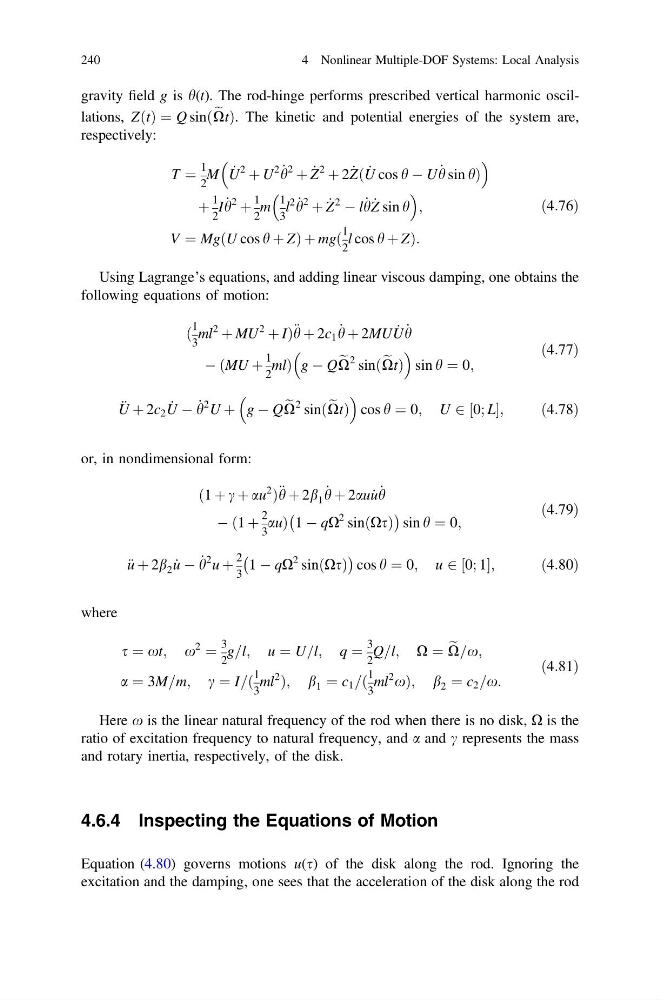
Here x is the linear natural frequency of the rod when there is no disk, X is the
ratio of excitation frequency to natural frequency, and a and c represents the mass
and rotary inertia, respectively, of the disk.
4.6.4 Inspecting the Equations of Motion
Equation (4.80) governs motions u(s) of the disk along the rod. Ignoring the
excitation and the damping, one sees that the acceleration of the disk along the rod
240
4 Nonlinear Multiple-DOF Systems: Local Analysis
XtÞ. The kinetic and potential energies of the system are,
respectively:
T ¼
1
2
M _
U
2
þ U
2 _
h
2
þ _
Z
2
þ 2 _
Zð _
U cos h À U _
h sin hÞ
þ
1
2
I _
h
2
þ
1
2
m
1
3
l
2 _
h
2
þ _
Z
2
À l _
h _
Z sin h
;
V ¼ Mg U cos h þ Z
ð
Þþmgð
1
2
l cos h þ ZÞ:
ð4:76Þ
Using Lagrange’s equations, and adding linear viscous damping, one obtains the
following equations of motion:
ð
1
3
ml
2
þ MU
2
þ IÞ € h þ 2c 1 _
h þ 2MU _
U _
h
À ðMU þ
1
2
mlÞ g À Q e
X
2 sinð e
XtÞ
sin h ¼ 0;
ð4:77Þ
€
U þ 2c 2 _
U À _
h
2 U þ g À Q e
X
2 sinð e
XtÞ
cos h ¼ 0; U 2 0; L
½ ;
ð4:78Þ
or, in nondimensional form:
ð1 þ c þ au
2
Þ € h þ 2b 1
_
h þ 2au _
u _
h
À ð1 þ
2
3
auÞ 1 À qX
2 sinðXsÞ
À
Á
sin h ¼ 0;
ð4:79Þ
€ u þ 2b 2 _
u À _
h
2 u þ
2
3
1 À qX
2 sinðXsÞ
À
Á
cos h ¼ 0; u 2 0; 1
½ ;
ð4:80Þ
where
s ¼ xt; x
2
¼
3
2
g=l; u ¼ U=l; q ¼
3
2
Q=l; X ¼ e
X=x;
a ¼ 3M=m; c ¼ I=ð
1
3
ml
2
Þ; b 1 ¼ c 1 =ð
1
3
ml
2 xÞ; b 2 ¼ c 2 =x:
ð4:81Þ
Here x is the linear natural frequency of the rod when there is no disk, X is the
ratio of excitation frequency to natural frequency, and a and c represents the mass
and rotary inertia, respectively, of the disk.
4.6.4 Inspecting the Equations of Motion
Equation (4.80) governs motions u(s) of the disk along the rod. Ignoring the
excitation and the damping, one sees that the acceleration of the disk along the rod
240
4 Nonlinear Multiple-DOF Systems: Local Analysis