

4.6.2 The System
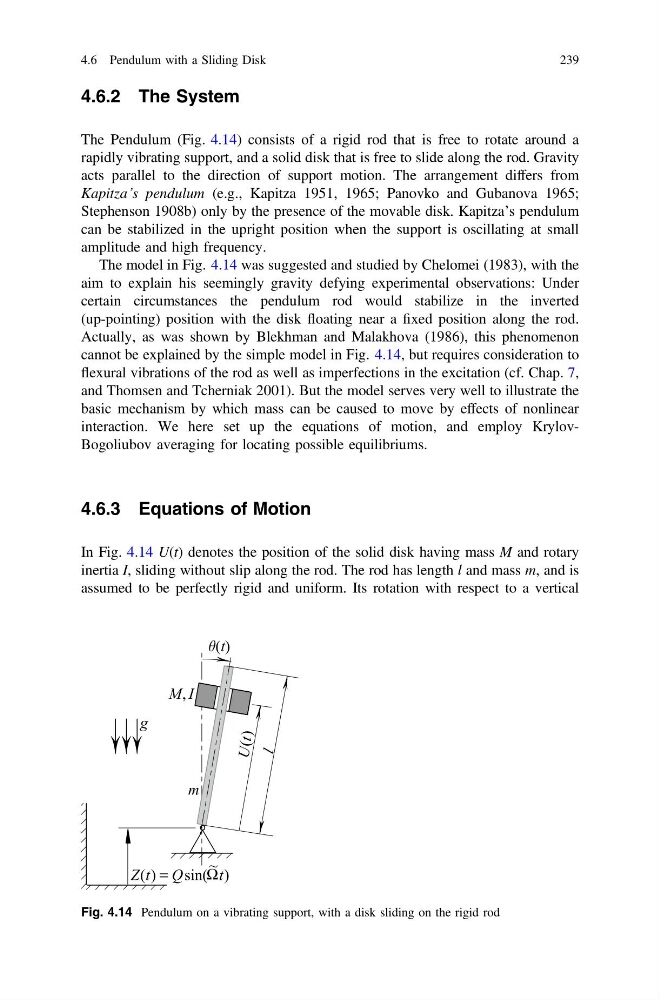
The Pendulum (Fig. 4.14) consists of a rigid rod that is free to rotate around a
rapidly vibrating support, and a solid disk that is free to slide along the rod. Gravity
acts parallel to the direction of support motion. The arrangement differs from
Kapitza’s pendulum (e.g., Kapitza 1951, 1965; Panovko and Gubanova 1965;
Stephenson 1908b) only by the presence of the movable disk. Kapitza’s pendulum
can be stabilized in the upright position when the support is oscillating at small
amplitude and high frequency.
The model in Fig. 4.14 was suggested and studied by Chelomei (1983), with the
aim to explain his seemingly gravity defying experimental observations: Under
certain circumstances the pendulum rod would stabilize in the inverted
(up-pointing) position with the disk floating near a fixed position along the rod.
Actually, as was shown by Blekhman and Malakhova (1986), this phenomenon
cannot be explained by the simple model in Fig. 4.14, but requires consideration to
flexural vibrations of the rod as well as imperfections in the excitation (cf. Chap. 7,
and Thomsen and Tcherniak 2001). But the model serves very well to illustrate the
basic mechanism by which mass can be caused to move by effects of nonlinear
interaction. We here set up the equations of motion, and employ KrylovBogoliubov averaging for locating possible equilibriums.
4.6.3 Equations of Motion
In Fig. 4.14 U(t) denotes the position of the solid disk having mass M and rotary
inertia I, sliding without slip along the rod. The rod has length l and mass m, and is
assumed to be perfectly rigid and uniform. Its rotation with respect to a vertical
Fig. 4.14 Pendulum on a vibrating support, with a disk sliding on the rigid rod
4.6 Pendulum with a Sliding Disk
239
The Pendulum (Fig. 4.14) consists of a rigid rod that is free to rotate around a
rapidly vibrating support, and a solid disk that is free to slide along the rod. Gravity
acts parallel to the direction of support motion. The arrangement differs from
Kapitza’s pendulum (e.g., Kapitza 1951, 1965; Panovko and Gubanova 1965;
Stephenson 1908b) only by the presence of the movable disk. Kapitza’s pendulum
can be stabilized in the upright position when the support is oscillating at small
amplitude and high frequency.
The model in Fig. 4.14 was suggested and studied by Chelomei (1983), with the
aim to explain his seemingly gravity defying experimental observations: Under
certain circumstances the pendulum rod would stabilize in the inverted
(up-pointing) position with the disk floating near a fixed position along the rod.
Actually, as was shown by Blekhman and Malakhova (1986), this phenomenon
cannot be explained by the simple model in Fig. 4.14, but requires consideration to
flexural vibrations of the rod as well as imperfections in the excitation (cf. Chap. 7,
and Thomsen and Tcherniak 2001). But the model serves very well to illustrate the
basic mechanism by which mass can be caused to move by effects of nonlinear
interaction. We here set up the equations of motion, and employ KrylovBogoliubov averaging for locating possible equilibriums.
4.6.3 Equations of Motion
In Fig. 4.14 U(t) denotes the position of the solid disk having mass M and rotary
inertia I, sliding without slip along the rod. The rod has length l and mass m, and is
assumed to be perfectly rigid and uniform. Its rotation with respect to a vertical
Fig. 4.14 Pendulum on a vibrating support, with a disk sliding on the rigid rod
4.6 Pendulum with a Sliding Disk
239