

The zero solution x = 0 is asymptotically stable (locally) if all roots of the characteristic equation (4.56) have negative real parts. According to the Routh-Hurwitz
criterion (see App. C) this is the case when the following four conditions are all met:
H 1 [ 0; D 2 ¼ H 1 H 2 À H 0 H 3 [ 0;
D 3 ¼ D 2 H 3 À H
2
1 H 4 [ 0; H 4 [ 0;
ð4:58Þ
where H j , j = 0, 4 are the simple functions of loading parameters (a, p) and
damping coefficient c given in (4.57).
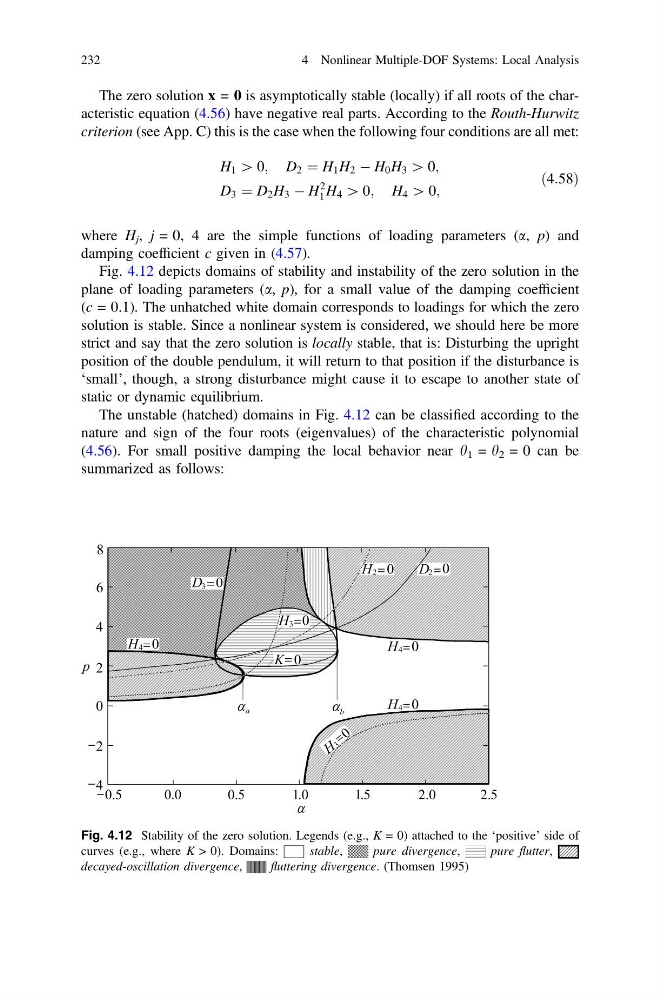
Fig. 4.12 depicts domains of stability and instability of the zero solution in the
plane of loading parameters (a, p), for a small value of the damping coefficient
(c = 0.1). The unhatched white domain corresponds to loadings for which the zero
solution is stable. Since a nonlinear system is considered, we should here be more
strict and say that the zero solution is locally stable, that is: Disturbing the upright
position of the double pendulum, it will return to that position if the disturbance is
‘small’, though, a strong disturbance might cause it to escape to another state of
static or dynamic equilibrium.
The unstable (hatched) domains in Fig. 4.12 can be classified according to the
nature and sign of the four roots (eigenvalues) of the characteristic polynomial
(4.56). For small positive damping the local behavior near h 1 = h 2 = 0 can be
summarized as follows:
Fig. 4.12 Stability of the zero solution. Legends (e.g., K = 0) attached to the ‘positive’ side of
curves (e.g., where K > 0). Domains:
stable,
pure divergence,
pure flutter,
decayed-oscillation divergence,
fluttering divergence. (Thomsen 1995)
232
4 Nonlinear Multiple-DOF Systems: Local Analysis
criterion (see App. C) this is the case when the following four conditions are all met:
H 1 [ 0; D 2 ¼ H 1 H 2 À H 0 H 3 [ 0;
D 3 ¼ D 2 H 3 À H
2
1 H 4 [ 0; H 4 [ 0;
ð4:58Þ
where H j , j = 0, 4 are the simple functions of loading parameters (a, p) and
damping coefficient c given in (4.57).
Fig. 4.12 depicts domains of stability and instability of the zero solution in the
plane of loading parameters (a, p), for a small value of the damping coefficient
(c = 0.1). The unhatched white domain corresponds to loadings for which the zero
solution is stable. Since a nonlinear system is considered, we should here be more
strict and say that the zero solution is locally stable, that is: Disturbing the upright
position of the double pendulum, it will return to that position if the disturbance is
‘small’, though, a strong disturbance might cause it to escape to another state of
static or dynamic equilibrium.
The unstable (hatched) domains in Fig. 4.12 can be classified according to the
nature and sign of the four roots (eigenvalues) of the characteristic polynomial
(4.56). For small positive damping the local behavior near h 1 = h 2 = 0 can be
summarized as follows:
Fig. 4.12 Stability of the zero solution. Legends (e.g., K = 0) attached to the ‘positive’ side of
curves (e.g., where K > 0). Domains:
stable,
pure divergence,
pure flutter,
decayed-oscillation divergence,
fluttering divergence. (Thomsen 1995)
232
4 Nonlinear Multiple-DOF Systems: Local Analysis