

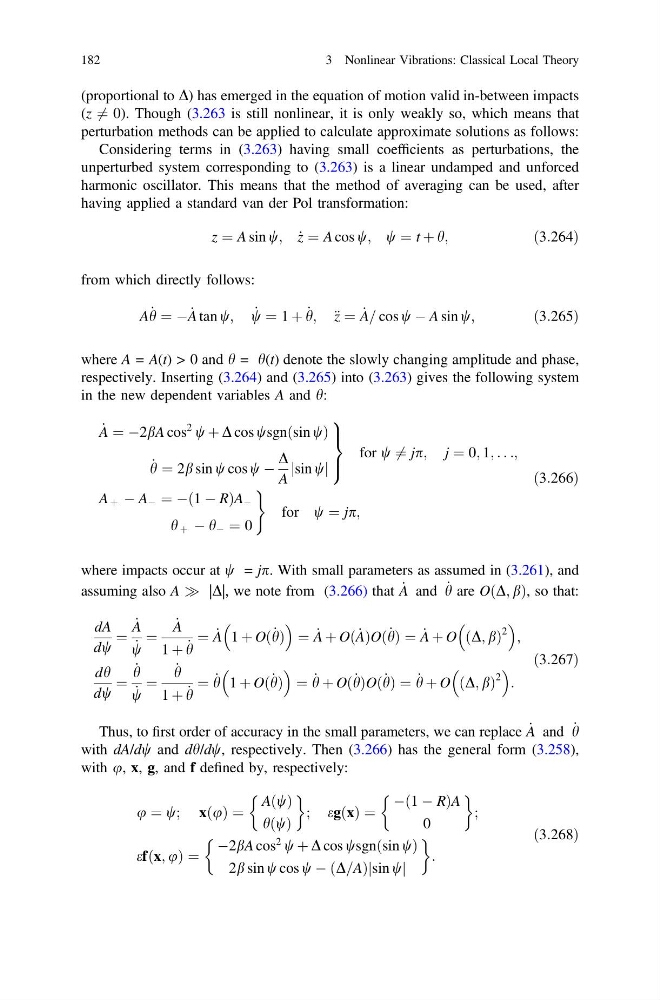
(proportional to D) has emerged in the equation of motion valid in-between impacts
(z 6 ¼ 0). Though (3.263 is still nonlinear, it is only weakly so, which means that
perturbation methods can be applied to calculate approximate solutions as follows:
Considering terms in (3.263) having small coefficients as perturbations, the
unperturbed system corresponding to (3.263) is a linear undamped and unforced
harmonic oscillator. This means that the method of averaging can be used, after
having applied a standard van der Pol transformation:
z ¼ A sin w; _
z ¼ A cos w; w ¼ t þ h;
ð3:264Þ
from which directly follows:
A _
h ¼ À _
A tan w; _
w ¼ 1 þ _
h; € z ¼ _
A= cos w À A sin w;
ð3:265Þ
where A = A(t) > 0 and h = h(t) denote the slowly changing amplitude and phase,
respectively. Inserting (3.264) and (3.265) into (3.263) gives the following system
in the new dependent variables A and h:
_
A ¼ À2bA cos
2 w þ D cos wsgn sin w
ð
Þ
_
h ¼ 2b sin w cos w À
D
A
sin w
j
j
9
> =
> ;
for w 6 ¼ jp; j ¼ 0; 1; . . .;
A þ À A À ¼ Àð1 À RÞA À
h þ À h À ¼ 0
)
for w ¼ jp;
ð3:266Þ
where impacts occur at w = jp. With small parameters as assumed in (3.261), and
assuming also A ) |D|, we note from (3.266) that _
A and _
h are OðD; bÞ, so that:
dA
dw
¼
_
A
_
w
¼
_
A
1 þ _
h
¼ _
A 1 þ Oð _
hÞ
¼ _
A þ Oð _
AÞOð _
hÞ ¼ _
A þ O ðD; bÞ
2
;
dh
dw
¼
_
h
_
w
¼
_
h
1 þ _
h
¼ _
h 1 þ Oð _
hÞ
¼ _
h þ Oð _
hÞOð _
hÞ ¼ _
h þ O ðD; bÞ
2
:
ð3:267Þ
Thus, to first order of accuracy in the small parameters, we can replace _
A and _
h
with dA/dw and dh/dw, respectively. Then (3.266) has the general form (3.258),
with u, x, g, and f defined by, respectively:
u ¼ w; xðuÞ ¼
AðwÞ
hðwÞ
&
'
; egðxÞ ¼
Àð1 À RÞA
0
&
'
;
efðx; uÞ ¼
À2bA cos
2 w þ D cos wsgnðsin wÞ
2b sin w cos w À ðD=AÞ sin w
j
j
&
'
:
ð3:268Þ
182
3 Nonlinear Vibrations: Classical Local Theory
(z 6 ¼ 0). Though (3.263 is still nonlinear, it is only weakly so, which means that
perturbation methods can be applied to calculate approximate solutions as follows:
Considering terms in (3.263) having small coefficients as perturbations, the
unperturbed system corresponding to (3.263) is a linear undamped and unforced
harmonic oscillator. This means that the method of averaging can be used, after
having applied a standard van der Pol transformation:
z ¼ A sin w; _
z ¼ A cos w; w ¼ t þ h;
ð3:264Þ
from which directly follows:
A _
h ¼ À _
A tan w; _
w ¼ 1 þ _
h; € z ¼ _
A= cos w À A sin w;
ð3:265Þ
where A = A(t) > 0 and h = h(t) denote the slowly changing amplitude and phase,
respectively. Inserting (3.264) and (3.265) into (3.263) gives the following system
in the new dependent variables A and h:
_
A ¼ À2bA cos
2 w þ D cos wsgn sin w
ð
Þ
_
h ¼ 2b sin w cos w À
D
A
sin w
j
j
9
> =
> ;
for w 6 ¼ jp; j ¼ 0; 1; . . .;
A þ À A À ¼ Àð1 À RÞA À
h þ À h À ¼ 0
)
for w ¼ jp;
ð3:266Þ
where impacts occur at w = jp. With small parameters as assumed in (3.261), and
assuming also A ) |D|, we note from (3.266) that _
A and _
h are OðD; bÞ, so that:
dA
dw
¼
_
A
_
w
¼
_
A
1 þ _
h
¼ _
A 1 þ Oð _
hÞ
¼ _
A þ Oð _
AÞOð _
hÞ ¼ _
A þ O ðD; bÞ
2
;
dh
dw
¼
_
h
_
w
¼
_
h
1 þ _
h
¼ _
h 1 þ Oð _
hÞ
¼ _
h þ Oð _
hÞOð _
hÞ ¼ _
h þ O ðD; bÞ
2
:
ð3:267Þ
Thus, to first order of accuracy in the small parameters, we can replace _
A and _
h
with dA/dw and dh/dw, respectively. Then (3.266) has the general form (3.258),
with u, x, g, and f defined by, respectively:
u ¼ w; xðuÞ ¼
AðwÞ
hðwÞ
&
'
; egðxÞ ¼
Àð1 À RÞA
0
&
'
;
efðx; uÞ ¼
À2bA cos
2 w þ D cos wsgnðsin wÞ
2b sin w cos w À ðD=AÞ sin w
j
j
&
'
:
ð3:268Þ
182
3 Nonlinear Vibrations: Classical Local Theory