

To transform vibro-impact problems into the form (3.258) can be a challenge, in
particular since for near-elastic vibro-impact the discontinuity in velocity is not
small. At least two transformations are then required: One for transforming large
discontinuities into small ones, and another one for transforming the impact-free
part of the equations of motion into the form of the first equation in (3.258). Below
we illustrate how this can be accomplished with four specific examples of
vibro-impact systems.
3.9.3 Example 1: Damped Harmonic Oscillator
Impacting a Stop
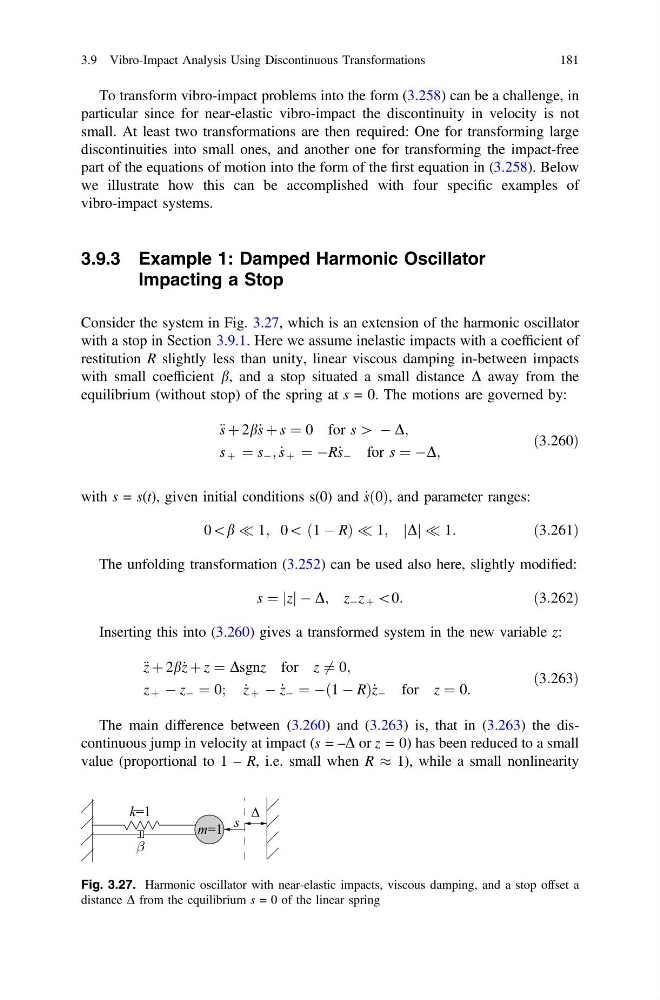
Consider the system in Fig. 3.27, which is an extension of the harmonic oscillator
with a stop in Section 3.9.1. Here we assume inelastic impacts with a coefficient of
restitution R slightly less than unity, linear viscous damping in-between impacts
with small coefficient b, and a stop situated a small distance D away from the
equilibrium (without stop) of the spring at s = 0. The motions are governed by:
€ s þ 2b_ s þ s ¼ 0 for s [ À D;
s þ ¼ s À ; _
s þ ¼ ÀR_ s À for s ¼ ÀD;
ð3:260Þ
with s = s(t), given initial conditions s(0) and _
sð0Þ, and parameter ranges:
0\b ( 1; 0\ ð1 À RÞ ( 1; D
j j ( 1:
ð3:261Þ
The unfolding transformation (3.252) can be used also here, slightly modified:
s ¼ z
j j À D; z À z þ \0:
ð3:262Þ
Inserting this into (3.260) gives a transformed system in the new variable z:
€ z þ 2b_ z þ z ¼ Dsgnz for z 6 ¼ 0;
z þ À z À ¼ 0; _
z þ À _
z À ¼ Àð1 À RÞ_ z À for z ¼ 0:
ð3:263Þ
The main difference between (3.260) and (3.263) is, that in (3.263) the discontinuous jump in velocity at impact (s = –D or z = 0) has been reduced to a small
value (proportional to 1 – R, i.e. small when R % 1), while a small nonlinearity
Fig. 3.27. Harmonic oscillator with near-elastic impacts, viscous damping, and a stop offset a
distance D from the equilibrium s = 0 of the linear spring
3.9 Vibro-Impact Analysis Using Discontinuous Transformations
181
particular since for near-elastic vibro-impact the discontinuity in velocity is not
small. At least two transformations are then required: One for transforming large
discontinuities into small ones, and another one for transforming the impact-free
part of the equations of motion into the form of the first equation in (3.258). Below
we illustrate how this can be accomplished with four specific examples of
vibro-impact systems.
3.9.3 Example 1: Damped Harmonic Oscillator
Impacting a Stop
Consider the system in Fig. 3.27, which is an extension of the harmonic oscillator
with a stop in Section 3.9.1. Here we assume inelastic impacts with a coefficient of
restitution R slightly less than unity, linear viscous damping in-between impacts
with small coefficient b, and a stop situated a small distance D away from the
equilibrium (without stop) of the spring at s = 0. The motions are governed by:
€ s þ 2b_ s þ s ¼ 0 for s [ À D;
s þ ¼ s À ; _
s þ ¼ ÀR_ s À for s ¼ ÀD;
ð3:260Þ
with s = s(t), given initial conditions s(0) and _
sð0Þ, and parameter ranges:
0\b ( 1; 0\ ð1 À RÞ ( 1; D
j j ( 1:
ð3:261Þ
The unfolding transformation (3.252) can be used also here, slightly modified:
s ¼ z
j j À D; z À z þ \0:
ð3:262Þ
Inserting this into (3.260) gives a transformed system in the new variable z:
€ z þ 2b_ z þ z ¼ Dsgnz for z 6 ¼ 0;
z þ À z À ¼ 0; _
z þ À _
z À ¼ Àð1 À RÞ_ z À for z ¼ 0:
ð3:263Þ
The main difference between (3.260) and (3.263) is, that in (3.263) the discontinuous jump in velocity at impact (s = –D or z = 0) has been reduced to a small
value (proportional to 1 – R, i.e. small when R % 1), while a small nonlinearity
Fig. 3.27. Harmonic oscillator with near-elastic impacts, viscous damping, and a stop offset a
distance D from the equilibrium s = 0 of the linear spring
3.9 Vibro-Impact Analysis Using Discontinuous Transformations
181