

discontinuities, recalling that such differential equations may appear after a
discontinuity-reducing transformation for a near-elastic vibro-impact system.
Common perturbation methods such as averaging, multiple scales, harmonic
linearization, and direct separation of motions all have difficulties in handling
discontinuities such as occur with vibro-impact systems. Typically the coordinates
of the impacting objects remain continuous, while the discontinuous change of
velocities during impact may be of the order of magnitude of the velocities
themselves. An effective approach, which enables the application of averaging to
systems with impacts, works by eliminating or reducing the discontinuity from the
equations by employing a variable transformation that contains or unfolds the
essential discontinuity, as was illustrated for a simple case in Sect. 3.9.1. This idea
was suggested by Zhuravlev (1976), and developed for different applications in e.g.
Ivanov (1997), Pilipchuk (1988, 2002), Fidlin (1991, 2004b), Dimentberg and
Iourtchenko (2004). The original objective was to eliminate the discontinuity
completely and to apply standard averaging. This is quite successful for perfectly
elastic impacts, but in the case of even small energy dissipation during impacts, it
becomes difficult to find suitable transformations that are reasonably simple and
with a clear physical interpretation. This seems to impede general use of
discontinuity-removing transformations.
However, it is actually not necessary to eliminate the discontinuities completely,
but only to reduce them to a sufficiently small level, comparable to other sources of
energy dissipation, and to generalize the averaging technique for that case. This
combination – of a discontinuity-reducing transformation and extended averaging –
leads to an efficient approach for asymptotic analysis of impacting oscillators, as
will be described below and exemplified in the following sections.
Standard Averaging – for Smooth Systems Standard averaging applies to
systems of the form:
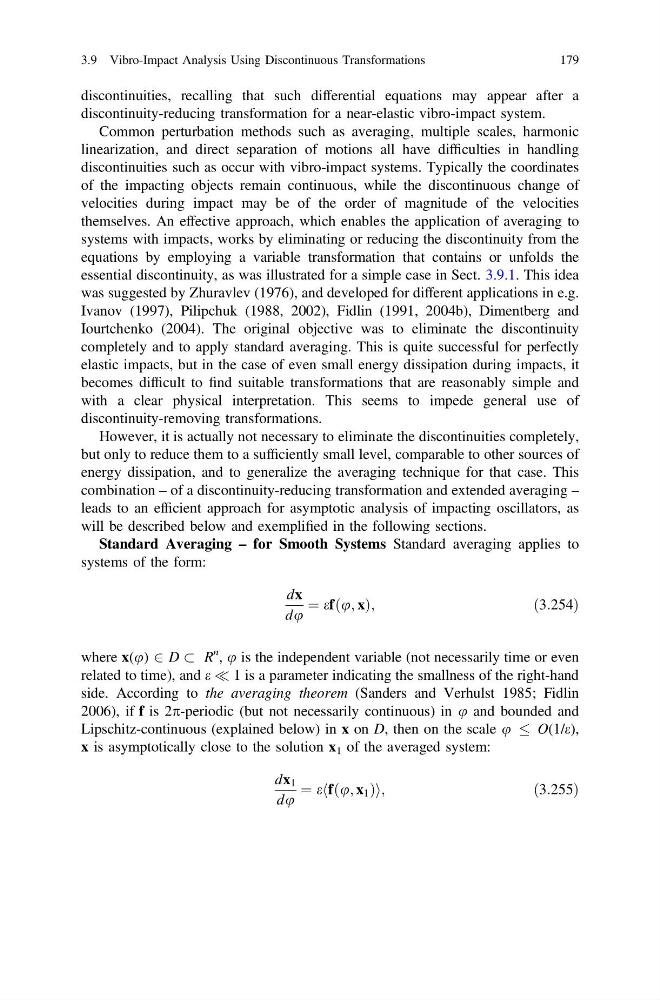
dx
du
¼ efðu; xÞ;
ð3:254Þ
where x(u) 2 D & R
n , u is the independent variable (not necessarily time or even
related to time), and e ( 1 is a parameter indicating the smallness of the right-hand
side. According to the averaging theorem (Sanders and Verhulst 1985; Fidlin
2006), if f is 2p-periodic (but not necessarily continuous) in u and bounded and
Lipschitz-continuous (explained below) in x on D, then on the scale u
O(1/e),
x is asymptotically close to the solution x 1 of the averaged system:
dx 1
du
¼ e fðu; x 1 Þ
h
i ;
ð3:255Þ
3.9 Vibro-Impact Analysis Using Discontinuous Transformations
179
discontinuity-reducing transformation for a near-elastic vibro-impact system.
Common perturbation methods such as averaging, multiple scales, harmonic
linearization, and direct separation of motions all have difficulties in handling
discontinuities such as occur with vibro-impact systems. Typically the coordinates
of the impacting objects remain continuous, while the discontinuous change of
velocities during impact may be of the order of magnitude of the velocities
themselves. An effective approach, which enables the application of averaging to
systems with impacts, works by eliminating or reducing the discontinuity from the
equations by employing a variable transformation that contains or unfolds the
essential discontinuity, as was illustrated for a simple case in Sect. 3.9.1. This idea
was suggested by Zhuravlev (1976), and developed for different applications in e.g.
Ivanov (1997), Pilipchuk (1988, 2002), Fidlin (1991, 2004b), Dimentberg and
Iourtchenko (2004). The original objective was to eliminate the discontinuity
completely and to apply standard averaging. This is quite successful for perfectly
elastic impacts, but in the case of even small energy dissipation during impacts, it
becomes difficult to find suitable transformations that are reasonably simple and
with a clear physical interpretation. This seems to impede general use of
discontinuity-removing transformations.
However, it is actually not necessary to eliminate the discontinuities completely,
but only to reduce them to a sufficiently small level, comparable to other sources of
energy dissipation, and to generalize the averaging technique for that case. This
combination – of a discontinuity-reducing transformation and extended averaging –
leads to an efficient approach for asymptotic analysis of impacting oscillators, as
will be described below and exemplified in the following sections.
Standard Averaging – for Smooth Systems Standard averaging applies to
systems of the form:
dx
du
¼ efðu; xÞ;
ð3:254Þ
where x(u) 2 D & R
n , u is the independent variable (not necessarily time or even
related to time), and e ( 1 is a parameter indicating the smallness of the right-hand
side. According to the averaging theorem (Sanders and Verhulst 1985; Fidlin
2006), if f is 2p-periodic (but not necessarily continuous) in u and bounded and
Lipschitz-continuous (explained below) in x on D, then on the scale u
O(1/e),
x is asymptotically close to the solution x 1 of the averaged system:
dx 1
du
¼ e fðu; x 1 Þ
h
i ;
ð3:255Þ
3.9 Vibro-Impact Analysis Using Discontinuous Transformations
179