

where the inequality condition implies that the new dependent variable z(t) changes
sign at every impact; this removes the non-uniqueness of the transformation due to
|z| in the first equation. Inserting (3.252) into (3.250), the system transforms into:
€ z þ z ¼ 0; for z 6 ¼ 0;
z þ ¼ z À ; _
z þ ¼ _
z À for z ¼ 0;
ð3:253Þ
where the second line is given only to emphasize that the transformed system is
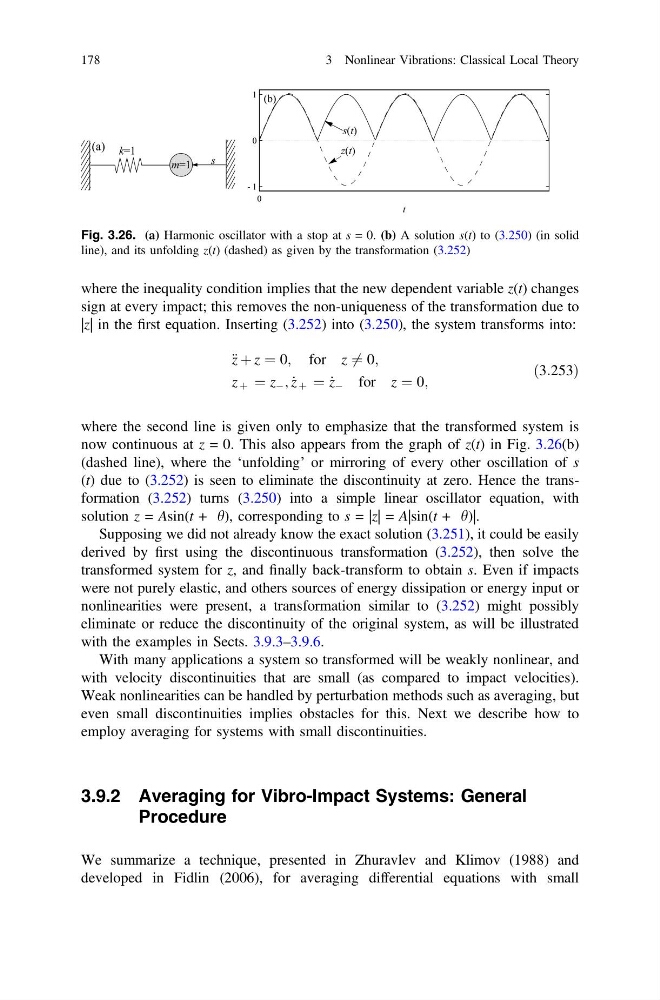
now continuous at z = 0. This also appears from the graph of z(t) in Fig. 3.26(b)
(dashed line), where the ‘unfolding’ or mirroring of every other oscillation of s
(t) due to (3.252) is seen to eliminate the discontinuity at zero. Hence the transformation (3.252) turns (3.250) into a simple linear oscillator equation, with
solution z = Asin(t + h), corresponding to s = |z| = A|sin(t + h)|.
Supposing we did not already know the exact solution (3.251), it could be easily
derived by first using the discontinuous transformation (3.252), then solve the
transformed system for z, and finally back-transform to obtain s. Even if impacts
were not purely elastic, and others sources of energy dissipation or energy input or
nonlinearities were present, a transformation similar to (3.252) might possibly
eliminate or reduce the discontinuity of the original system, as will be illustrated
with the examples in Sects. 3.9.3–3.9.6.
With many applications a system so transformed will be weakly nonlinear, and
with velocity discontinuities that are small (as compared to impact velocities).
Weak nonlinearities can be handled by perturbation methods such as averaging, but
even small discontinuities implies obstacles for this. Next we describe how to
employ averaging for systems with small discontinuities.
3.9.2 Averaging for Vibro-Impact Systems: General
Procedure
We summarize a technique, presented in Zhuravlev and Klimov (1988) and
developed in Fidlin (2006), for averaging differential equations with small
Fig. 3.26. (a) Harmonic oscillator with a stop at s = 0. (b) A solution s(t) to (3.250) (in solid
line), and its unfolding z(t) (dashed) as given by the transformation (3.252)
178
3 Nonlinear Vibrations: Classical Local Theory
sign at every impact; this removes the non-uniqueness of the transformation due to
|z| in the first equation. Inserting (3.252) into (3.250), the system transforms into:
€ z þ z ¼ 0; for z 6 ¼ 0;
z þ ¼ z À ; _
z þ ¼ _
z À for z ¼ 0;
ð3:253Þ
where the second line is given only to emphasize that the transformed system is
now continuous at z = 0. This also appears from the graph of z(t) in Fig. 3.26(b)
(dashed line), where the ‘unfolding’ or mirroring of every other oscillation of s
(t) due to (3.252) is seen to eliminate the discontinuity at zero. Hence the transformation (3.252) turns (3.250) into a simple linear oscillator equation, with
solution z = Asin(t + h), corresponding to s = |z| = A|sin(t + h)|.
Supposing we did not already know the exact solution (3.251), it could be easily
derived by first using the discontinuous transformation (3.252), then solve the
transformed system for z, and finally back-transform to obtain s. Even if impacts
were not purely elastic, and others sources of energy dissipation or energy input or
nonlinearities were present, a transformation similar to (3.252) might possibly
eliminate or reduce the discontinuity of the original system, as will be illustrated
with the examples in Sects. 3.9.3–3.9.6.
With many applications a system so transformed will be weakly nonlinear, and
with velocity discontinuities that are small (as compared to impact velocities).
Weak nonlinearities can be handled by perturbation methods such as averaging, but
even small discontinuities implies obstacles for this. Next we describe how to
employ averaging for systems with small discontinuities.
3.9.2 Averaging for Vibro-Impact Systems: General
Procedure
We summarize a technique, presented in Zhuravlev and Klimov (1988) and
developed in Fidlin (2006), for averaging differential equations with small
Fig. 3.26. (a) Harmonic oscillator with a stop at s = 0. (b) A solution s(t) to (3.250) (in solid
line), and its unfolding z(t) (dashed) as given by the transformation (3.252)
178
3 Nonlinear Vibrations: Classical Local Theory