

eigenvalues imply solutions of the form e = a 0 e
kt + a 1 te
kt + + a m t
m e
kt , where m is
the multiplicity of the non-distinct eigenvalue.
To keep the presentation on a manageable level, we restrict attention to the case
n = 2, that is, to systems described by two ordinary, autonomous differential
equations. For a discussion of the topology of higher-dimensional singular points
see, e.g., Blaquiére (1966) or Guckenheimer and Holmes (1983).
Jacobian Eigenvalues for n = 2 With two first-order equations of motion, there
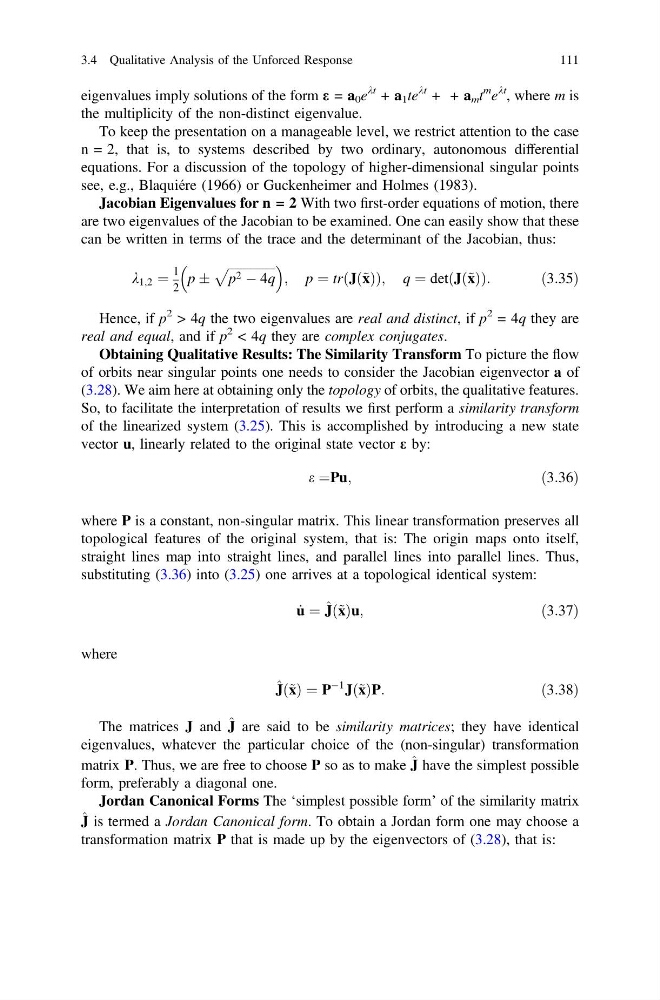
are two eigenvalues of the Jacobian to be examined. One can easily show that these
can be written in terms of the trace and the determinant of the Jacobian, thus:
k 1;2 ¼
1
2
p Æ
ffiffiffiffiffiffiffiffiffiffiffiffiffiffiffi
p 2 À 4q
p
; p ¼ tr Jð~ xÞ
ð
Þ; q ¼ det Jð~ xÞ
ð
Þ:
ð3:35Þ
Hence, if p
2 > 4q the two eigenvalues are real and distinct, if p
2 = 4q they are
real and equal, and if p
2 < 4q they are complex conjugates.
Obtaining Qualitative Results: The Similarity Transform To picture the flow
of orbits near singular points one needs to consider the Jacobian eigenvector a of
(3.28). We aim here at obtaining only the topology of orbits, the qualitative features.
So, to facilitate the interpretation of results we first perform a similarity transform
of the linearized system (3.25). This is accomplished by introducing a new state
vector u, linearly related to the original state vector e by:
e ¼Pu;
ð3:36Þ
where P is a constant, non-singular matrix. This linear transformation preserves all
topological features of the original system, that is: The origin maps onto itself,
straight lines map into straight lines, and parallel lines into parallel lines. Thus,
substituting (3.36) into (3.25) one arrives at a topological identical system:
_
u ¼ ^ Jð~ xÞu;
ð3:37Þ
where
^ Jð~ xÞ ¼ P
À1
Jð~ xÞP:
ð3:38Þ
The matrices J and ^ J are said to be similarity matrices; they have identical
eigenvalues, whatever the particular choice of the (non-singular) transformation
matrix P. Thus, we are free to choose P so as to make ^ J have the simplest possible
form, preferably a diagonal one.
Jordan Canonical Forms The ‘simplest possible form’ of the similarity matrix
^ J is termed a Jordan Canonical form. To obtain a Jordan form one may choose a
transformation matrix P that is made up by the eigenvectors of (3.28), that is:
3.4 Qualitative Analysis of the Unforced Response
111
kt + a 1 te
kt + + a m t
m e
kt , where m is
the multiplicity of the non-distinct eigenvalue.
To keep the presentation on a manageable level, we restrict attention to the case
n = 2, that is, to systems described by two ordinary, autonomous differential
equations. For a discussion of the topology of higher-dimensional singular points
see, e.g., Blaquiére (1966) or Guckenheimer and Holmes (1983).
Jacobian Eigenvalues for n = 2 With two first-order equations of motion, there
are two eigenvalues of the Jacobian to be examined. One can easily show that these
can be written in terms of the trace and the determinant of the Jacobian, thus:
k 1;2 ¼
1
2
p Æ
ffiffiffiffiffiffiffiffiffiffiffiffiffiffiffi
p 2 À 4q
p
; p ¼ tr Jð~ xÞ
ð
Þ; q ¼ det Jð~ xÞ
ð
Þ:
ð3:35Þ
Hence, if p
2 > 4q the two eigenvalues are real and distinct, if p
2 = 4q they are
real and equal, and if p
2 < 4q they are complex conjugates.
Obtaining Qualitative Results: The Similarity Transform To picture the flow
of orbits near singular points one needs to consider the Jacobian eigenvector a of
(3.28). We aim here at obtaining only the topology of orbits, the qualitative features.
So, to facilitate the interpretation of results we first perform a similarity transform
of the linearized system (3.25). This is accomplished by introducing a new state
vector u, linearly related to the original state vector e by:
e ¼Pu;
ð3:36Þ
where P is a constant, non-singular matrix. This linear transformation preserves all
topological features of the original system, that is: The origin maps onto itself,
straight lines map into straight lines, and parallel lines into parallel lines. Thus,
substituting (3.36) into (3.25) one arrives at a topological identical system:
_
u ¼ ^ Jð~ xÞu;
ð3:37Þ
where
^ Jð~ xÞ ¼ P
À1
Jð~ xÞP:
ð3:38Þ
The matrices J and ^ J are said to be similarity matrices; they have identical
eigenvalues, whatever the particular choice of the (non-singular) transformation
matrix P. Thus, we are free to choose P so as to make ^ J have the simplest possible
form, preferably a diagonal one.
Jordan Canonical Forms The ‘simplest possible form’ of the similarity matrix
^ J is termed a Jordan Canonical form. To obtain a Jordan form one may choose a
transformation matrix P that is made up by the eigenvectors of (3.28), that is:
3.4 Qualitative Analysis of the Unforced Response
111