

which upon substitution into (3.25) yields an algebraic eigenvalue problem:
Jð~ xÞ À kI
ð
Þ a ¼ 0;
ð3:28Þ
for the determination of a set of eigenvalues k j and corresponding eigenvectors a j ,
j = 1, n. Inspecting (3.27), it appears that any eigenvalue k having a positive real
part causes orbits of the linearized system (3.25) to escape from the singular point.
An orbit of the corresponding nonlinear system (3.23) will escape as well, since
near the singular point the nonlinear system is closely approximated by the linearized one.
Thus, the stability of a singular point of a nonlinear system is determined by
examining eigenvalues of the Jacobian matrix evaluated at that point. The following
rules apply:
• Re(k j ) < 0 for all j = 1,n: ~ x is stable
• Re(k j ) > 0 for at least one j = 1,n: ~ x is unstable
• max[Re(k j )] = 0 for j = 1,n: ~ x may be stable or unstable
In the third case there is at least one eigenvalue with vanishing real part, but no
eigenvalues with positive real parts. This is a critical case, for which the stability of
the singular point cannot be deduced from the linearized system; higher-order
nonlinear terms may render the point stable or unstable.
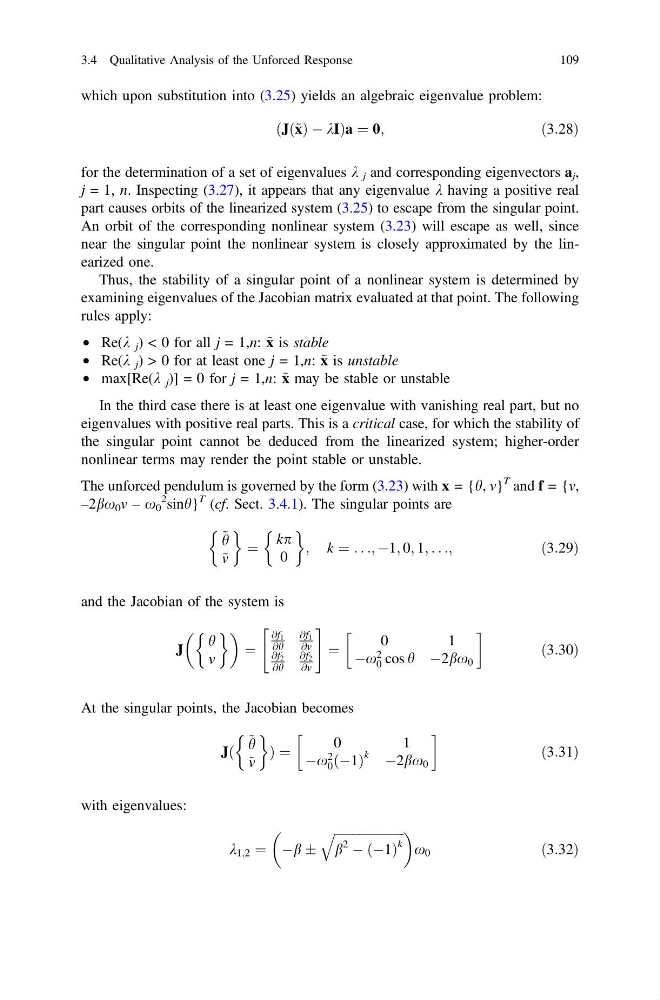
The unforced pendulum is governed by the form (3.23) with x = {h, v}
T and f = {v,
–2bx 0 v – x 0
2
sinh}
T (cf. Sect. 3.4.1). The singular points are
~ h
~ v
& '
¼
kp
0
& '
; k ¼ . . .; À1; 0; 1; . . .;
ð3:29Þ
and the Jacobian of the system is
J
h
v
& '
¼
@f 1
@h
@f 1
@v
@f 2
@h
@f 2
@v
"
#
¼
0
1
Àx
2
0 cos h À2bx 0
!
ð3:30Þ
At the singular points, the Jacobian becomes
Jð
~ h
~ v
& '
Þ ¼
0
1
Àx
2
0 ðÀ1Þ
k
À2bx 0
!
ð3:31Þ
with eigenvalues:
k 1;2 ¼ Àb Æ
ffiffiffiffiffiffiffiffiffiffiffiffiffiffiffiffiffiffiffiffiffiffi ffi
b
2
À ðÀ1Þ
k
q
x 0
ð3:32Þ
3.4 Qualitative Analysis of the Unforced Response
109
Jð~ xÞ À kI
ð
Þ a ¼ 0;
ð3:28Þ
for the determination of a set of eigenvalues k j and corresponding eigenvectors a j ,
j = 1, n. Inspecting (3.27), it appears that any eigenvalue k having a positive real
part causes orbits of the linearized system (3.25) to escape from the singular point.
An orbit of the corresponding nonlinear system (3.23) will escape as well, since
near the singular point the nonlinear system is closely approximated by the linearized one.
Thus, the stability of a singular point of a nonlinear system is determined by
examining eigenvalues of the Jacobian matrix evaluated at that point. The following
rules apply:
• Re(k j ) < 0 for all j = 1,n: ~ x is stable
• Re(k j ) > 0 for at least one j = 1,n: ~ x is unstable
• max[Re(k j )] = 0 for j = 1,n: ~ x may be stable or unstable
In the third case there is at least one eigenvalue with vanishing real part, but no
eigenvalues with positive real parts. This is a critical case, for which the stability of
the singular point cannot be deduced from the linearized system; higher-order
nonlinear terms may render the point stable or unstable.
The unforced pendulum is governed by the form (3.23) with x = {h, v}
T and f = {v,
–2bx 0 v – x 0
2
sinh}
T (cf. Sect. 3.4.1). The singular points are
~ h
~ v
& '
¼
kp
0
& '
; k ¼ . . .; À1; 0; 1; . . .;
ð3:29Þ
and the Jacobian of the system is
J
h
v
& '
¼
@f 1
@h
@f 1
@v
@f 2
@h
@f 2
@v
"
#
¼
0
1
Àx
2
0 cos h À2bx 0
!
ð3:30Þ
At the singular points, the Jacobian becomes
Jð
~ h
~ v
& '
Þ ¼
0
1
Àx
2
0 ðÀ1Þ
k
À2bx 0
!
ð3:31Þ
with eigenvalues:
k 1;2 ¼ Àb Æ
ffiffiffiffiffiffiffiffiffiffiffiffiffiffiffiffiffiffiffiffiffiffi ffi
b
2
À ðÀ1Þ
k
q
x 0
ð3:32Þ
3.4 Qualitative Analysis of the Unforced Response
109