

attracting orbits from some directions while repelling orbits from other directions
(e.g., (p,0) in Fig. 3.7); these are called unstable.
We consider here only the local stability of singular points. The question to be
answered is, whether orbits in the immediate vicinity of a singular point stay near or
escape. For analyzing local stability, a study of the linearized system will suffice. In
regular cases the stability properties of singular points for the linearized system hold
too for the nonlinear system. That is, if a singular point of a linearized system is
(un)stable, then so is the same singular point of the original nonlinear system.
Consider a general nonlinear system, written as a set of n first-order autonomous
differential equations:
_
x ¼ fðxÞ; x ¼ xðtÞ 2 R
n
;
ð3:23Þ
for which we aim at determining the local stability of a given singular point x ¼ ~ x.
Taylor-expanding the right-hand side near x ¼ ~ x one obtains:
_
x ¼ fð~ xÞ þ
@f
@x
x¼~ x
x À ~ x
ð
Þ þ O x À ~ x
ð
Þ
T x À ~ x
ð
Þ
À
Á
ð3:24Þ
where the last term represents quadratic and higher-order terms. The first term of the
expansion vanishes, since by definition f(~ x) = 0. To indicate the nearness of an
orbit x(t) to the singular point ~ x, we introduce a new dependent variable e(t) = x
(t) – ~ x. For orbits near the singular point |e| ( 1, so that higher-order terms of the
Taylor expansion can be dropped. Performing the variable shift from x to e in (3.24)
and neglecting higher-order terms, we find that small distances between orbits and
the singular point ~ x are governed by the linear set of equations:
_
¼ Jð~ xÞe;
ð3:25Þ
where J(~ x) denotes the Jacobian of the nonlinear system, evaluated at the singular
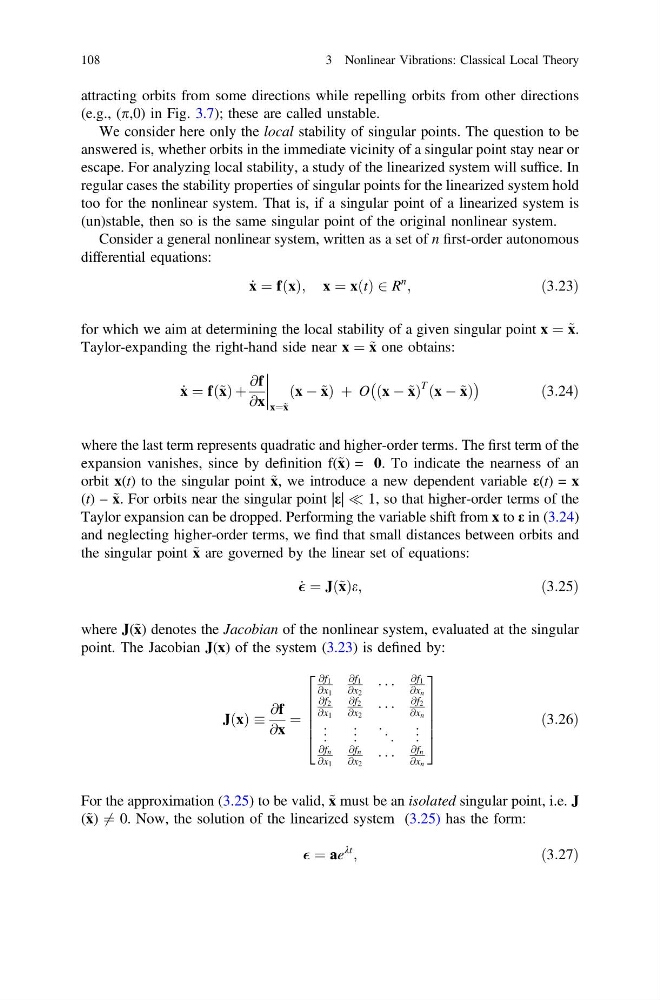
point. The Jacobian J(x) of the system (3.23) is defined by:
JðxÞ
@f
@x
¼
@f 1
@x 1
@f 1
@x 2
Á Á Á
@f 1
@x n
@f 2
@x 1
@f 2
@x 2
Á Á Á
@f 2
@x n
. .
.
. .
.
. .
.
. .
.
@f n
@x 1
@f n
@x 2
Á Á Á
@f n
@x n
2
6
6
6
6
4
3
7
7
7
7
5
ð3:26Þ
For the approximation (3.25) to be valid, ~ x must be an isolated singular point, i.e. J
(~ x) 6 ¼ 0. Now, the solution of the linearized system (3.25) has the form:
¼ ae
kt
;
ð3:27Þ
108
3 Nonlinear Vibrations: Classical Local Theory
(e.g., (p,0) in Fig. 3.7); these are called unstable.
We consider here only the local stability of singular points. The question to be
answered is, whether orbits in the immediate vicinity of a singular point stay near or
escape. For analyzing local stability, a study of the linearized system will suffice. In
regular cases the stability properties of singular points for the linearized system hold
too for the nonlinear system. That is, if a singular point of a linearized system is
(un)stable, then so is the same singular point of the original nonlinear system.
Consider a general nonlinear system, written as a set of n first-order autonomous
differential equations:
_
x ¼ fðxÞ; x ¼ xðtÞ 2 R
n
;
ð3:23Þ
for which we aim at determining the local stability of a given singular point x ¼ ~ x.
Taylor-expanding the right-hand side near x ¼ ~ x one obtains:
_
x ¼ fð~ xÞ þ
@f
@x
x¼~ x
x À ~ x
ð
Þ þ O x À ~ x
ð
Þ
T x À ~ x
ð
Þ
À
Á
ð3:24Þ
where the last term represents quadratic and higher-order terms. The first term of the
expansion vanishes, since by definition f(~ x) = 0. To indicate the nearness of an
orbit x(t) to the singular point ~ x, we introduce a new dependent variable e(t) = x
(t) – ~ x. For orbits near the singular point |e| ( 1, so that higher-order terms of the
Taylor expansion can be dropped. Performing the variable shift from x to e in (3.24)
and neglecting higher-order terms, we find that small distances between orbits and
the singular point ~ x are governed by the linear set of equations:
_
¼ Jð~ xÞe;
ð3:25Þ
where J(~ x) denotes the Jacobian of the nonlinear system, evaluated at the singular
point. The Jacobian J(x) of the system (3.23) is defined by:
JðxÞ
@f
@x
¼
@f 1
@x 1
@f 1
@x 2
Á Á Á
@f 1
@x n
@f 2
@x 1
@f 2
@x 2
Á Á Á
@f 2
@x n
. .
.
. .
.
. .
.
. .
.
@f n
@x 1
@f n
@x 2
Á Á Á
@f n
@x n
2
6
6
6
6
4
3
7
7
7
7
5
ð3:26Þ
For the approximation (3.25) to be valid, ~ x must be an isolated singular point, i.e. J
(~ x) 6 ¼ 0. Now, the solution of the linearized system (3.25) has the form:
¼ ae
kt
;
ð3:27Þ
108
3 Nonlinear Vibrations: Classical Local Theory