

97
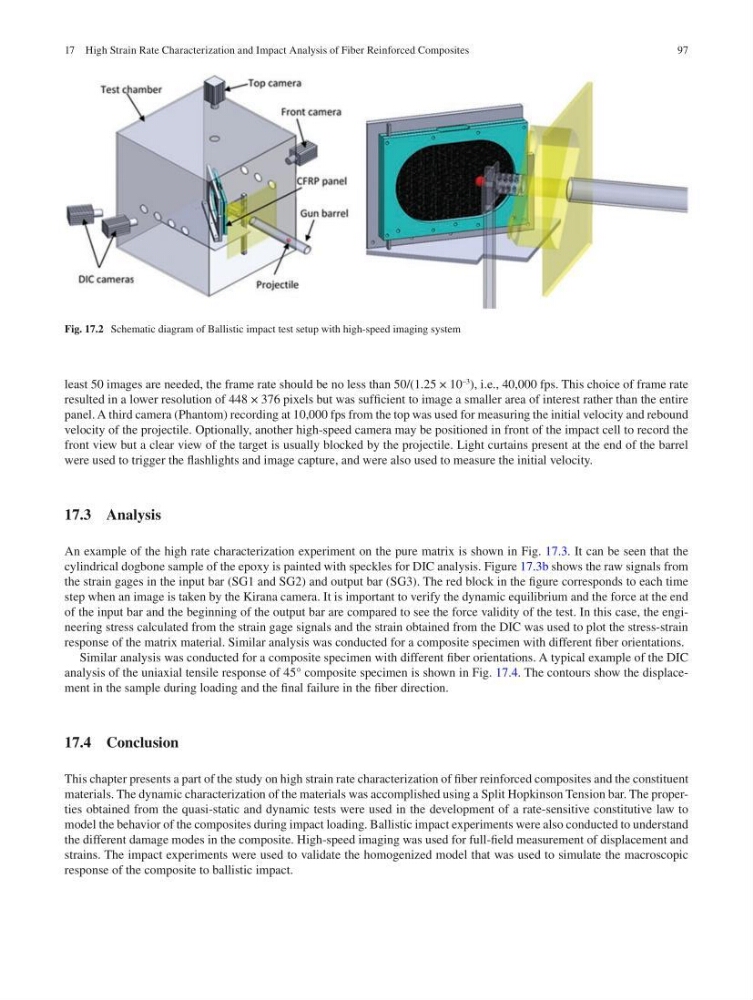
least 50 images are needed, the frame rate should be no less than 50/(1.25 × 10
–3
), i.e., 40,000 fps. This choice of frame rate
resulted in a lower resolution of 448 × 376 pixels but was sufficient to image a smaller area of interest rather than the entire
panel. A third camera (Phantom) recording at 10,000 fps from the top was used for measuring the initial velocity and rebound
velocity of the projectile. Optionally, another high-speed camera may be positioned in front of the impact cell to record the
front view but a clear view of the target is usually blocked by the projectile. Light curtains present at the end of the barrel
were used to trigger the flashlights and image capture, and were also used to measure the initial velocity.
17.3 Analysis
An example of the high rate characterization experiment on the pure matrix is shown in Fig. 17.3. It can be seen that the
cylindrical dogbone sample of the epoxy is painted with speckles for DIC analysis. Figure 17.3b shows the raw signals from
the strain gages in the input bar (SG1 and SG2) and output bar (SG3). The red block in the figure corresponds to each time
step when an image is taken by the Kirana camera. It is important to verify the dynamic equilibrium and the force at the end
of the input bar and the beginning of the output bar are compared to see the force validity of the test. In this case, the engineering stress calculated from the strain gage signals and the strain obtained from the DIC was used to plot the stress-strain
response of the matrix material. Similar analysis was conducted for a composite specimen with different fiber orientations.
Similar analysis was conducted for a composite specimen with different fiber orientations. A typical example of the DIC
analysis of the uniaxial tensile response of 45° composite specimen is shown in Fig. 17.4. The contours show the displacement in the sample during loading and the final failure in the fiber direction.
17.4 Conclusion
This chapter presents a part of the study on high strain rate characterization of fiber reinforced composites and the constituent
materials. The dynamic characterization of the materials was accomplished using a Split Hopkinson Tension bar. The properties obtained from the quasi-static and dynamic tests were used in the development of a rate-sensitive constitutive law to
model the behavior of the composites during impact loading. Ballistic impact experiments were also conducted to understand
the different damage modes in the composite. High-speed imaging was used for full-field measurement of displacement and
strains. The impact experiments were used to validate the homogenized model that was used to simulate the macroscopic
response of the composite to ballistic impact.
Fig. 17.2 Schematic diagram of Ballistic impact test setup with high-speed imaging system
17 High Strain Rate Characterization and Impact Analysis of Fiber Reinforced Composites
least 50 images are needed, the frame rate should be no less than 50/(1.25 × 10
–3
), i.e., 40,000 fps. This choice of frame rate
resulted in a lower resolution of 448 × 376 pixels but was sufficient to image a smaller area of interest rather than the entire
panel. A third camera (Phantom) recording at 10,000 fps from the top was used for measuring the initial velocity and rebound
velocity of the projectile. Optionally, another high-speed camera may be positioned in front of the impact cell to record the
front view but a clear view of the target is usually blocked by the projectile. Light curtains present at the end of the barrel
were used to trigger the flashlights and image capture, and were also used to measure the initial velocity.
17.3 Analysis
An example of the high rate characterization experiment on the pure matrix is shown in Fig. 17.3. It can be seen that the
cylindrical dogbone sample of the epoxy is painted with speckles for DIC analysis. Figure 17.3b shows the raw signals from
the strain gages in the input bar (SG1 and SG2) and output bar (SG3). The red block in the figure corresponds to each time
step when an image is taken by the Kirana camera. It is important to verify the dynamic equilibrium and the force at the end
of the input bar and the beginning of the output bar are compared to see the force validity of the test. In this case, the engineering stress calculated from the strain gage signals and the strain obtained from the DIC was used to plot the stress-strain
response of the matrix material. Similar analysis was conducted for a composite specimen with different fiber orientations.
Similar analysis was conducted for a composite specimen with different fiber orientations. A typical example of the DIC
analysis of the uniaxial tensile response of 45° composite specimen is shown in Fig. 17.4. The contours show the displacement in the sample during loading and the final failure in the fiber direction.
17.4 Conclusion
This chapter presents a part of the study on high strain rate characterization of fiber reinforced composites and the constituent
materials. The dynamic characterization of the materials was accomplished using a Split Hopkinson Tension bar. The properties obtained from the quasi-static and dynamic tests were used in the development of a rate-sensitive constitutive law to
model the behavior of the composites during impact loading. Ballistic impact experiments were also conducted to understand
the different damage modes in the composite. High-speed imaging was used for full-field measurement of displacement and
strains. The impact experiments were used to validate the homogenized model that was used to simulate the macroscopic
response of the composite to ballistic impact.
Fig. 17.2 Schematic diagram of Ballistic impact test setup with high-speed imaging system
17 High Strain Rate Characterization and Impact Analysis of Fiber Reinforced Composites