

86
15.4 Conclusion
Quasi-static and dynamic mechanical properties of a 70 wt.% B 6 O–30 wt.% B 4 C composite were determined and compared
to those of monolithic B 6 O. Ultrasonic and Archimedes measurements indicated that the composite sample had a significantly lower density than its theoretical value. Investigation of the composite microstructure indicated a substantial phase
segregation in the composite, with at least three distinct phases: a porous and weak B 6 O-dominant phase, a dense and hard
B 4 C-dominant phase, and an intermediate matrix interphase. The porosity in the regions containing predominantly B 6 O
phase, as well as large cracks along the interfaces between the phases, resulted in the degradation of mechanical properties.
The indentation hardness of the 100% B 6 O sample was within the expected range however the hardness in the composite
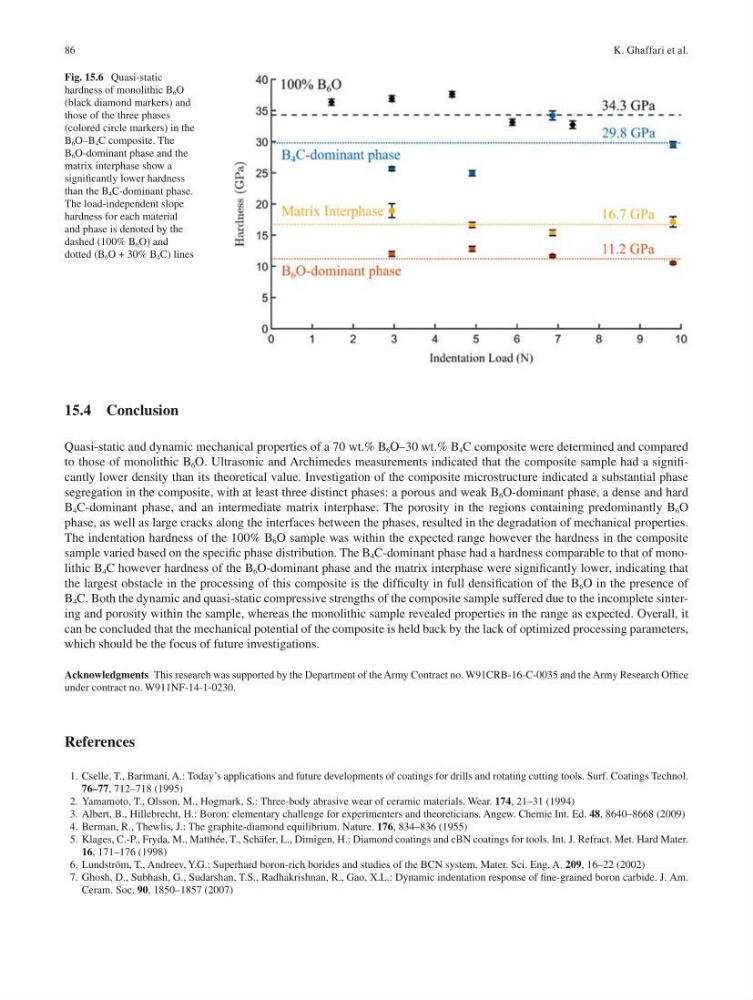
sample varied based on the specific phase distribution. The B 4 C-dominant phase had a hardness comparable to that of monolithic B 4 C however hardness of the B 6 O-dominant phase and the matrix interphase were significantly lower, indicating that
the largest obstacle in the processing of this composite is the difficulty in full densification of the B 6 O in the presence of
B 4 C. Both the dynamic and quasi-static compressive strengths of the composite sample suffered due to the incomplete sintering and porosity within the sample, whereas the monolithic sample revealed properties in the range as expected. Overall, it
can be concluded that the mechanical potential of the composite is held back by the lack of optimized processing parameters,
which should be the focus of future investigations.
Acknowledgments This research was supported by the Department of the Army Contract no. W91CRB-16-C-0035 and the Army Research Office
under contract no. W911NF-14-1-0230.
References
1. Cselle, T., Barimani, A.: Today’s applications and future developments of coatings for drills and rotating cutting tools. Surf. Coatings Technol.
76–77, 712–718 (1995)
2. Yamamoto, T., Olsson, M., Hogmark, S.: Three-body abrasive wear of ceramic materials. Wear. 174, 21–31 (1994)
3. Albert, B., Hillebrecht, H.: Boron: elementary challenge for experimenters and theoreticians. Angew. Chemie Int. Ed. 48, 8640–8668 (2009)
4. Berman, R., Thewlis, J.: The graphite-diamond equilibrium. Nature. 176, 834–836 (1955)
5. Klages, C.-P., Fryda, M., Matthée, T., Schäfer, L., Dimigen, H.: Diamond coatings and cBN coatings for tools. Int. J. Refract. Met. Hard Mater.
16, 171–176 (1998)
6. Lundström, T., Andreev, Y.G.: Superhard boron-rich borides and studies of the BCN system. Mater. Sci. Eng. A. 209, 16–22 (2002)
7. Ghosh, D., Subhash, G., Sudarshan, T.S., Radhakrishnan, R., Gao, X.L.: Dynamic indentation response of fine-grained boron carbide. J. Am.
Ceram. Soc. 90, 1850–1857 (2007)
Fig. 15.6 Quasi-static
hardness of monolithic B 6 O
(black diamond markers) and
those of the three phases
(colored circle markers) in the
B 6 O–B 4 C composite. The
B 6 O-dominant phase and the
matrix interphase show a
significantly lower hardness
than the B 4 C-dominant phase.
The load-independent slope
hardness for each material
and phase is denoted by the
dashed (100% B 6 O) and
dotted (B 6 O + 30% B 4 C) lines
K. Ghaffari et al.
15.4 Conclusion
Quasi-static and dynamic mechanical properties of a 70 wt.% B 6 O–30 wt.% B 4 C composite were determined and compared
to those of monolithic B 6 O. Ultrasonic and Archimedes measurements indicated that the composite sample had a significantly lower density than its theoretical value. Investigation of the composite microstructure indicated a substantial phase
segregation in the composite, with at least three distinct phases: a porous and weak B 6 O-dominant phase, a dense and hard
B 4 C-dominant phase, and an intermediate matrix interphase. The porosity in the regions containing predominantly B 6 O
phase, as well as large cracks along the interfaces between the phases, resulted in the degradation of mechanical properties.
The indentation hardness of the 100% B 6 O sample was within the expected range however the hardness in the composite
sample varied based on the specific phase distribution. The B 4 C-dominant phase had a hardness comparable to that of monolithic B 4 C however hardness of the B 6 O-dominant phase and the matrix interphase were significantly lower, indicating that
the largest obstacle in the processing of this composite is the difficulty in full densification of the B 6 O in the presence of
B 4 C. Both the dynamic and quasi-static compressive strengths of the composite sample suffered due to the incomplete sintering and porosity within the sample, whereas the monolithic sample revealed properties in the range as expected. Overall, it
can be concluded that the mechanical potential of the composite is held back by the lack of optimized processing parameters,
which should be the focus of future investigations.
Acknowledgments This research was supported by the Department of the Army Contract no. W91CRB-16-C-0035 and the Army Research Office
under contract no. W911NF-14-1-0230.
References
1. Cselle, T., Barimani, A.: Today’s applications and future developments of coatings for drills and rotating cutting tools. Surf. Coatings Technol.
76–77, 712–718 (1995)
2. Yamamoto, T., Olsson, M., Hogmark, S.: Three-body abrasive wear of ceramic materials. Wear. 174, 21–31 (1994)
3. Albert, B., Hillebrecht, H.: Boron: elementary challenge for experimenters and theoreticians. Angew. Chemie Int. Ed. 48, 8640–8668 (2009)
4. Berman, R., Thewlis, J.: The graphite-diamond equilibrium. Nature. 176, 834–836 (1955)
5. Klages, C.-P., Fryda, M., Matthée, T., Schäfer, L., Dimigen, H.: Diamond coatings and cBN coatings for tools. Int. J. Refract. Met. Hard Mater.
16, 171–176 (1998)
6. Lundström, T., Andreev, Y.G.: Superhard boron-rich borides and studies of the BCN system. Mater. Sci. Eng. A. 209, 16–22 (2002)
7. Ghosh, D., Subhash, G., Sudarshan, T.S., Radhakrishnan, R., Gao, X.L.: Dynamic indentation response of fine-grained boron carbide. J. Am.
Ceram. Soc. 90, 1850–1857 (2007)
Fig. 15.6 Quasi-static
hardness of monolithic B 6 O
(black diamond markers) and
those of the three phases
(colored circle markers) in the
B 6 O–B 4 C composite. The
B 6 O-dominant phase and the
matrix interphase show a
significantly lower hardness
than the B 4 C-dominant phase.
The load-independent slope
hardness for each material
and phase is denoted by the
dashed (100% B 6 O) and
dotted (B 6 O + 30% B 4 C) lines
K. Ghaffari et al.