

48
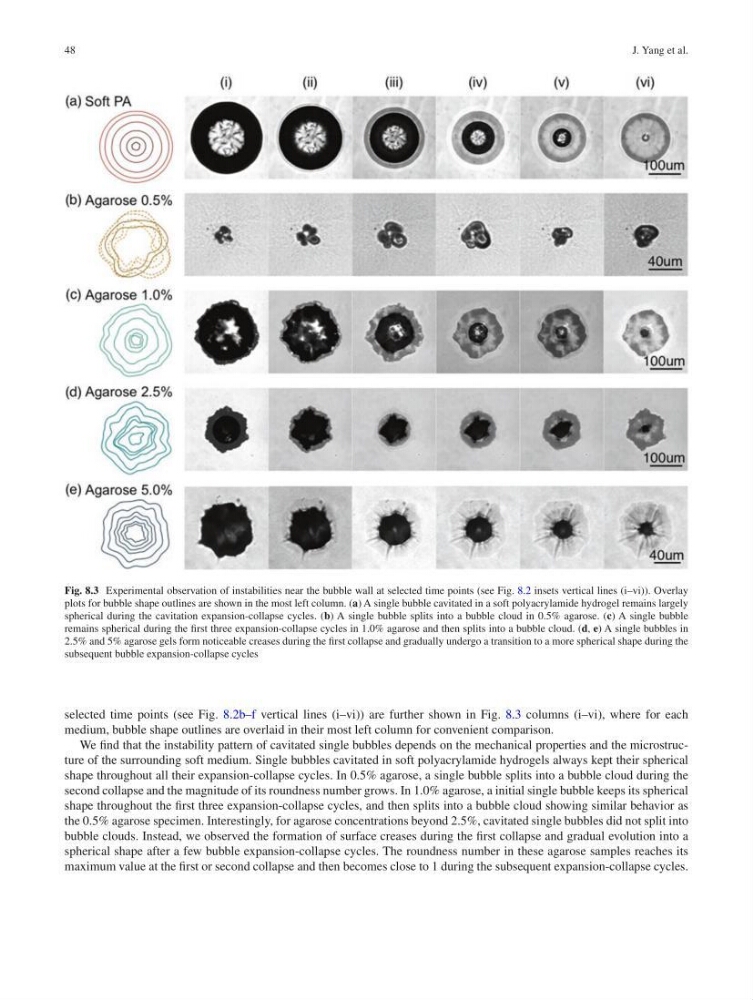
selected time points (see Fig. 8.2b–f vertical lines (i–vi)) are further shown in Fig. 8.3 columns (i–vi), where for each
medium, bubble shape outlines are overlaid in their most left column for convenient comparison.
We find that the instability pattern of cavitated single bubbles depends on the mechanical properties and the microstructure of the surrounding soft medium. Single bubbles cavitated in soft polyacrylamide hydrogels always kept their spherical
shape throughout all their expansion-collapse cycles. In 0.5% agarose, a single bubble splits into a bubble cloud during the
second collapse and the magnitude of its roundness number grows. In 1.0% agarose, a initial single bubble keeps its spherical
shape throughout the first three expansion-collapse cycles, and then splits into a bubble cloud showing similar behavior as
the 0.5% agarose specimen. Interestingly, for agarose concentrations beyond 2.5%, cavitated single bubbles did not split into
bubble clouds. Instead, we observed the formation of surface creases during the first collapse and gradual evolution into a
spherical shape after a few bubble expansion-collapse cycles. The roundness number in these agarose samples reaches its
maximum value at the first or second collapse and then becomes close to 1 during the subsequent expansion-collapse cycles.
Fig. 8.3 Experimental observation of instabilities near the bubble wall at selected time points (see Fig. 8.2 insets vertical lines (i–vi)). Overlay
plots for bubble shape outlines are shown in the most left column. (a) A single bubble cavitated in a soft polyacrylamide hydrogel remains largely
spherical during the cavitation expansion-collapse cycles. (b) A single bubble splits into a bubble cloud in 0.5% agarose. (c) A single bubble
remains spherical during the first three expansion- collapse cycles in 1.0% agarose and then splits into a bubble cloud. (d, e) A single bubbles in
2.5% and 5% agarose gels form noticeable creases during the first collapse and gradually undergo a transition to a more spherical shape during the
subsequent bubble expansion-collapse cycles
J. Yang et al.
selected time points (see Fig. 8.2b–f vertical lines (i–vi)) are further shown in Fig. 8.3 columns (i–vi), where for each
medium, bubble shape outlines are overlaid in their most left column for convenient comparison.
We find that the instability pattern of cavitated single bubbles depends on the mechanical properties and the microstructure of the surrounding soft medium. Single bubbles cavitated in soft polyacrylamide hydrogels always kept their spherical
shape throughout all their expansion-collapse cycles. In 0.5% agarose, a single bubble splits into a bubble cloud during the
second collapse and the magnitude of its roundness number grows. In 1.0% agarose, a initial single bubble keeps its spherical
shape throughout the first three expansion-collapse cycles, and then splits into a bubble cloud showing similar behavior as
the 0.5% agarose specimen. Interestingly, for agarose concentrations beyond 2.5%, cavitated single bubbles did not split into
bubble clouds. Instead, we observed the formation of surface creases during the first collapse and gradual evolution into a
spherical shape after a few bubble expansion-collapse cycles. The roundness number in these agarose samples reaches its
maximum value at the first or second collapse and then becomes close to 1 during the subsequent expansion-collapse cycles.
Fig. 8.3 Experimental observation of instabilities near the bubble wall at selected time points (see Fig. 8.2 insets vertical lines (i–vi)). Overlay
plots for bubble shape outlines are shown in the most left column. (a) A single bubble cavitated in a soft polyacrylamide hydrogel remains largely
spherical during the cavitation expansion-collapse cycles. (b) A single bubble splits into a bubble cloud in 0.5% agarose. (c) A single bubble
remains spherical during the first three expansion- collapse cycles in 1.0% agarose and then splits into a bubble cloud. (d, e) A single bubbles in
2.5% and 5% agarose gels form noticeable creases during the first collapse and gradually undergo a transition to a more spherical shape during the
subsequent bubble expansion-collapse cycles
J. Yang et al.