

34
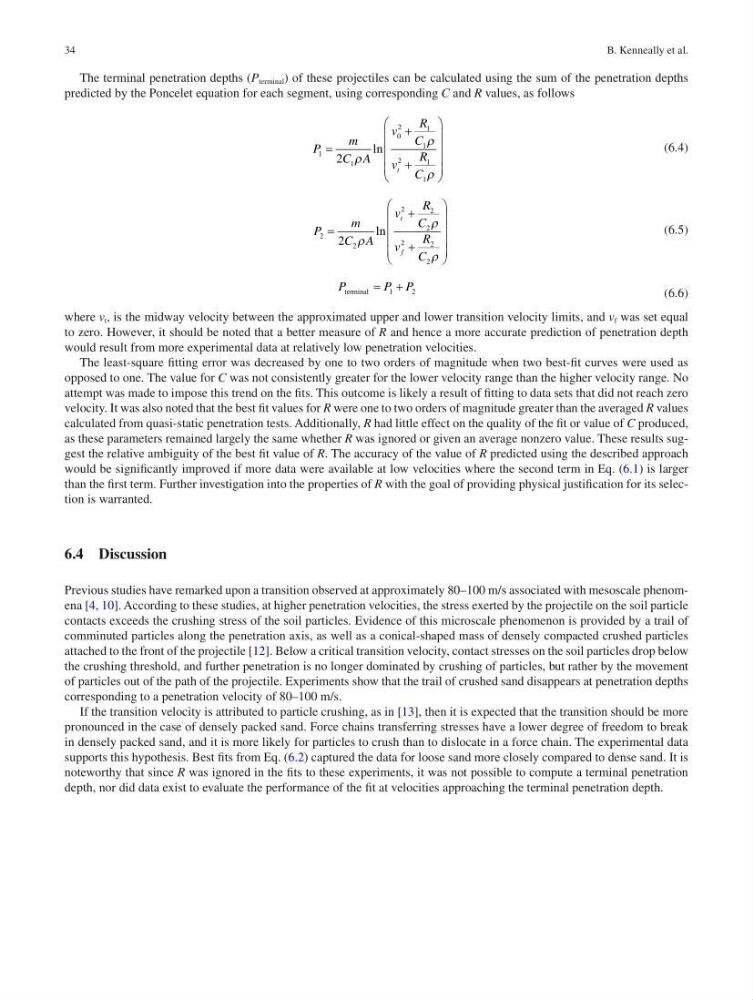
The terminal penetration depths (P terminal ) of these projectiles can be calculated using the sum of the penetration depths
predicted by the Poncelet equation for each segment, using corresponding C and R values, as follows
P
m
C A
v
R
C
v
R
C
t
1
1
0
2
1
1
2
1
1
2
=
+
+
æ
è
ç
ç
ç
ç
ö
ø
÷
÷
÷
÷
r
r
r
ln
(6.4)
P
m
C A
v
R
C
v
R
C
t
f
2
2
2
2
2
2
2
2
2
=
+
+
æ
è
ç
ç
ç
ç
ö
ø
÷
÷
÷
÷
r
r
r
ln
(6.5)
P
P P
terminal = +
1
2
(6.6)
where v t , is the midway velocity between the approximated upper and lower transition velocity limits, and v f was set equal
to zero. However, it should be noted that a better measure of R and hence a more accurate prediction of penetration depth
would result from more experimental data at relatively low penetration velocities.
The least-square fitting error was decreased by one to two orders of magnitude when two best-fit curves were used as
opposed to one. The value for C was not consistently greater for the lower velocity range than the higher velocity range. No
attempt was made to impose this trend on the fits. This outcome is likely a result of fitting to data sets that did not reach zero
velocity. It was also noted that the best fit values for R were one to two orders of magnitude greater than the averaged R values
calculated from quasi-static penetration tests. Additionally, R had little effect on the quality of the fit or value of C produced,
as these parameters remained largely the same whether R was ignored or given an average nonzero value. These results suggest the relative ambiguity of the best fit value of R. The accuracy of the value of R predicted using the described approach
would be significantly improved if more data were available at low velocities where the second term in Eq. (6.1) is larger
than the first term. Further investigation into the properties of R with the goal of providing physical justification for its selection is warranted.
6.4 Discussion
Previous studies have remarked upon a transition observed at approximately 80–100 m/s associated with mesoscale phenomena [4, 10]. According to these studies, at higher penetration velocities, the stress exerted by the projectile on the soil particle
contacts exceeds the crushing stress of the soil particles. Evidence of this microscale phenomenon is provided by a trail of
comminuted particles along the penetration axis, as well as a conical-shaped mass of densely compacted crushed particles
attached to the front of the projectile [12]. Below a critical transition velocity, contact stresses on the soil particles drop below
the crushing threshold, and further penetration is no longer dominated by crushing of particles, but rather by the movement
of particles out of the path of the projectile. Experiments show that the trail of crushed sand disappears at penetration depths
corresponding to a penetration velocity of 80–100 m/s.
If the transition velocity is attributed to particle crushing, as in [13], then it is expected that the transition should be more
pronounced in the case of densely packed sand. Force chains transferring stresses have a lower degree of freedom to break
in densely packed sand, and it is more likely for particles to crush than to dislocate in a force chain. The experimental data
supports this hypothesis. Best fits from Eq. (6.2) captured the data for loose sand more closely compared to dense sand. It is
noteworthy that since R was ignored in the fits to these experiments, it was not possible to compute a terminal penetration
depth, nor did data exist to evaluate the performance of the fit at velocities approaching the terminal penetration depth.
B. Kenneally et al.
The terminal penetration depths (P terminal ) of these projectiles can be calculated using the sum of the penetration depths
predicted by the Poncelet equation for each segment, using corresponding C and R values, as follows
P
m
C A
v
R
C
v
R
C
t
1
1
0
2
1
1
2
1
1
2
=
+
+
æ
è
ç
ç
ç
ç
ö
ø
÷
÷
÷
÷
r
r
r
ln
(6.4)
P
m
C A
v
R
C
v
R
C
t
f
2
2
2
2
2
2
2
2
2
=
+
+
æ
è
ç
ç
ç
ç
ö
ø
÷
÷
÷
÷
r
r
r
ln
(6.5)
P
P P
terminal = +
1
2
(6.6)
where v t , is the midway velocity between the approximated upper and lower transition velocity limits, and v f was set equal
to zero. However, it should be noted that a better measure of R and hence a more accurate prediction of penetration depth
would result from more experimental data at relatively low penetration velocities.
The least-square fitting error was decreased by one to two orders of magnitude when two best-fit curves were used as
opposed to one. The value for C was not consistently greater for the lower velocity range than the higher velocity range. No
attempt was made to impose this trend on the fits. This outcome is likely a result of fitting to data sets that did not reach zero
velocity. It was also noted that the best fit values for R were one to two orders of magnitude greater than the averaged R values
calculated from quasi-static penetration tests. Additionally, R had little effect on the quality of the fit or value of C produced,
as these parameters remained largely the same whether R was ignored or given an average nonzero value. These results suggest the relative ambiguity of the best fit value of R. The accuracy of the value of R predicted using the described approach
would be significantly improved if more data were available at low velocities where the second term in Eq. (6.1) is larger
than the first term. Further investigation into the properties of R with the goal of providing physical justification for its selection is warranted.
6.4 Discussion
Previous studies have remarked upon a transition observed at approximately 80–100 m/s associated with mesoscale phenomena [4, 10]. According to these studies, at higher penetration velocities, the stress exerted by the projectile on the soil particle
contacts exceeds the crushing stress of the soil particles. Evidence of this microscale phenomenon is provided by a trail of
comminuted particles along the penetration axis, as well as a conical-shaped mass of densely compacted crushed particles
attached to the front of the projectile [12]. Below a critical transition velocity, contact stresses on the soil particles drop below
the crushing threshold, and further penetration is no longer dominated by crushing of particles, but rather by the movement
of particles out of the path of the projectile. Experiments show that the trail of crushed sand disappears at penetration depths
corresponding to a penetration velocity of 80–100 m/s.
If the transition velocity is attributed to particle crushing, as in [13], then it is expected that the transition should be more
pronounced in the case of densely packed sand. Force chains transferring stresses have a lower degree of freedom to break
in densely packed sand, and it is more likely for particles to crush than to dislocate in a force chain. The experimental data
supports this hypothesis. Best fits from Eq. (6.2) captured the data for loose sand more closely compared to dense sand. It is
noteworthy that since R was ignored in the fits to these experiments, it was not possible to compute a terminal penetration
depth, nor did data exist to evaluate the performance of the fit at velocities approaching the terminal penetration depth.
B. Kenneally et al.