

19
0.00
0.05
0.10
0.15
0.20
-2000
0
2000
4000
6000
8000
1340
762
)
a
P
M
(
e
t
a
R
g
n
i
n
e
d
r
a
H
n
i
a
r
t
S
Plastic Strain
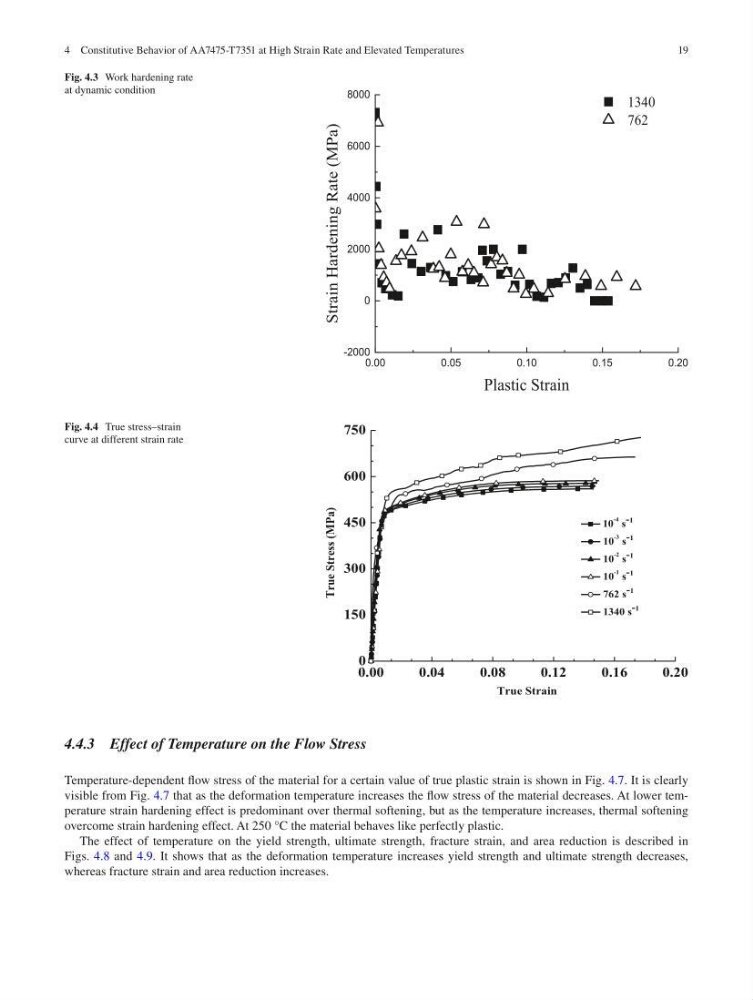
Fig. 4.3 Work hardening rate
at dynamic condition
0.00
0.04
0.08
0.12
0.16
0.20
0
150
300
450
600
750
)
a
P
M
(
s
s
e
r
t
S
e
u
r
T
True Strain
10
-4 s -1
10
-3 s -1
10
-2 s -1
10
-1 s -1
762 s -1
1340 s -1
Fig. 4.4 True stress–strain
curve at different strain rate
4.4.3 Effect of Temperature on the Flow Stress
Temperature-dependent flow stress of the material for a certain value of true plastic strain is shown in Fig. 4.7. It is clearly
visible from Fig. 4.7 that as the deformation temperature increases the flow stress of the material decreases. At lower temperature strain hardening effect is predominant over thermal softening, but as the temperature increases, thermal softening
overcome strain hardening effect. At 250 °C the material behaves like perfectly plastic.
The effect of temperature on the yield strength, ultimate strength, fracture strain, and area reduction is described in
Figs. 4.8 and 4.9. It shows that as the deformation temperature increases yield strength and ultimate strength decreases,
whereas fracture strain and area reduction increases.
4 Constitutive Behavior of AA7475-T7351 at High Strain Rate and Elevated Temperatures
0.00
0.05
0.10
0.15
0.20
-2000
0
2000
4000
6000
8000
1340
762
)
a
P
M
(
e
t
a
R
g
n
i
n
e
d
r
a
H
n
i
a
r
t
S
Plastic Strain
Fig. 4.3 Work hardening rate
at dynamic condition
0.00
0.04
0.08
0.12
0.16
0.20
0
150
300
450
600
750
)
a
P
M
(
s
s
e
r
t
S
e
u
r
T
True Strain
10
-4 s -1
10
-3 s -1
10
-2 s -1
10
-1 s -1
762 s -1
1340 s -1
Fig. 4.4 True stress–strain
curve at different strain rate
4.4.3 Effect of Temperature on the Flow Stress
Temperature-dependent flow stress of the material for a certain value of true plastic strain is shown in Fig. 4.7. It is clearly
visible from Fig. 4.7 that as the deformation temperature increases the flow stress of the material decreases. At lower temperature strain hardening effect is predominant over thermal softening, but as the temperature increases, thermal softening
overcome strain hardening effect. At 250 °C the material behaves like perfectly plastic.
The effect of temperature on the yield strength, ultimate strength, fracture strain, and area reduction is described in
Figs. 4.8 and 4.9. It shows that as the deformation temperature increases yield strength and ultimate strength decreases,
whereas fracture strain and area reduction increases.
4 Constitutive Behavior of AA7475-T7351 at High Strain Rate and Elevated Temperatures