

16
into three categories (1) phenomenological model, (2) artificial neural network models, and (3) physics-based models. Due
to the convenience of lesser material constant Johnson- Cook [12] model is widely used to predict the stress-strain response
of material at dynamic condition.
The first objective of this experimental investigation is to quantify the effect of the strain rate and the temperature on
mechanical properties (yield, ultimate and flow tensile stresses) of AA7475-T7351. Secondly, to evaluate the parameter for
Johnson-Cook constitutive material parameter form the experimentally obtained stress-strain data at different strain rate and
temperature. Deviation of model predictions from experimental results is also estimated through error calculation. The structure of this chapter is given as follows. In Sect. 4.2, chemical composition of the material is reported. In Sect. 4.3, the experimental procedure is explained. Experimental results are demonstrated in Sect. 4.4. In Sect. 4.5, material parameters of
Johnson-Cook constitutive modeling are evaluated. The effectiveness of this model is checked through error analysis in
Sect. 4.6.
4.2 Material
The 7475-aluminum alloy used in the present study was procured from Falcon Aerospace (USA) in the form of rolled plate
of 12.75 mm thick and as T7351 temper condition. This is basically Al-Zn-Mg-based alloy, with high yield, high fracture
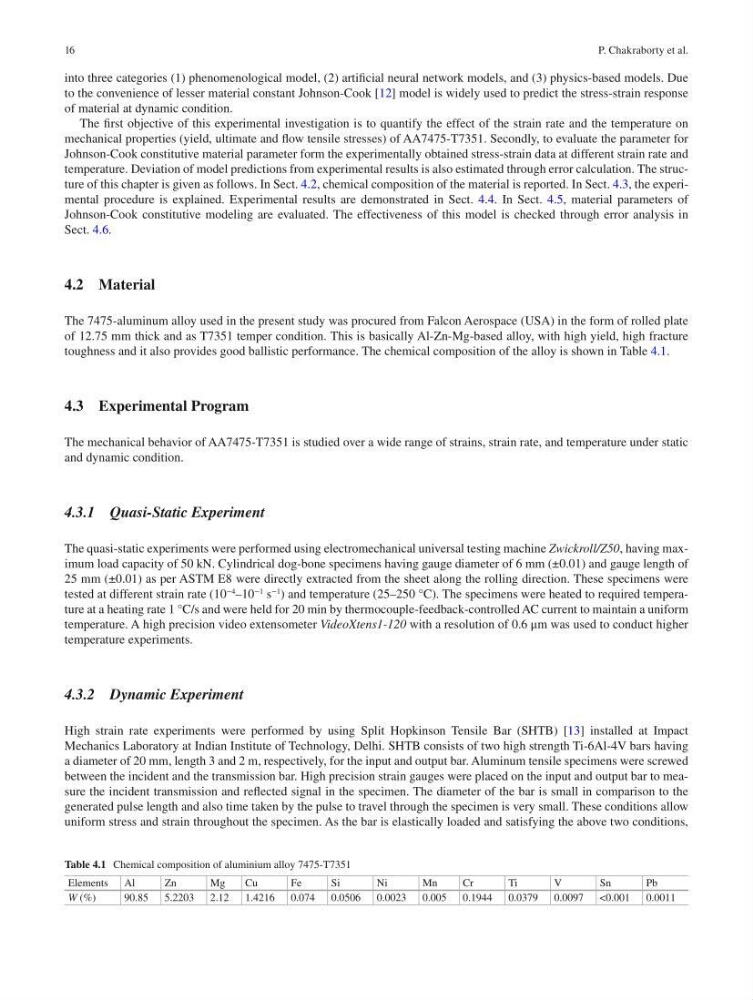
toughness and it also provides good ballistic performance. The chemical composition of the alloy is shown in Table 4.1.
4.3 Experimental Program
The mechanical behavior of AA7475-T7351 is studied over a wide range of strains, strain rate, and temperature under static
and dynamic condition.
4.3.1 Quasi-Static Experiment
The quasi-static experiments were performed using electromechanical universal testing machine Zwickroll/Z50, having maximum load capacity of 50 kN. Cylindrical dog-bone specimens having gauge diameter of 6 mm (±0.01) and gauge length of
25 mm (±0.01) as per ASTM E8 were directly extracted from the sheet along the rolling direction. These specimens were
tested at different strain rate (10
−4
–10
−1
s
−1
) and temperature (25–250 °C). The specimens were heated to required temperature at a heating rate 1 °C/s and were held for 20 min by thermocouple-feedback-controlled AC current to maintain a uniform
temperature. A high precision video extensometer VideoXtens1-120 with a resolution of 0.6 μm was used to conduct higher
temperature experiments.
4.3.2 Dynamic Experiment
High strain rate experiments were performed by using Split Hopkinson Tensile Bar (SHTB) [13] installed at Impact
Mechanics Laboratory at Indian Institute of Technology, Delhi. SHTB consists of two high strength Ti-6Al-4V bars having
a diameter of 20 mm, length 3 and 2 m, respectively, for the input and output bar. Aluminum tensile specimens were screwed
between the incident and the transmission bar. High precision strain gauges were placed on the input and output bar to measure the incident transmission and reflected signal in the specimen. The diameter of the bar is small in comparison to the
generated pulse length and also time taken by the pulse to travel through the specimen is very small. These conditions allow
uniform stress and strain throughout the specimen. As the bar is elastically loaded and satisfying the above two conditions,
Table 4.1 Chemical composition of aluminium alloy 7475-T7351
Elements Al
Zn
Mg
Cu
Fe
Si
Ni
Mn
Cr
Ti
V
Sn
Pb
W (%)
90.85 5.2203 2.12 1.4216 0.074 0.0506 0.0023 0.005 0.1944 0.0379 0.0097 <0.001 0.0011
P. Chakraborty et al.
into three categories (1) phenomenological model, (2) artificial neural network models, and (3) physics-based models. Due
to the convenience of lesser material constant Johnson- Cook [12] model is widely used to predict the stress-strain response
of material at dynamic condition.
The first objective of this experimental investigation is to quantify the effect of the strain rate and the temperature on
mechanical properties (yield, ultimate and flow tensile stresses) of AA7475-T7351. Secondly, to evaluate the parameter for
Johnson-Cook constitutive material parameter form the experimentally obtained stress-strain data at different strain rate and
temperature. Deviation of model predictions from experimental results is also estimated through error calculation. The structure of this chapter is given as follows. In Sect. 4.2, chemical composition of the material is reported. In Sect. 4.3, the experimental procedure is explained. Experimental results are demonstrated in Sect. 4.4. In Sect. 4.5, material parameters of
Johnson-Cook constitutive modeling are evaluated. The effectiveness of this model is checked through error analysis in
Sect. 4.6.
4.2 Material
The 7475-aluminum alloy used in the present study was procured from Falcon Aerospace (USA) in the form of rolled plate
of 12.75 mm thick and as T7351 temper condition. This is basically Al-Zn-Mg-based alloy, with high yield, high fracture
toughness and it also provides good ballistic performance. The chemical composition of the alloy is shown in Table 4.1.
4.3 Experimental Program
The mechanical behavior of AA7475-T7351 is studied over a wide range of strains, strain rate, and temperature under static
and dynamic condition.
4.3.1 Quasi-Static Experiment
The quasi-static experiments were performed using electromechanical universal testing machine Zwickroll/Z50, having maximum load capacity of 50 kN. Cylindrical dog-bone specimens having gauge diameter of 6 mm (±0.01) and gauge length of
25 mm (±0.01) as per ASTM E8 were directly extracted from the sheet along the rolling direction. These specimens were
tested at different strain rate (10
−4
–10
−1
s
−1
) and temperature (25–250 °C). The specimens were heated to required temperature at a heating rate 1 °C/s and were held for 20 min by thermocouple-feedback-controlled AC current to maintain a uniform
temperature. A high precision video extensometer VideoXtens1-120 with a resolution of 0.6 μm was used to conduct higher
temperature experiments.
4.3.2 Dynamic Experiment
High strain rate experiments were performed by using Split Hopkinson Tensile Bar (SHTB) [13] installed at Impact
Mechanics Laboratory at Indian Institute of Technology, Delhi. SHTB consists of two high strength Ti-6Al-4V bars having
a diameter of 20 mm, length 3 and 2 m, respectively, for the input and output bar. Aluminum tensile specimens were screwed
between the incident and the transmission bar. High precision strain gauges were placed on the input and output bar to measure the incident transmission and reflected signal in the specimen. The diameter of the bar is small in comparison to the
generated pulse length and also time taken by the pulse to travel through the specimen is very small. These conditions allow
uniform stress and strain throughout the specimen. As the bar is elastically loaded and satisfying the above two conditions,
Table 4.1 Chemical composition of aluminium alloy 7475-T7351
Elements Al
Zn
Mg
Cu
Fe
Si
Ni
Mn
Cr
Ti
V
Sn
Pb
W (%)
90.85 5.2203 2.12 1.4216 0.074 0.0506 0.0023 0.005 0.1944 0.0379 0.0097 <0.001 0.0011
P. Chakraborty et al.