

40
3 Geometrically Nonlinear Theories
g
i
=
1
V
e
i jk g j × g k ,
(3.2)
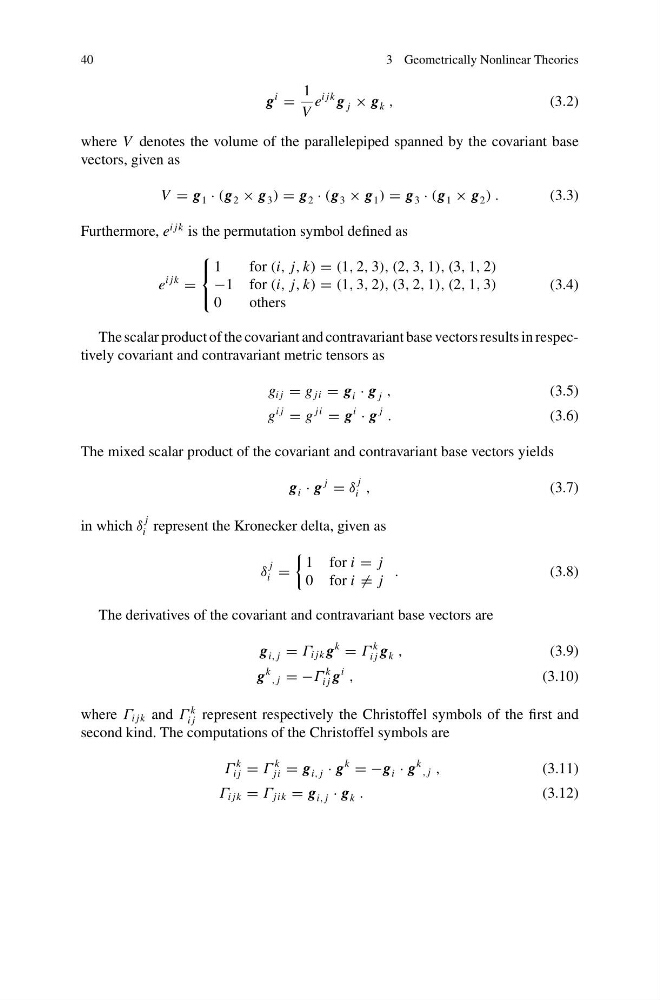
where V denotes the volume of the parallelepiped spanned by the covariant base
vectors, given as
V = g 1 · (g 2 × g 3 ) = g 2 · (g 3 × g 1 ) = g 3 · (g 1 × g 2 ) .
(3.3)
Furthermore, e
i jk is the permutation symbol defined as
e
i jk
=
⎧
⎨
⎩
1
for(i, j, k) = (1, 2, 3), (2, 3, 1), (3, 1, 2)
−1 for (i, j, k) = (1, 3, 2), (3, 2, 1), (2, 1, 3)
0
others
(3.4)
The scalar product of the covariant and contravariant base vectors results in respectively covariant and contravariant metric tensors as
g i j = g ji = g i · g j ,
(3.5)
g
i j
= g
ji
= g
i
· g
j
.
(3.6)
The mixed scalar product of the covariant and contravariant base vectors yields
g i · g
j
= δ
j
i ,
(3.7)
in which δ
j
i represent the Kronecker delta, given as
δ
j
i =
1 for i = j
0 for i = j
.
(3.8)
The derivatives of the covariant and contravariant base vectors are
g i, j = Γ i jk g
k
= Γ
k
i j g k ,
(3.9)
g
k , j = −Γ
k
i j g
i
,
(3.10)
where Γ i jk and Γ
k
i j represent respectively the Christoffel symbols of the first and
second kind. The computations of the Christoffel symbols are
Γ
k
i j = Γ
k
ji = g i, j · g
k
= −g i · g
k , j ,
(3.11)
Γ i jk = Γ jik = g i, j · g k .
(3.12)
3 Geometrically Nonlinear Theories
g
i
=
1
V
e
i jk g j × g k ,
(3.2)
where V denotes the volume of the parallelepiped spanned by the covariant base
vectors, given as
V = g 1 · (g 2 × g 3 ) = g 2 · (g 3 × g 1 ) = g 3 · (g 1 × g 2 ) .
(3.3)
Furthermore, e
i jk is the permutation symbol defined as
e
i jk
=
⎧
⎨
⎩
1
for(i, j, k) = (1, 2, 3), (2, 3, 1), (3, 1, 2)
−1 for (i, j, k) = (1, 3, 2), (3, 2, 1), (2, 1, 3)
0
others
(3.4)
The scalar product of the covariant and contravariant base vectors results in respectively covariant and contravariant metric tensors as
g i j = g ji = g i · g j ,
(3.5)
g
i j
= g
ji
= g
i
· g
j
.
(3.6)
The mixed scalar product of the covariant and contravariant base vectors yields
g i · g
j
= δ
j
i ,
(3.7)
in which δ
j
i represent the Kronecker delta, given as
δ
j
i =
1 for i = j
0 for i = j
.
(3.8)
The derivatives of the covariant and contravariant base vectors are
g i, j = Γ i jk g
k
= Γ
k
i j g k ,
(3.9)
g
k , j = −Γ
k
i j g
i
,
(3.10)
where Γ i jk and Γ
k
i j represent respectively the Christoffel symbols of the first and
second kind. The computations of the Christoffel symbols are
Γ
k
i j = Γ
k
ji = g i, j · g
k
= −g i · g
k , j ,
(3.11)
Γ i jk = Γ jik = g i, j · g k .
(3.12)