

92
5 Finite Element Formulations
Adding the damping coefficient matrix yields the equation of motion with considering the damping effects as
1 M uu
2
0 ¨
q +
1 C uu
2
0 ˙
q +
1 K uu q +
1 K uφ φ a = F ue −
1 F ui ,
(5.76)
where
2
0 ˙
q represents the velocity of the nodal DOF vector in the virtual configuration.
5.6.2 Static FE Model
By applying the FE method and the principle of virtual work, an electro-mechanically
coupled static FE model including an equilibrium equation and a sensor equation for
smart structures can be obtained as
1 ¯
K uu q +
1 K uφ φ a = F ue −
1 F ui ,
(5.77)
1 K φu q +
1 K φφ φ s = G φe −
1 G φi .
(5.78)
Here, the coefficient matrices have the same meanings as those given in Sect. 5.6.1.
5.7 Geometrically and Electroelastic Nonlinear FE Model
Geometrically nonlinear phenomenon should be considered when smart structures
undergo large displacements and rotations. At the meantime, electroelastic materially nonlinear effect should be included in the model when structures under strong
electric field. Including both geometrically nonlinear and materially nonlinear phenomena, electroelastic nonlinear constitutive equations given in Eq. (4.48) and GreenLagrange nonlinear strains given in Eqs. (3.83)–(3.88) have to be employed in the
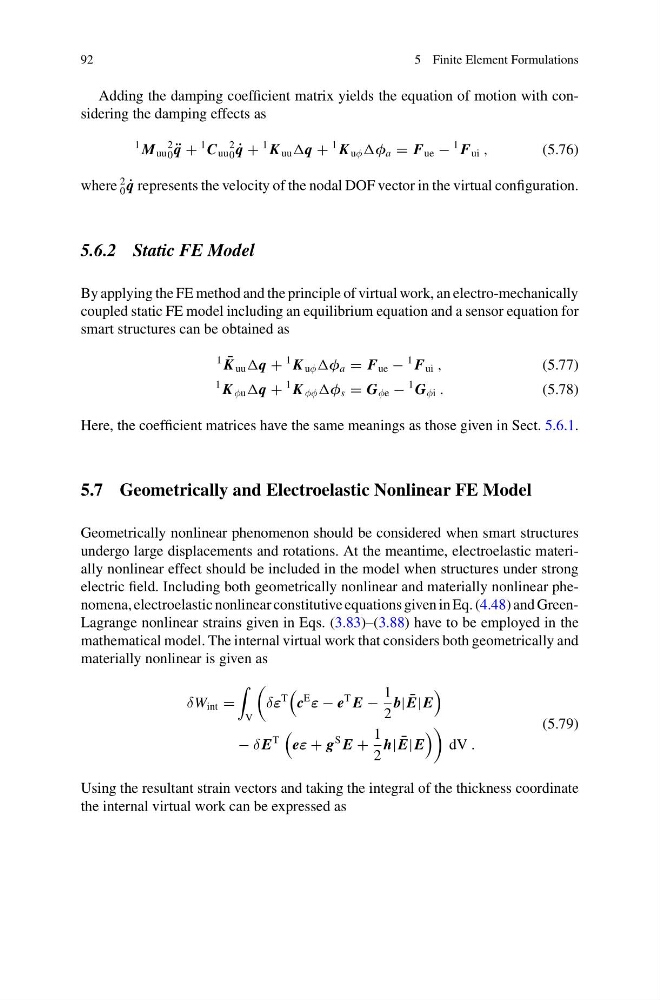
mathematical model. The internal virtual work that considers both geometrically and
materially nonlinear is given as
δW int =
V
δε
T
c
E
ε − e
T E −
1
2
b| ¯
E|E
− δ E
T
eε + g
S E +
1
2
h| ¯
E|E
dV .
(5.79)
Using the resultant strain vectors and taking the integral of the thickness coordinate
the internal virtual work can be expressed as
5 Finite Element Formulations
Adding the damping coefficient matrix yields the equation of motion with considering the damping effects as
1 M uu
2
0 ¨
q +
1 C uu
2
0 ˙
q +
1 K uu q +
1 K uφ φ a = F ue −
1 F ui ,
(5.76)
where
2
0 ˙
q represents the velocity of the nodal DOF vector in the virtual configuration.
5.6.2 Static FE Model
By applying the FE method and the principle of virtual work, an electro-mechanically
coupled static FE model including an equilibrium equation and a sensor equation for
smart structures can be obtained as
1 ¯
K uu q +
1 K uφ φ a = F ue −
1 F ui ,
(5.77)
1 K φu q +
1 K φφ φ s = G φe −
1 G φi .
(5.78)
Here, the coefficient matrices have the same meanings as those given in Sect. 5.6.1.
5.7 Geometrically and Electroelastic Nonlinear FE Model
Geometrically nonlinear phenomenon should be considered when smart structures
undergo large displacements and rotations. At the meantime, electroelastic materially nonlinear effect should be included in the model when structures under strong
electric field. Including both geometrically nonlinear and materially nonlinear phenomena, electroelastic nonlinear constitutive equations given in Eq. (4.48) and GreenLagrange nonlinear strains given in Eqs. (3.83)–(3.88) have to be employed in the
mathematical model. The internal virtual work that considers both geometrically and
materially nonlinear is given as
δW int =
V
δε
T
c
E
ε − e
T E −
1
2
b| ¯
E|E
− δ E
T
eε + g
S E +
1
2
h| ¯
E|E
dV .
(5.79)
Using the resultant strain vectors and taking the integral of the thickness coordinate
the internal virtual work can be expressed as