

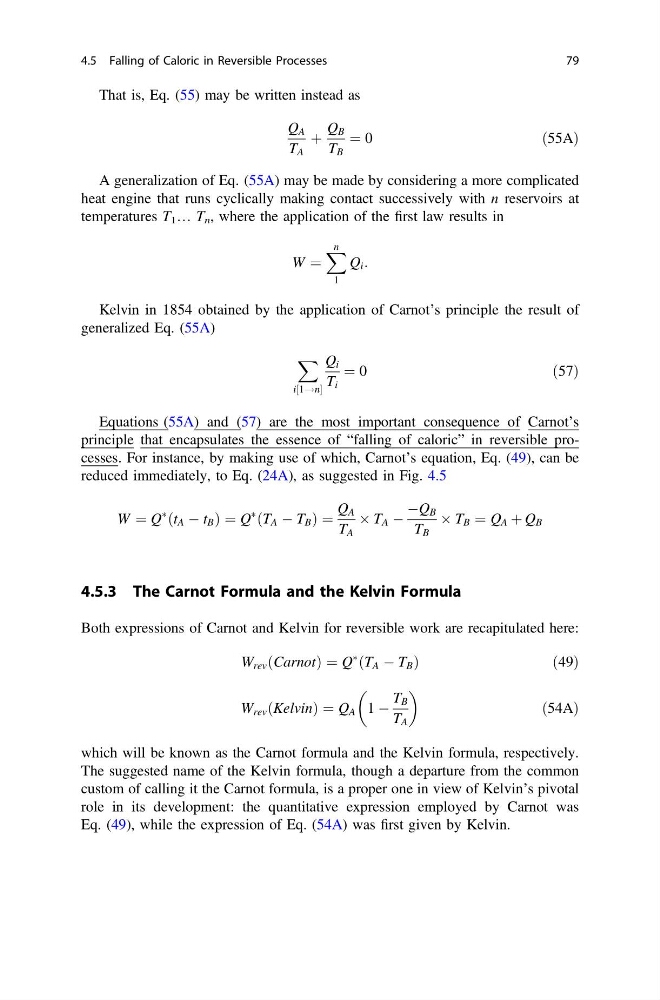
That is, Eq. (55) may be written instead as
Q A
T A
þ
Q B
T B
¼ 0
ð55AÞ
A generalization of Eq. (55A) may be made by considering a more complicated
heat engine that runs cyclically making contact successively with n reservoirs at
temperatures T 1 … T n , where the application of the first law results in
W ¼
X n
1
Q i :
Kelvin in 1854 obtained by the application of Carnot’s principle the result of
generalized Eq. (55A)
X
i 1!n
½
Q i
T i
¼ 0
ð57Þ
Equations (55A) and (57) are the most important consequence of Carnot’s
principle that encapsulates the essence of “falling of caloric” in reversible processes. For instance, by making use of which, Carnot’s equation, Eq. (49), can be
reduced immediately, to Eq. (24A), as suggested in Fig. 4.5
W ¼ Q
à t A À t B
ð
Þ¼Q
à T A À T B
ð
Þ¼
Q A
T A
 T A ÀQ B
T B
 T B ¼ Q A þ Q B
4.5.3 The Carnot Formula and the Kelvin Formula
Both expressions of Carnot and Kelvin for reversible work are recapitulated here:
W rev Carnot
ð
Þ¼Q
à T A À T B
ð
Þ
ð 49Þ
W rev Kelvin
ð
Þ¼Q A 1 À
T B
T A
ð54AÞ
which will be known as the Carnot formula and the Kelvin formula, respectively.
The suggested name of the Kelvin formula, though a departure from the common
custom of calling it the Carnot formula, is a proper one in view of Kelvin’s pivotal
role in its development: the quantitative expression employed by Carnot was
Eq. (49), while the expression of Eq. (54A) was first given by Kelvin.
4.5 Falling of Caloric in Reversible Processes
79
Q A
T A
þ
Q B
T B
¼ 0
ð55AÞ
A generalization of Eq. (55A) may be made by considering a more complicated
heat engine that runs cyclically making contact successively with n reservoirs at
temperatures T 1 … T n , where the application of the first law results in
W ¼
X n
1
Q i :
Kelvin in 1854 obtained by the application of Carnot’s principle the result of
generalized Eq. (55A)
X
i 1!n
½
Q i
T i
¼ 0
ð57Þ
Equations (55A) and (57) are the most important consequence of Carnot’s
principle that encapsulates the essence of “falling of caloric” in reversible processes. For instance, by making use of which, Carnot’s equation, Eq. (49), can be
reduced immediately, to Eq. (24A), as suggested in Fig. 4.5
W ¼ Q
à t A À t B
ð
Þ¼Q
à T A À T B
ð
Þ¼
Q A
T A
 T A ÀQ B
T B
 T B ¼ Q A þ Q B
4.5.3 The Carnot Formula and the Kelvin Formula
Both expressions of Carnot and Kelvin for reversible work are recapitulated here:
W rev Carnot
ð
Þ¼Q
à T A À T B
ð
Þ
ð 49Þ
W rev Kelvin
ð
Þ¼Q A 1 À
T B
T A
ð54AÞ
which will be known as the Carnot formula and the Kelvin formula, respectively.
The suggested name of the Kelvin formula, though a departure from the common
custom of calling it the Carnot formula, is a proper one in view of Kelvin’s pivotal
role in its development: the quantitative expression employed by Carnot was
Eq. (49), while the expression of Eq. (54A) was first given by Kelvin.
4.5 Falling of Caloric in Reversible Processes
79