

or
Q A
T A
¼
Q B
T B
¼ Q
Ã
ð
Þ
ð55Þ
That is, in view of Eqs. (46) and (55), a choice can be made
h ¼ T
ð56Þ
The empirically defined ideal-gas thermometric temperature T in Chap. 1 is
shown to coincide with the theoretical constructed thermodynamic temperature h,
which is independent of the special properties of any particular thermometric
substance. The empirically measurable T is shown to rest on a theoretical basis
independent of thermometric assumptions.
Finally, Eq. (54) becomes in view of Eq. (56)
W ¼ Q A 1 À
T B
T A
ð54AÞ
4.5.2 Falling of Caloric
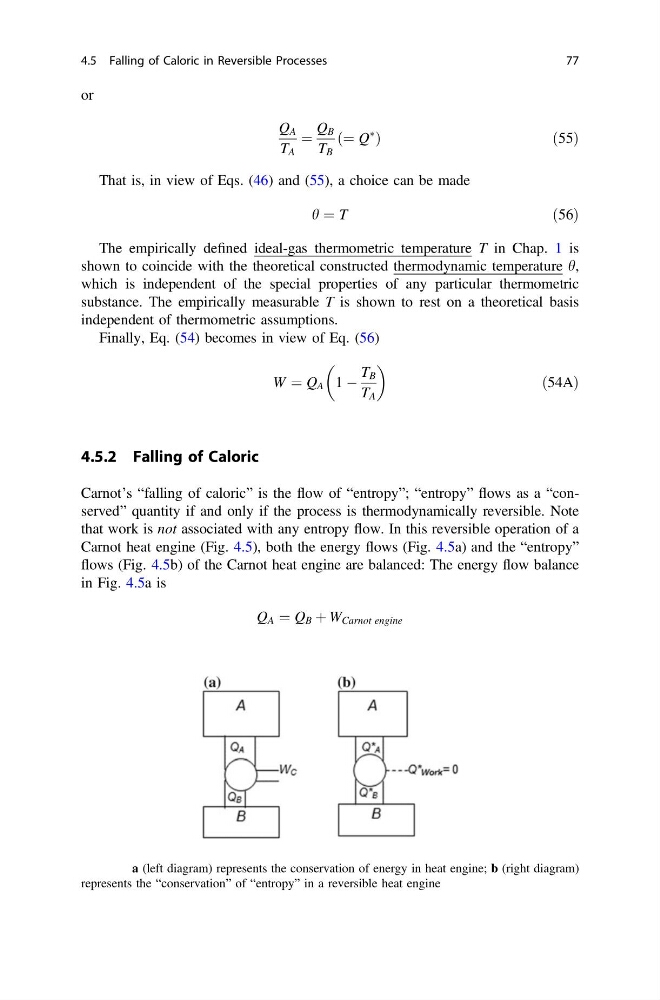
Carnot’s “falling of caloric” is the flow of “entropy”; “entropy” flows as a “conserved” quantity if and only if the process is thermodynamically reversible. Note
that work is not associated with any entropy flow. In this reversible operation of a
Carnot heat engine (Fig. 4.5), both the energy flows (Fig. 4.5a) and the “entropy”
flows (Fig. 4.5b) of the Carnot heat engine are balanced: The energy flow balance
in Fig. 4.5a is
Q A ¼ Q B þ W Carnot engine
Fig. 4.5 a (left diagram) represents the conservation of energy in heat engine; b (right diagram)
represents the “conservation” of “entropy” in a reversible heat engine
4.5 Falling of Caloric in Reversible Processes
77
Q A
T A
¼
Q B
T B
¼ Q
Ã
ð
Þ
ð55Þ
That is, in view of Eqs. (46) and (55), a choice can be made
h ¼ T
ð56Þ
The empirically defined ideal-gas thermometric temperature T in Chap. 1 is
shown to coincide with the theoretical constructed thermodynamic temperature h,
which is independent of the special properties of any particular thermometric
substance. The empirically measurable T is shown to rest on a theoretical basis
independent of thermometric assumptions.
Finally, Eq. (54) becomes in view of Eq. (56)
W ¼ Q A 1 À
T B
T A
ð54AÞ
4.5.2 Falling of Caloric
Carnot’s “falling of caloric” is the flow of “entropy”; “entropy” flows as a “conserved” quantity if and only if the process is thermodynamically reversible. Note
that work is not associated with any entropy flow. In this reversible operation of a
Carnot heat engine (Fig. 4.5), both the energy flows (Fig. 4.5a) and the “entropy”
flows (Fig. 4.5b) of the Carnot heat engine are balanced: The energy flow balance
in Fig. 4.5a is
Q A ¼ Q B þ W Carnot engine
Fig. 4.5 a (left diagram) represents the conservation of energy in heat engine; b (right diagram)
represents the “conservation” of “entropy” in a reversible heat engine
4.5 Falling of Caloric in Reversible Processes
77