

In the general case of system changes that may involve change in the kinetic
energy KE or the potential energy PE (see Footnote 3), we can express the first law
in terms of total internal energy, E ( U + KE + PE),
E f À E i ¼ Q i!f À W i!f
ð22AÞ
dE ¼ dQ À dW
ð23AÞ
This may be considered for the effect of heat and work on a system, which is
initially of negligible KE and PE with internal energy U i ,
Q i!f À W i!f ¼ E f U
0
f þ KE
0
þ PE
0
À U i ¼ U f À U i
ð22BÞ
That is, the system will go through a transitory state in which its kinetic and
potential energy will be transformed into internal energy ending with final internal
energy of U f ¼ E f .
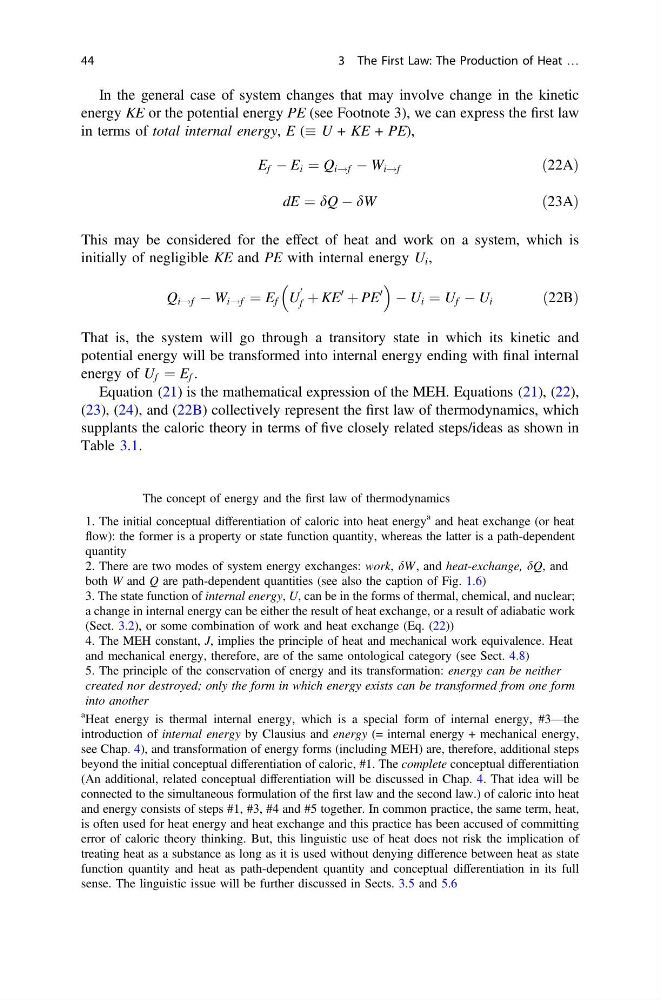
Equation (21) is the mathematical expression of the MEH. Equations (21), (22),
(23), (24), and (22B) collectively represent the first law of thermodynamics, which
supplants the caloric theory in terms of five closely related steps/ideas as shown in
Table 3.1.
Table 3.1 The concept of energy and the first law of thermodynamics
1. The initial conceptual differentiation of caloric into heat energy
a and heat exchange (or heat
flow): the former is a property or state function quantity, whereas the latter is a path-dependent
quantity
2. There are two modes of system energy exchanges: work, dW, and heat-exchange, dQ, and
both W and Q are path-dependent quantities (see also the caption of Fig. 1.6)
3. The state function of internal energy, U, can be in the forms of thermal, chemical, and nuclear;
a change in internal energy can be either the result of heat exchange, or a result of adiabatic work
(Sect. 3.2), or some combination of work and heat exchange (Eq. (22))
4. The MEH constant, J, implies the principle of heat and mechanical work equivalence. Heat
and mechanical energy, therefore, are of the same ontological category (see Sect. 4.8)
5. The principle of the conservation of energy and its transformation: energy can be neither
created nor destroyed; only the form in which energy exists can be transformed from one form
into another
a Heat energy is thermal internal energy, which is a special form of internal energy, #3—the
introduction of internal energy by Clausius and energy (= internal energy + mechanical energy,
see Chap. 4), and transformation of energy forms (including MEH) are, therefore, additional steps
beyond the initial conceptual differentiation of caloric, #1. The complete conceptual differentiation
(An additional, related conceptual differentiation will be discussed in Chap. 4. That idea will be
connected to the simultaneous formulation of the first law and the second law.) of caloric into heat
and energy consists of steps #1, #3, #4 and #5 together. In common practice, the same term, heat,
is often used for heat energy and heat exchange and this practice has been accused of committing
error of caloric theory thinking. But, this linguistic use of heat does not risk the implication of
treating heat as a substance as long as it is used without denying difference between heat as state
function quantity and heat as path-dependent quantity and conceptual differentiation in its full
sense. The linguistic issue will be further discussed in Sects. 3.5 and 5.6
44
3 The First Law: The Production of Heat …
energy KE or the potential energy PE (see Footnote 3), we can express the first law
in terms of total internal energy, E ( U + KE + PE),
E f À E i ¼ Q i!f À W i!f
ð22AÞ
dE ¼ dQ À dW
ð23AÞ
This may be considered for the effect of heat and work on a system, which is
initially of negligible KE and PE with internal energy U i ,
Q i!f À W i!f ¼ E f U
0
f þ KE
0
þ PE
0
À U i ¼ U f À U i
ð22BÞ
That is, the system will go through a transitory state in which its kinetic and
potential energy will be transformed into internal energy ending with final internal
energy of U f ¼ E f .
Equation (21) is the mathematical expression of the MEH. Equations (21), (22),
(23), (24), and (22B) collectively represent the first law of thermodynamics, which
supplants the caloric theory in terms of five closely related steps/ideas as shown in
Table 3.1.
Table 3.1 The concept of energy and the first law of thermodynamics
1. The initial conceptual differentiation of caloric into heat energy
a and heat exchange (or heat
flow): the former is a property or state function quantity, whereas the latter is a path-dependent
quantity
2. There are two modes of system energy exchanges: work, dW, and heat-exchange, dQ, and
both W and Q are path-dependent quantities (see also the caption of Fig. 1.6)
3. The state function of internal energy, U, can be in the forms of thermal, chemical, and nuclear;
a change in internal energy can be either the result of heat exchange, or a result of adiabatic work
(Sect. 3.2), or some combination of work and heat exchange (Eq. (22))
4. The MEH constant, J, implies the principle of heat and mechanical work equivalence. Heat
and mechanical energy, therefore, are of the same ontological category (see Sect. 4.8)
5. The principle of the conservation of energy and its transformation: energy can be neither
created nor destroyed; only the form in which energy exists can be transformed from one form
into another
a Heat energy is thermal internal energy, which is a special form of internal energy, #3—the
introduction of internal energy by Clausius and energy (= internal energy + mechanical energy,
see Chap. 4), and transformation of energy forms (including MEH) are, therefore, additional steps
beyond the initial conceptual differentiation of caloric, #1. The complete conceptual differentiation
(An additional, related conceptual differentiation will be discussed in Chap. 4. That idea will be
connected to the simultaneous formulation of the first law and the second law.) of caloric into heat
and energy consists of steps #1, #3, #4 and #5 together. In common practice, the same term, heat,
is often used for heat energy and heat exchange and this practice has been accused of committing
error of caloric theory thinking. But, this linguistic use of heat does not risk the implication of
treating heat as a substance as long as it is used without denying difference between heat as state
function quantity and heat as path-dependent quantity and conceptual differentiation in its full
sense. The linguistic issue will be further discussed in Sects. 3.5 and 5.6
44
3 The First Law: The Production of Heat …