

universal constant and thus provided the proof that the supposition is true: the
supposition of the conservation of energy became the principle of the conservation
of energy.
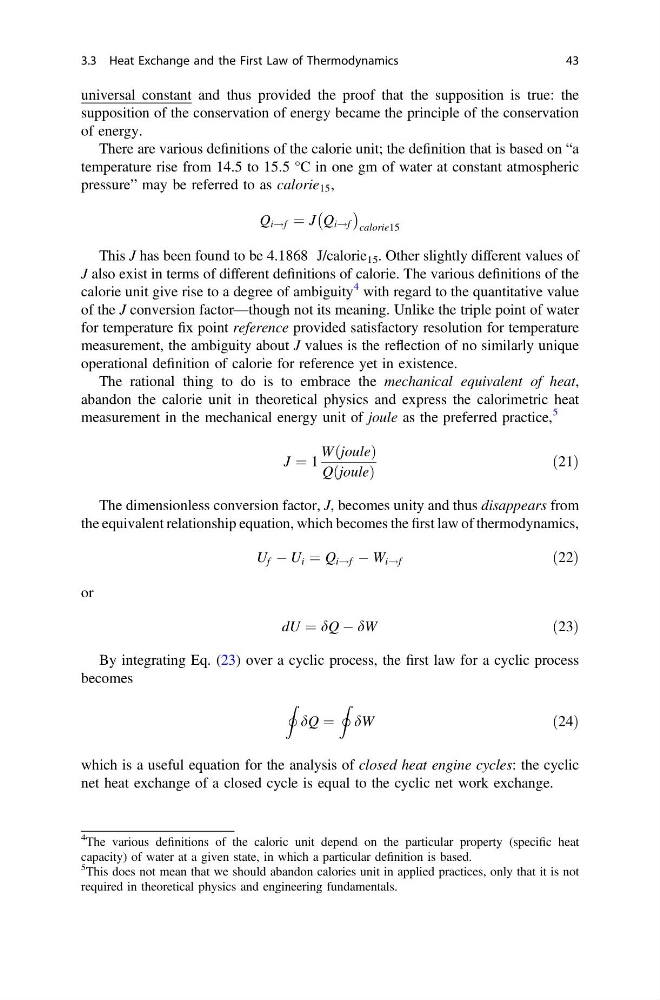
There are various definitions of the calorie unit; the definition that is based on “a
temperature rise from 14.5 to 15.5 °C in one gm of water at constant atmospheric
pressure” may be referred to as calorie 15 ,
Q i!f ¼ J Q i!f
À
Á
calorie15
This J has been found to be 4.1868 J/calorie 15 . Other slightly different values of
J also exist in terms of different definitions of calorie. The various definitions of the
calorie unit give rise to a degree of ambiguity
4 with regard to the quantitative value
of the J conversion factor—though not its meaning. Unlike the triple point of water
for temperature fix point reference provided satisfactory resolution for temperature
measurement, the ambiguity about J values is the reflection of no similarly unique
operational definition of calorie for reference yet in existence.
The rational thing to do is to embrace the mechanical equivalent of heat,
abandon the calorie unit in theoretical physics and express the calorimetric heat
measurement in the mechanical energy unit of joule as the preferred practice,
5
J ¼ 1
WðjouleÞ
QðjouleÞ
ð21Þ
The dimensionless conversion factor, J, becomes unity and thus disappears from
the equivalent relationship equation, which becomes the first law of thermodynamics,
U f À U i ¼ Q i!f À W i!f
ð22Þ
or
dU ¼ dQ À dW
ð23Þ
By integrating Eq. (23) over a cyclic process, the first law for a cyclic process
becomes
I
dQ ¼
I
dW
ð24Þ
which is a useful equation for the analysis of closed heat engine cycles: the cyclic
net heat exchange of a closed cycle is equal to the cyclic net work exchange.
4
The various definitions of the caloric unit depend on the particular property (specific heat
capacity) of water at a given state, in which a particular definition is based.
5
This does not mean that we should abandon calories unit in applied practices, only that it is not
required in theoretical physics and engineering fundamentals.
3.3 Heat Exchange and the First Law of Thermodynamics
43
supposition of the conservation of energy became the principle of the conservation
of energy.
There are various definitions of the calorie unit; the definition that is based on “a
temperature rise from 14.5 to 15.5 °C in one gm of water at constant atmospheric
pressure” may be referred to as calorie 15 ,
Q i!f ¼ J Q i!f
À
Á
calorie15
This J has been found to be 4.1868 J/calorie 15 . Other slightly different values of
J also exist in terms of different definitions of calorie. The various definitions of the
calorie unit give rise to a degree of ambiguity
4 with regard to the quantitative value
of the J conversion factor—though not its meaning. Unlike the triple point of water
for temperature fix point reference provided satisfactory resolution for temperature
measurement, the ambiguity about J values is the reflection of no similarly unique
operational definition of calorie for reference yet in existence.
The rational thing to do is to embrace the mechanical equivalent of heat,
abandon the calorie unit in theoretical physics and express the calorimetric heat
measurement in the mechanical energy unit of joule as the preferred practice,
5
J ¼ 1
WðjouleÞ
QðjouleÞ
ð21Þ
The dimensionless conversion factor, J, becomes unity and thus disappears from
the equivalent relationship equation, which becomes the first law of thermodynamics,
U f À U i ¼ Q i!f À W i!f
ð22Þ
or
dU ¼ dQ À dW
ð23Þ
By integrating Eq. (23) over a cyclic process, the first law for a cyclic process
becomes
I
dQ ¼
I
dW
ð24Þ
which is a useful equation for the analysis of closed heat engine cycles: the cyclic
net heat exchange of a closed cycle is equal to the cyclic net work exchange.
4
The various definitions of the caloric unit depend on the particular property (specific heat
capacity) of water at a given state, in which a particular definition is based.
5
This does not mean that we should abandon calories unit in applied practices, only that it is not
required in theoretical physics and engineering fundamentals.
3.3 Heat Exchange and the First Law of Thermodynamics
43