

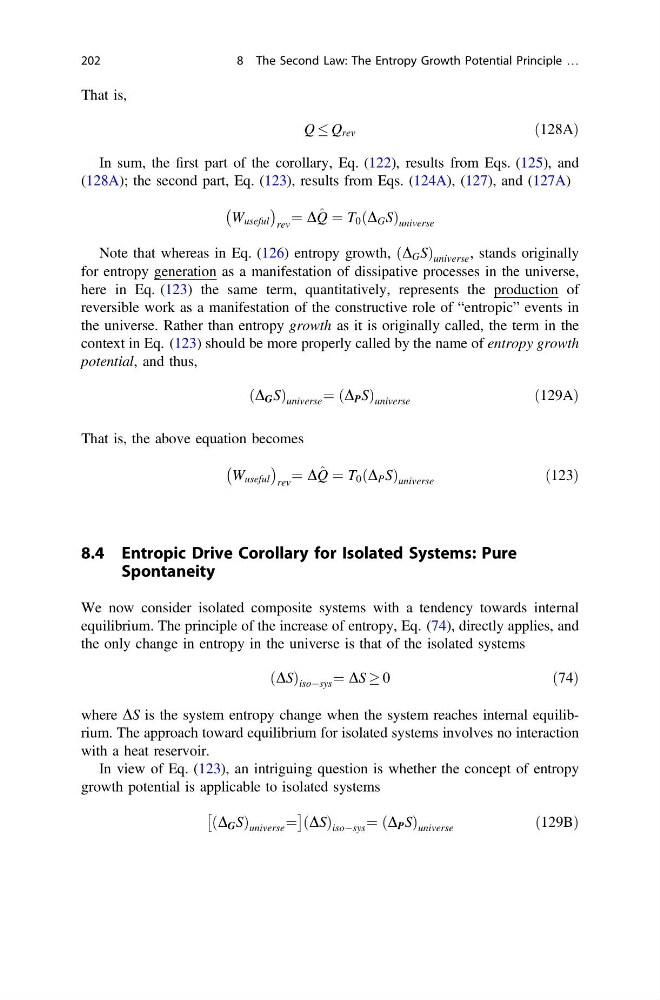
That is,
Q Q rev
ð128AÞ
In sum, the first part of the corollary, Eq. (122), results from Eqs. (125), and
(128A); the second part, Eq. (123), results from Eqs. (124A), (127), and (127A)
W useful
À
Á
rev
¼ D ^
Q ¼ T 0 D G S
ð
Þ universe
Note that whereas in Eq. (126) entropy growth, D G S
ð
Þ universe , stands originally
for entropy generation as a manifestation of dissipative processes in the universe,
here in Eq. (123) the same term, quantitatively, represents the production of
reversible work as a manifestation of the constructive role of “entropic” events in
the universe. Rather than entropy growth as it is originally called, the term in the
context in Eq. (123) should be more properly called by the name of entropy growth
potential, and thus,
D G S
ð
Þ universe ¼ D P S
ð
Þ universe
ð129AÞ
That is, the above equation becomes
W useful
À
Á
rev
¼ D ^
Q ¼ T 0 D P S
ð
Þ universe
ð123Þ
8.4 Entropic Drive Corollary for Isolated Systems: Pure
Spontaneity
We now consider isolated composite systems with a tendency towards internal
equilibrium. The principle of the increase of entropy, Eq. (74), directly applies, and
the only change in entropy in the universe is that of the isolated systems
DS
ð Þ isoÀsys ¼ DS ! 0
ð74Þ
where DS is the system entropy change when the system reaches internal equilibrium. The approach toward equilibrium for isolated systems involves no interaction
with a heat reservoir.
In view of Eq. (123), an intriguing question is whether the concept of entropy
growth potential is applicable to isolated systems
D G S
ð
Þ universe ¼
Â
à DS
ð Þ isoÀsys ¼ D P S
ð
Þ universe
ð129BÞ
202
8 The Second Law: The Entropy Growth Potential Principle …
Q Q rev
ð128AÞ
In sum, the first part of the corollary, Eq. (122), results from Eqs. (125), and
(128A); the second part, Eq. (123), results from Eqs. (124A), (127), and (127A)
W useful
À
Á
rev
¼ D ^
Q ¼ T 0 D G S
ð
Þ universe
Note that whereas in Eq. (126) entropy growth, D G S
ð
Þ universe , stands originally
for entropy generation as a manifestation of dissipative processes in the universe,
here in Eq. (123) the same term, quantitatively, represents the production of
reversible work as a manifestation of the constructive role of “entropic” events in
the universe. Rather than entropy growth as it is originally called, the term in the
context in Eq. (123) should be more properly called by the name of entropy growth
potential, and thus,
D G S
ð
Þ universe ¼ D P S
ð
Þ universe
ð129AÞ
That is, the above equation becomes
W useful
À
Á
rev
¼ D ^
Q ¼ T 0 D P S
ð
Þ universe
ð123Þ
8.4 Entropic Drive Corollary for Isolated Systems: Pure
Spontaneity
We now consider isolated composite systems with a tendency towards internal
equilibrium. The principle of the increase of entropy, Eq. (74), directly applies, and
the only change in entropy in the universe is that of the isolated systems
DS
ð Þ isoÀsys ¼ DS ! 0
ð74Þ
where DS is the system entropy change when the system reaches internal equilibrium. The approach toward equilibrium for isolated systems involves no interaction
with a heat reservoir.
In view of Eq. (123), an intriguing question is whether the concept of entropy
growth potential is applicable to isolated systems
D G S
ð
Þ universe ¼
Â
à DS
ð Þ isoÀsys ¼ D P S
ð
Þ universe
ð129BÞ
202
8 The Second Law: The Entropy Growth Potential Principle …