

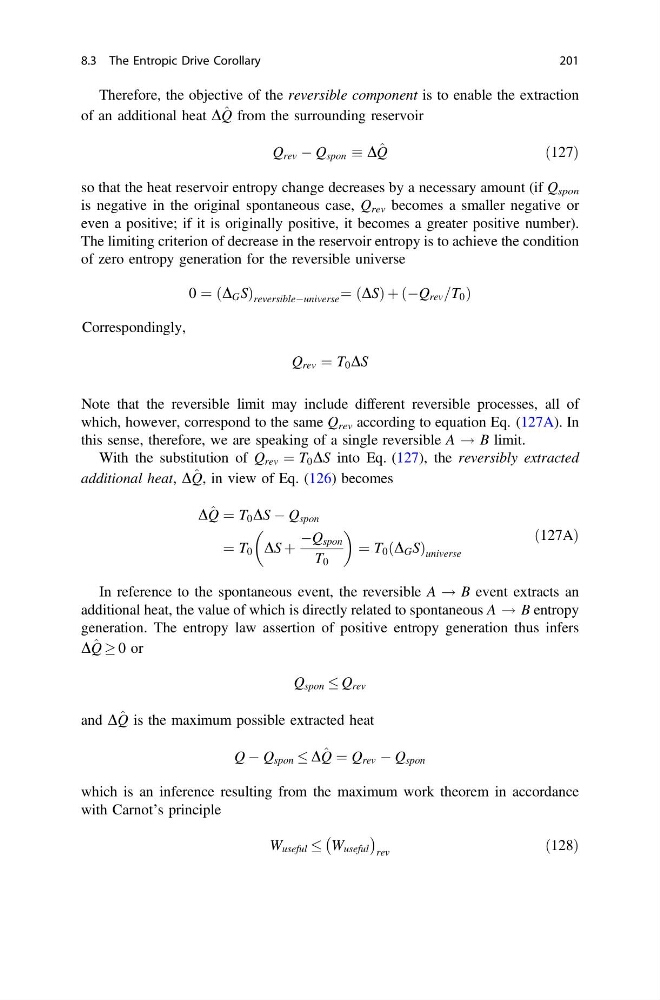
Therefore, the objective of the reversible component is to enable the extraction
of an additional heat D ^
Q from the surrounding reservoir
Q rev À Q spon D ^
Q
ð127Þ
so that the heat reservoir entropy change decreases by a necessary amount (if Q spon
is negative in the original spontaneous case, Q rev becomes a smaller negative or
even a positive; if it is originally positive, it becomes a greater positive number).
The limiting criterion of decrease in the reservoir entropy is to achieve the condition
of zero entropy generation for the reversible universe
0 ¼ D G S
ð
Þ reversibleÀuniverse ¼ DS
ð Þþ ÀQ rev =T 0
ð
Þ
Correspondingly,
Q rev ¼ T 0 DS
Note that the reversible limit may include different reversible processes, all of
which, however, correspond to the same Q rev according to equation Eq. (127A). In
this sense, therefore, we are speaking of a single reversible A ! B limit.
With the substitution of Q rev ¼ T 0 DS into Eq. (127), the reversibly extracted
additional heat, D ^
Q, in view of Eq. (126) becomes
D ^
Q ¼ T 0 DS À Q spon
¼ T 0 DS þ
ÀQ spon
T 0
¼ T 0 D G S
ð
Þ universe
ð127AÞ
In reference to the spontaneous event, the reversible A ! B event extracts an
additional heat, the value of which is directly related to spontaneous A ! B entropy
generation. The entropy law assertion of positive entropy generation thus infers
D ^
Q ! 0 or
Q spon Q rev
and D ^
Q is the maximum possible extracted heat
Q À Q spon D ^
Q ¼ Q rev À Q spon
which is an inference resulting from the maximum work theorem in accordance
with Carnot’s principle
W useful
W useful
À
Á
rev
ð128Þ
8.3 The Entropic Drive Corollary
201
of an additional heat D ^
Q from the surrounding reservoir
Q rev À Q spon D ^
Q
ð127Þ
so that the heat reservoir entropy change decreases by a necessary amount (if Q spon
is negative in the original spontaneous case, Q rev becomes a smaller negative or
even a positive; if it is originally positive, it becomes a greater positive number).
The limiting criterion of decrease in the reservoir entropy is to achieve the condition
of zero entropy generation for the reversible universe
0 ¼ D G S
ð
Þ reversibleÀuniverse ¼ DS
ð Þþ ÀQ rev =T 0
ð
Þ
Correspondingly,
Q rev ¼ T 0 DS
Note that the reversible limit may include different reversible processes, all of
which, however, correspond to the same Q rev according to equation Eq. (127A). In
this sense, therefore, we are speaking of a single reversible A ! B limit.
With the substitution of Q rev ¼ T 0 DS into Eq. (127), the reversibly extracted
additional heat, D ^
Q, in view of Eq. (126) becomes
D ^
Q ¼ T 0 DS À Q spon
¼ T 0 DS þ
ÀQ spon
T 0
¼ T 0 D G S
ð
Þ universe
ð127AÞ
In reference to the spontaneous event, the reversible A ! B event extracts an
additional heat, the value of which is directly related to spontaneous A ! B entropy
generation. The entropy law assertion of positive entropy generation thus infers
D ^
Q ! 0 or
Q spon Q rev
and D ^
Q is the maximum possible extracted heat
Q À Q spon D ^
Q ¼ Q rev À Q spon
which is an inference resulting from the maximum work theorem in accordance
with Carnot’s principle
W useful
W useful
À
Á
rev
ð128Þ
8.3 The Entropic Drive Corollary
201