

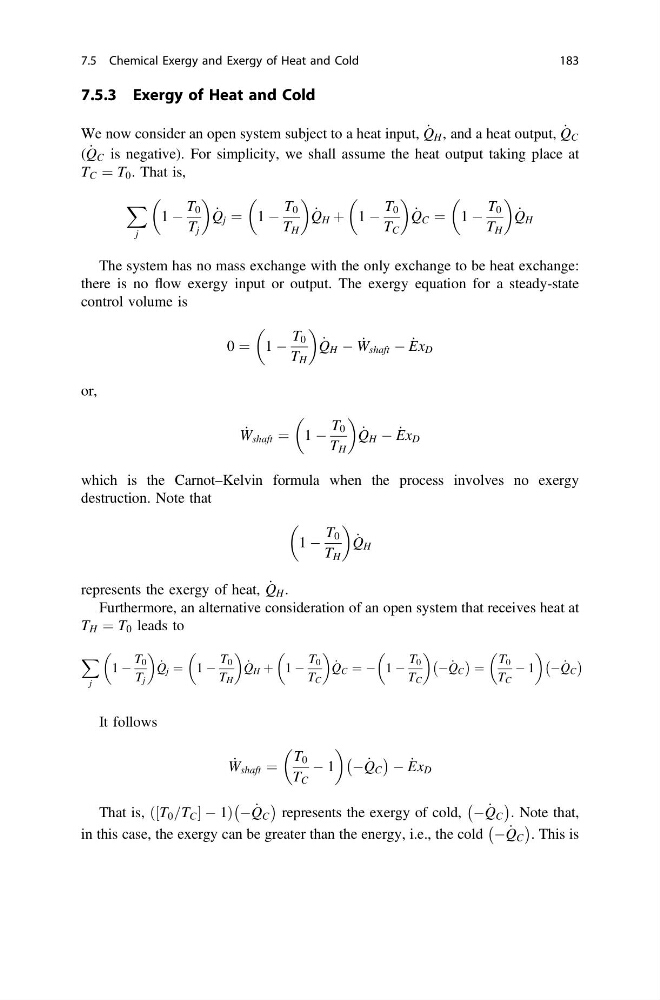
7.5.3 Exergy of Heat and Cold
We now consider an open system subject to a heat input, _
Q H , and a heat output, _
Q C
( _
Q C is negative). For simplicity, we shall assume the heat output taking place at
T C ¼ T 0 . That is,
X
j
1 À
T 0
T j
_
Q j ¼ 1 À
T 0
T H
_
Q H þ 1 À
T 0
T C
_
Q C ¼ 1 À
T 0
T H
_
Q H
The system has no mass exchange with the only exchange to be heat exchange:
there is no flow exergy input or output. The exergy equation for a steady-state
control volume is
0 ¼ 1 À
T 0
T H
_
Q H À _
W shaft À _
Ex D
or,
_
W shaft ¼ 1 À
T 0
T H
_
Q H À _
Ex D
which is the Carnot–Kelvin formula when the process involves no exergy
destruction. Note that
1 À
T 0
T H
_
Q H
represents the exergy of heat, _
Q H .
Furthermore, an alternative consideration of an open system that receives heat at
T H ¼ T 0 leads to
X
j
1 À
T 0
T j
_
Q j ¼ 1 À
T 0
T H
_
Q H þ 1 À
T 0
T C
_
Q C ¼ À 1 À
T 0
T C
À _
Q C
À
Á ¼
T 0
T C
À 1
À _
Q C
À
Á
It follows
_
W shaft ¼
T 0
T C
À 1
À _
Q C
À
Á À _
Ex D
That is, T 0 =T C
½
À1
ð
ÞÀ _
Q C
À
Á
represents the exergy of cold, À _
Q C
À
Á : Note that,
in this case, the exergy can be greater than the energy, i.e., the cold À _
Q C
À
Á
. This is
7.5 Chemical Exergy and Exergy of Heat and Cold
183
We now consider an open system subject to a heat input, _
Q H , and a heat output, _
Q C
( _
Q C is negative). For simplicity, we shall assume the heat output taking place at
T C ¼ T 0 . That is,
X
j
1 À
T 0
T j
_
Q j ¼ 1 À
T 0
T H
_
Q H þ 1 À
T 0
T C
_
Q C ¼ 1 À
T 0
T H
_
Q H
The system has no mass exchange with the only exchange to be heat exchange:
there is no flow exergy input or output. The exergy equation for a steady-state
control volume is
0 ¼ 1 À
T 0
T H
_
Q H À _
W shaft À _
Ex D
or,
_
W shaft ¼ 1 À
T 0
T H
_
Q H À _
Ex D
which is the Carnot–Kelvin formula when the process involves no exergy
destruction. Note that
1 À
T 0
T H
_
Q H
represents the exergy of heat, _
Q H .
Furthermore, an alternative consideration of an open system that receives heat at
T H ¼ T 0 leads to
X
j
1 À
T 0
T j
_
Q j ¼ 1 À
T 0
T H
_
Q H þ 1 À
T 0
T C
_
Q C ¼ À 1 À
T 0
T C
À _
Q C
À
Á ¼
T 0
T C
À 1
À _
Q C
À
Á
It follows
_
W shaft ¼
T 0
T C
À 1
À _
Q C
À
Á À _
Ex D
That is, T 0 =T C
½
À1
ð
ÞÀ _
Q C
À
Á
represents the exergy of cold, À _
Q C
À
Á : Note that,
in this case, the exergy can be greater than the energy, i.e., the cold À _
Q C
À
Á
. This is
7.5 Chemical Exergy and Exergy of Heat and Cold
183