

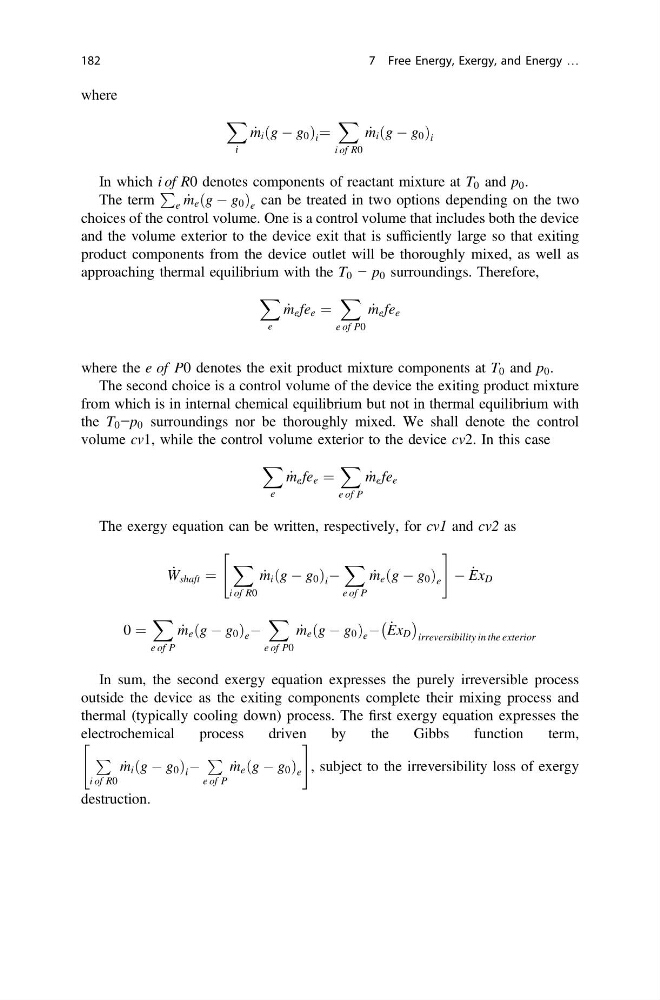
where
X
i
_
m i g À g 0
ð
Þ i ¼
X
i of R0
_
m i g À g 0
ð
Þ i
In which i of R0 denotes components of reactant mixture at T 0 and p 0 .
The term
P
e _
m e g À g 0
ð
Þ e can be treated in two options depending on the two
choices of the control volume. One is a control volume that includes both the device
and the volume exterior to the device exit that is sufficiently large so that exiting
product components from the device outlet will be thoroughly mixed, as well as
approaching thermal equilibrium with the T 0 − p 0 surroundings. Therefore,
X
e
_
m e fe e ¼
X
e of P0
_
m e fe e
where the e of P0 denotes the exit product mixture components at T 0 and p 0 .
The second choice is a control volume of the device the exiting product mixture
from which is in internal chemical equilibrium but not in thermal equilibrium with
the T 0 −p 0 surroundings nor be thoroughly mixed. We shall denote the control
volume cv1, while the control volume exterior to the device cv2. In this case
X
e
_
m e fe e ¼
X
e of P
_
m e fe e
The exergy equation can be written, respectively, for cv1 and cv2 as
_
W shaft ¼
X
i of R0
_
m i g À g 0
ð
Þ i À
X
e of P
_
m e g À g 0
ð
Þ e
"
#
À _
Ex D
0 ¼
X
e of P
_
m e g À g 0
ð
Þ e À
X
e of P0
_
m e g À g 0
ð
Þ e À _
Ex D
À
Á
irreversibility in the exterior
In sum, the second exergy equation expresses the purely irreversible process
outside the device as the exiting components complete their mixing process and
thermal (typically cooling down) process. The first exergy equation expresses the
electrochemical
process
driven
by
the
Gibbs
function
term,
P
i of R0
_
m i g À g 0
ð
Þ i À
P
e of P
_
m e g À g 0
ð
Þ e
"
#
, subject to the irreversibility loss of exergy
destruction.
182
7 Free Energy, Exergy, and Energy …
X
i
_
m i g À g 0
ð
Þ i ¼
X
i of R0
_
m i g À g 0
ð
Þ i
In which i of R0 denotes components of reactant mixture at T 0 and p 0 .
The term
P
e _
m e g À g 0
ð
Þ e can be treated in two options depending on the two
choices of the control volume. One is a control volume that includes both the device
and the volume exterior to the device exit that is sufficiently large so that exiting
product components from the device outlet will be thoroughly mixed, as well as
approaching thermal equilibrium with the T 0 − p 0 surroundings. Therefore,
X
e
_
m e fe e ¼
X
e of P0
_
m e fe e
where the e of P0 denotes the exit product mixture components at T 0 and p 0 .
The second choice is a control volume of the device the exiting product mixture
from which is in internal chemical equilibrium but not in thermal equilibrium with
the T 0 −p 0 surroundings nor be thoroughly mixed. We shall denote the control
volume cv1, while the control volume exterior to the device cv2. In this case
X
e
_
m e fe e ¼
X
e of P
_
m e fe e
The exergy equation can be written, respectively, for cv1 and cv2 as
_
W shaft ¼
X
i of R0
_
m i g À g 0
ð
Þ i À
X
e of P
_
m e g À g 0
ð
Þ e
"
#
À _
Ex D
0 ¼
X
e of P
_
m e g À g 0
ð
Þ e À
X
e of P0
_
m e g À g 0
ð
Þ e À _
Ex D
À
Á
irreversibility in the exterior
In sum, the second exergy equation expresses the purely irreversible process
outside the device as the exiting components complete their mixing process and
thermal (typically cooling down) process. The first exergy equation expresses the
electrochemical
process
driven
by
the
Gibbs
function
term,
P
i of R0
_
m i g À g 0
ð
Þ i À
P
e of P
_
m e g À g 0
ð
Þ e
"
#
, subject to the irreversibility loss of exergy
destruction.
182
7 Free Energy, Exergy, and Energy …