

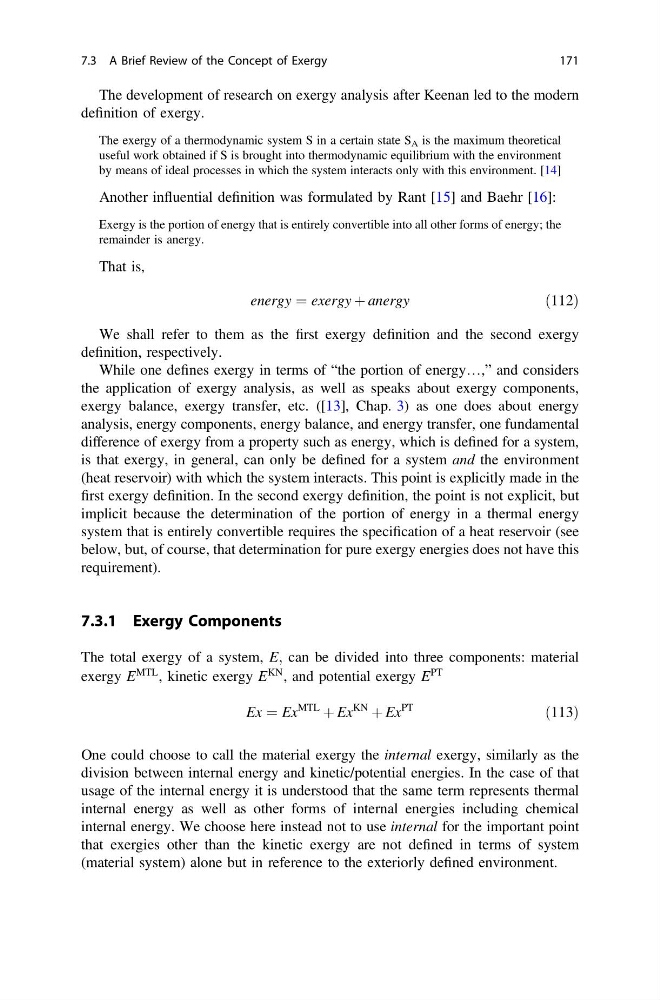
The development of research on exergy analysis after Keenan led to the modern
definition of exergy.
The exergy of a thermodynamic system S in a certain state S A is the maximum theoretical
useful work obtained if S is brought into thermodynamic equilibrium with the environment
by means of ideal processes in which the system interacts only with this environment. [14]
Another influential definition was formulated by Rant [15] and Baehr [16]:
Exergy is the portion of energy that is entirely convertible into all other forms of energy; the
remainder is anergy.
That is,
energy ¼ exergy þ anergy
ð112Þ
We shall refer to them as the first exergy definition and the second exergy
definition, respectively.
While one defines exergy in terms of “the portion of energy…,” and considers
the application of exergy analysis, as well as speaks about exergy components,
exergy balance, exergy transfer, etc. ([13], Chap. 3) as one does about energy
analysis, energy components, energy balance, and energy transfer, one fundamental
difference of exergy from a property such as energy, which is defined for a system,
is that exergy, in general, can only be defined for a system and the environment
(heat reservoir) with which the system interacts. This point is explicitly made in the
first exergy definition. In the second exergy definition, the point is not explicit, but
implicit because the determination of the portion of energy in a thermal energy
system that is entirely convertible requires the specification of a heat reservoir (see
below, but, of course, that determination for pure exergy energies does not have this
requirement).
7.3.1 Exergy Components
The total exergy of a system, E; can be divided into three components: material
exergy E
MTL , kinetic exergy E
KN , and potential exergy E
PT
Ex ¼ Ex
MTL
þ Ex
KN
þ Ex
PT
ð113Þ
One could choose to call the material exergy the internal exergy, similarly as the
division between internal energy and kinetic/potential energies. In the case of that
usage of the internal energy it is understood that the same term represents thermal
internal energy as well as other forms of internal energies including chemical
internal energy. We choose here instead not to use internal for the important point
that exergies other than the kinetic exergy are not defined in terms of system
(material system) alone but in reference to the exteriorly defined environment.
7.3 A Brief Review of the Concept of Exergy
171
definition of exergy.
The exergy of a thermodynamic system S in a certain state S A is the maximum theoretical
useful work obtained if S is brought into thermodynamic equilibrium with the environment
by means of ideal processes in which the system interacts only with this environment. [14]
Another influential definition was formulated by Rant [15] and Baehr [16]:
Exergy is the portion of energy that is entirely convertible into all other forms of energy; the
remainder is anergy.
That is,
energy ¼ exergy þ anergy
ð112Þ
We shall refer to them as the first exergy definition and the second exergy
definition, respectively.
While one defines exergy in terms of “the portion of energy…,” and considers
the application of exergy analysis, as well as speaks about exergy components,
exergy balance, exergy transfer, etc. ([13], Chap. 3) as one does about energy
analysis, energy components, energy balance, and energy transfer, one fundamental
difference of exergy from a property such as energy, which is defined for a system,
is that exergy, in general, can only be defined for a system and the environment
(heat reservoir) with which the system interacts. This point is explicitly made in the
first exergy definition. In the second exergy definition, the point is not explicit, but
implicit because the determination of the portion of energy in a thermal energy
system that is entirely convertible requires the specification of a heat reservoir (see
below, but, of course, that determination for pure exergy energies does not have this
requirement).
7.3.1 Exergy Components
The total exergy of a system, E; can be divided into three components: material
exergy E
MTL , kinetic exergy E
KN , and potential exergy E
PT
Ex ¼ Ex
MTL
þ Ex
KN
þ Ex
PT
ð113Þ
One could choose to call the material exergy the internal exergy, similarly as the
division between internal energy and kinetic/potential energies. In the case of that
usage of the internal energy it is understood that the same term represents thermal
internal energy as well as other forms of internal energies including chemical
internal energy. We choose here instead not to use internal for the important point
that exergies other than the kinetic exergy are not defined in terms of system
(material system) alone but in reference to the exteriorly defined environment.
7.3 A Brief Review of the Concept of Exergy
171