

_
W ¼ _
W shaft þ _
W surface ¼ _
W shaft þ
Z
cs
p ~ V Á d ~ A
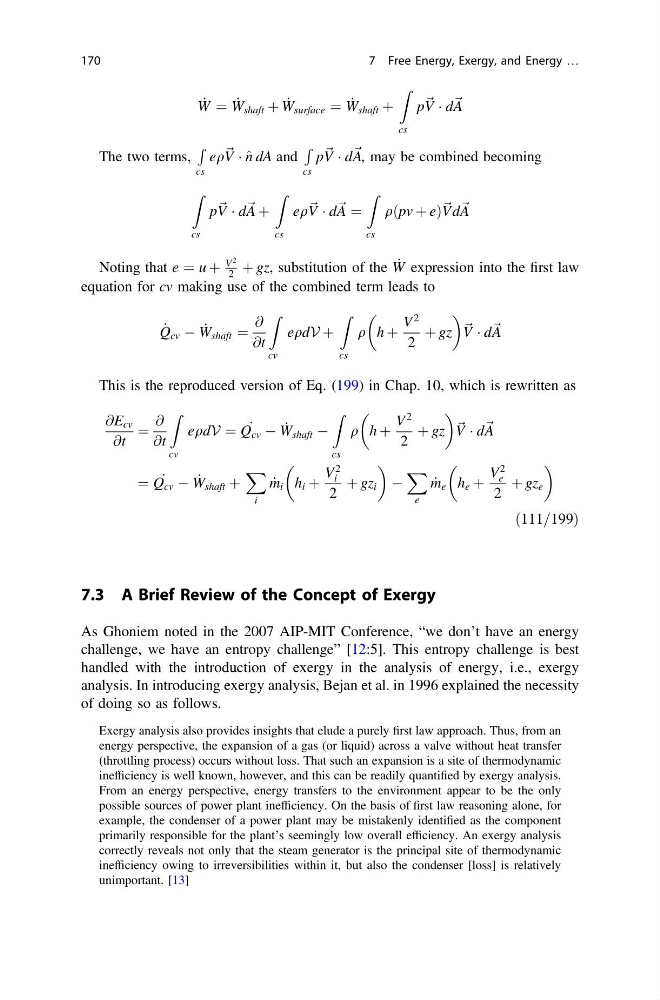
The two terms,
R
cs
eq ~ V Á ^ n dA and
R
cs
p ~ V Á d ~ A, may be combined becoming
Z
cs
p ~ V Á d ~ A þ
Z
cs
eq ~ V Á d ~ A ¼
Z
cs
q pv þ e
ð
Þ ~ Vd ~ A
Noting that e ¼ u þ
V
2
2 þ gz, substitution of the _
W expression into the first law
equation for cv making use of the combined term leads to
_
Q cv À _
W shaft ¼
@
@t
Z
cv
eqdV þ
Z
cs
q h þ
V
2
2
þ gz
~ V Á d ~ A
This is the reproduced version of Eq. (199) in Chap. 10, which is rewritten as
@E cv
@t
¼
@
@t
Z
cv
eqdV ¼ _
Q cv À _
W shaft À
Z
cs
q h þ
V
2
2
þ gz
~ V Á d ~ A
¼ _
Q cv À _
W shaft þ
X
i
_
m i h i þ
V
2
i
2
þ gz i
À
X
e
_
m e h e þ
V
2
e
2
þ gz e
ð111=199Þ
7.3 A Brief Review of the Concept of Exergy
As Ghoniem noted in the 2007 AIP-MIT Conference, “we don’t have an energy
challenge, we have an entropy challenge” [12:5]. This entropy challenge is best
handled with the introduction of exergy in the analysis of energy, i.e., exergy
analysis. In introducing exergy analysis, Bejan et al. in 1996 explained the necessity
of doing so as follows.
Exergy analysis also provides insights that elude a purely first law approach. Thus, from an
energy perspective, the expansion of a gas (or liquid) across a valve without heat transfer
(throttling process) occurs without loss. That such an expansion is a site of thermodynamic
inefficiency is well known, however, and this can be readily quantified by exergy analysis.
From an energy perspective, energy transfers to the environment appear to be the only
possible sources of power plant inefficiency. On the basis of first law reasoning alone, for
example, the condenser of a power plant may be mistakenly identified as the component
primarily responsible for the plant’s seemingly low overall efficiency. An exergy analysis
correctly reveals not only that the steam generator is the principal site of thermodynamic
inefficiency owing to irreversibilities within it, but also the condenser [loss] is relatively
unimportant. [13]
170
7 Free Energy, Exergy, and Energy …
W ¼ _
W shaft þ _
W surface ¼ _
W shaft þ
Z
cs
p ~ V Á d ~ A
The two terms,
R
cs
eq ~ V Á ^ n dA and
R
cs
p ~ V Á d ~ A, may be combined becoming
Z
cs
p ~ V Á d ~ A þ
Z
cs
eq ~ V Á d ~ A ¼
Z
cs
q pv þ e
ð
Þ ~ Vd ~ A
Noting that e ¼ u þ
V
2
2 þ gz, substitution of the _
W expression into the first law
equation for cv making use of the combined term leads to
_
Q cv À _
W shaft ¼
@
@t
Z
cv
eqdV þ
Z
cs
q h þ
V
2
2
þ gz
~ V Á d ~ A
This is the reproduced version of Eq. (199) in Chap. 10, which is rewritten as
@E cv
@t
¼
@
@t
Z
cv
eqdV ¼ _
Q cv À _
W shaft À
Z
cs
q h þ
V
2
2
þ gz
~ V Á d ~ A
¼ _
Q cv À _
W shaft þ
X
i
_
m i h i þ
V
2
i
2
þ gz i
À
X
e
_
m e h e þ
V
2
e
2
þ gz e
ð111=199Þ
7.3 A Brief Review of the Concept of Exergy
As Ghoniem noted in the 2007 AIP-MIT Conference, “we don’t have an energy
challenge, we have an entropy challenge” [12:5]. This entropy challenge is best
handled with the introduction of exergy in the analysis of energy, i.e., exergy
analysis. In introducing exergy analysis, Bejan et al. in 1996 explained the necessity
of doing so as follows.
Exergy analysis also provides insights that elude a purely first law approach. Thus, from an
energy perspective, the expansion of a gas (or liquid) across a valve without heat transfer
(throttling process) occurs without loss. That such an expansion is a site of thermodynamic
inefficiency is well known, however, and this can be readily quantified by exergy analysis.
From an energy perspective, energy transfers to the environment appear to be the only
possible sources of power plant inefficiency. On the basis of first law reasoning alone, for
example, the condenser of a power plant may be mistakenly identified as the component
primarily responsible for the plant’s seemingly low overall efficiency. An exergy analysis
correctly reveals not only that the steam generator is the principal site of thermodynamic
inefficiency owing to irreversibilities within it, but also the condenser [loss] is relatively
unimportant. [13]
170
7 Free Energy, Exergy, and Energy …