

6.5.1 Nonreversible Processes and Reversible-like Processes
It is also useful to introduce the concepts of nonreversible processes and
reversible-like processes [18]. All real processes are irreversible. It is, therefore,
pointless to characterize a real process irreversible. Spontaneous natural processes
(“nature as it is”: a room being warmed up in the summer) are irreversible and
nonreversible, i.e., irreversible processes that are not “managed”. In contrast,
reversible-like processes (“nature as it can be”: a room is made colder in the
summer) are irreversible but not nonreversible, i.e., irreversible processes that are
“managed” or are made to happen. The distinction between nonreversible processes
and reversible-like processes serves a useful purpose, e.g., in Chap. 10 an important
distinction is made between heat transfer processes/heat production processes,
which are nonreversible spontaneous natural processes, and heat extraction processes, which are reversible-like.
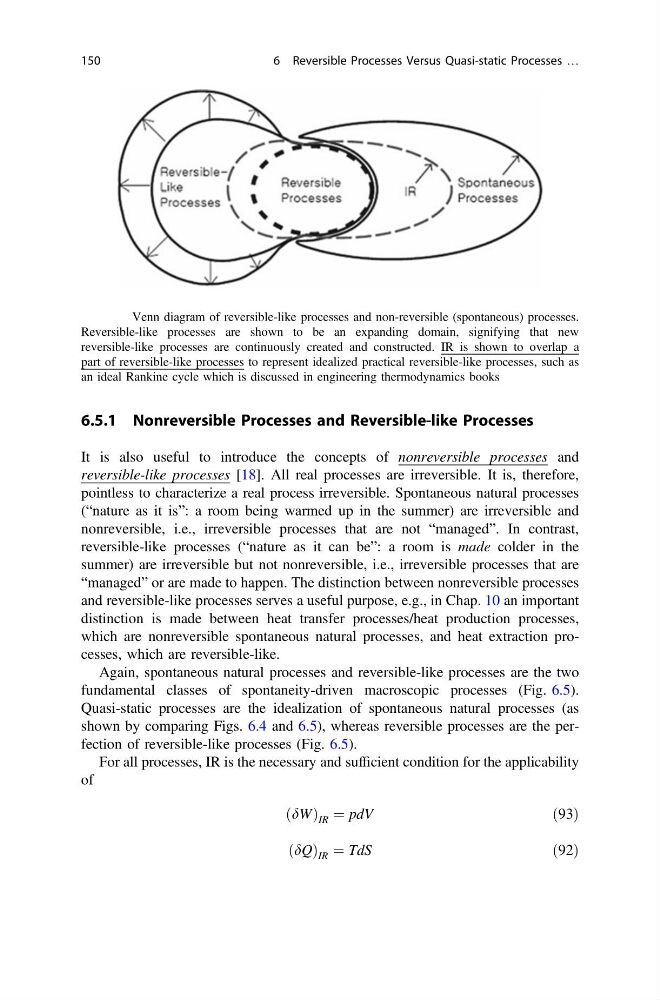
Again, spontaneous natural processes and reversible-like processes are the two
fundamental classes of spontaneity-driven macroscopic processes (Fig. 6.5).
Quasi-static processes are the idealization of spontaneous natural processes (as
shown by comparing Figs. 6.4 and 6.5), whereas reversible processes are the perfection of reversible-like processes (Fig. 6.5).
For all processes, IR is the necessary and sufficient condition for the applicability
of
ðdWÞ IR ¼ pdV
ð93Þ
ðdQÞ IR ¼ TdS
ð92Þ
Fig. 6.5 Venn diagram of reversible-like processes and non-reversible (spontaneous) processes.
Reversible-like processes are shown to be an expanding domain, signifying that new
reversible-like processes are continuously created and constructed. IR is shown to overlap a
part of reversible-like processes to represent idealized practical reversible-like processes, such as
an ideal Rankine cycle which is discussed in engineering thermodynamics books
150
6 Reversible Processes Versus Quasi-static Processes …
It is also useful to introduce the concepts of nonreversible processes and
reversible-like processes [18]. All real processes are irreversible. It is, therefore,
pointless to characterize a real process irreversible. Spontaneous natural processes
(“nature as it is”: a room being warmed up in the summer) are irreversible and
nonreversible, i.e., irreversible processes that are not “managed”. In contrast,
reversible-like processes (“nature as it can be”: a room is made colder in the
summer) are irreversible but not nonreversible, i.e., irreversible processes that are
“managed” or are made to happen. The distinction between nonreversible processes
and reversible-like processes serves a useful purpose, e.g., in Chap. 10 an important
distinction is made between heat transfer processes/heat production processes,
which are nonreversible spontaneous natural processes, and heat extraction processes, which are reversible-like.
Again, spontaneous natural processes and reversible-like processes are the two
fundamental classes of spontaneity-driven macroscopic processes (Fig. 6.5).
Quasi-static processes are the idealization of spontaneous natural processes (as
shown by comparing Figs. 6.4 and 6.5), whereas reversible processes are the perfection of reversible-like processes (Fig. 6.5).
For all processes, IR is the necessary and sufficient condition for the applicability
of
ðdWÞ IR ¼ pdV
ð93Þ
ðdQÞ IR ¼ TdS
ð92Þ
Fig. 6.5 Venn diagram of reversible-like processes and non-reversible (spontaneous) processes.
Reversible-like processes are shown to be an expanding domain, signifying that new
reversible-like processes are continuously created and constructed. IR is shown to overlap a
part of reversible-like processes to represent idealized practical reversible-like processes, such as
an ideal Rankine cycle which is discussed in engineering thermodynamics books
150
6 Reversible Processes Versus Quasi-static Processes …