

[20:43] their corresponding pairs of equilibrium states of the first subset. A set of
infinitesimally close constraints only ensures that the first set is infinitely dense, not
this condition of transient states being infinitesimally near equilibrium. The
merging of the second sets into the first set, i.e., the whole process in totality being
infinitely slow, requires that the process be brought about by infinitesimal affinity,
not merely its constraints being infinitesimally close.
The second sets of a quasi-static process sometimes, e.g., thermal processes,
merge into the first set, but in other instances, e.g., mechanical free expansion
processes [5:99] and chemical processes, they do not merge into the first set and the
transient states remain non-representable and nonequilibrium.
It is useful to review the three conditions of (a) reversibility, (b) IR, and
(c) quasi-staticity. Reversibility is synonymous with reversible processes, which are
ensured by machines (and work reservoir) that keep all affinity (driving forces)
differences balanced and all affinity gradients infinitesimally small. Reversibility
means having this condition both within the system (internally reversible) and
outside the system (externally reversible).
The condition of reversibility, thus, is a subset of IR (which is defined above)—
see Fig. 6.3. Quasi-staticity is the condition that a system passes through a series of
equilibrium states, i.e., the first quasi-equilibrium set of a quasi-static process. IR is
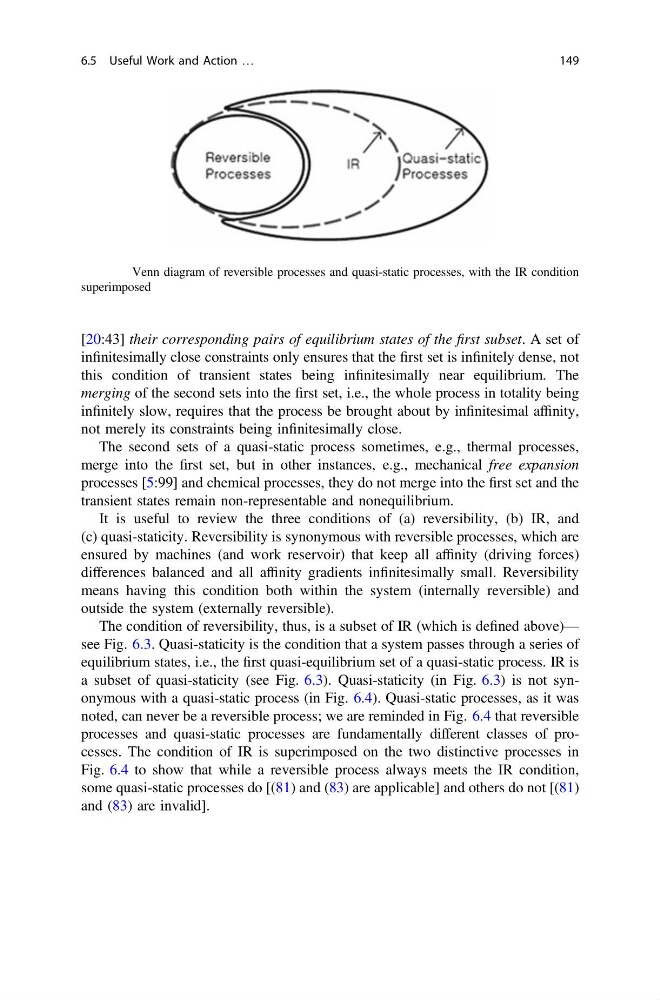
a subset of quasi-staticity (see Fig. 6.3). Quasi-staticity (in Fig. 6.3) is not synonymous with a quasi-static process (in Fig. 6.4). Quasi-static processes, as it was
noted, can never be a reversible process; we are reminded in Fig. 6.4 that reversible
processes and quasi-static processes are fundamentally different classes of processes. The condition of IR is superimposed on the two distinctive processes in
Fig. 6.4 to show that while a reversible process always meets the IR condition,
some quasi-static processes do [(81) and (83) are applicable] and others do not [(81)
and (83) are invalid].
Fig. 6.4 Venn diagram of reversible processes and quasi-static processes, with the IR condition
superimposed
6.5 Useful Work and Action …
149
infinitesimally close constraints only ensures that the first set is infinitely dense, not
this condition of transient states being infinitesimally near equilibrium. The
merging of the second sets into the first set, i.e., the whole process in totality being
infinitely slow, requires that the process be brought about by infinitesimal affinity,
not merely its constraints being infinitesimally close.
The second sets of a quasi-static process sometimes, e.g., thermal processes,
merge into the first set, but in other instances, e.g., mechanical free expansion
processes [5:99] and chemical processes, they do not merge into the first set and the
transient states remain non-representable and nonequilibrium.
It is useful to review the three conditions of (a) reversibility, (b) IR, and
(c) quasi-staticity. Reversibility is synonymous with reversible processes, which are
ensured by machines (and work reservoir) that keep all affinity (driving forces)
differences balanced and all affinity gradients infinitesimally small. Reversibility
means having this condition both within the system (internally reversible) and
outside the system (externally reversible).
The condition of reversibility, thus, is a subset of IR (which is defined above)—
see Fig. 6.3. Quasi-staticity is the condition that a system passes through a series of
equilibrium states, i.e., the first quasi-equilibrium set of a quasi-static process. IR is
a subset of quasi-staticity (see Fig. 6.3). Quasi-staticity (in Fig. 6.3) is not synonymous with a quasi-static process (in Fig. 6.4). Quasi-static processes, as it was
noted, can never be a reversible process; we are reminded in Fig. 6.4 that reversible
processes and quasi-static processes are fundamentally different classes of processes. The condition of IR is superimposed on the two distinctive processes in
Fig. 6.4 to show that while a reversible process always meets the IR condition,
some quasi-static processes do [(81) and (83) are applicable] and others do not [(81)
and (83) are invalid].
Fig. 6.4 Venn diagram of reversible processes and quasi-static processes, with the IR condition
superimposed
6.5 Useful Work and Action …
149