

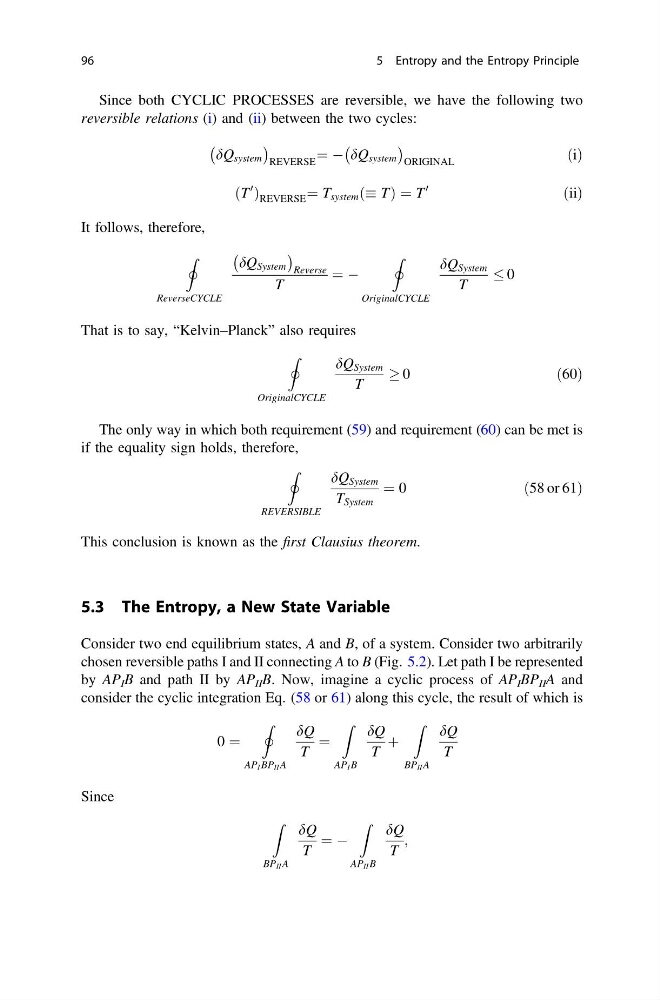
Since both CYCLIC PROCESSES are reversible, we have the following two
reversible relations (i) and (ii) between the two cycles:
dQ system
À
Á
REVERSE
¼ À dQ system
À
Á
ORIGINAL
ðiÞ
T
0
ð Þ REVERSE ¼ T system T
ð
Þ ¼ T
0
ðiiÞ
It follows, therefore,
I
ReverseCYCLE
dQ System
À
Á
Reverse
T
¼ À
I
OriginalCYCLE
dQ System
T
0
That is to say, “Kelvin–Planck” also requires
I
OriginalCYCLE
dQ System
T
! 0
ð60Þ
The only way in which both requirement (59) and requirement (60) can be met is
if the equality sign holds, therefore,
I
REVERSIBLE
dQ System
T System
¼ 0
ð58 or 61Þ
This conclusion is known as the first Clausius theorem.
5.3 The Entropy, a New State Variable
Consider two end equilibrium states, A and B, of a system. Consider two arbitrarily
chosen reversible paths I and II connecting A to B (Fig. 5.2). Let path I be represented
by AP I B and path II by AP II B. Now, imagine a cyclic process of AP I BP II A and
consider the cyclic integration Eq. (58 or 61) along this cycle, the result of which is
0 ¼
I
AP I BP II A
dQ
T
¼
Z
AP I B
dQ
T
þ
Z
BP II A
dQ
T
Since
Z
BP II A
dQ
T
¼ À
Z
AP II B
dQ
T
;
96
5 Entropy and the Entropy Principle
reversible relations (i) and (ii) between the two cycles:
dQ system
À
Á
REVERSE
¼ À dQ system
À
Á
ORIGINAL
ðiÞ
T
0
ð Þ REVERSE ¼ T system T
ð
Þ ¼ T
0
ðiiÞ
It follows, therefore,
I
ReverseCYCLE
dQ System
À
Á
Reverse
T
¼ À
I
OriginalCYCLE
dQ System
T
0
That is to say, “Kelvin–Planck” also requires
I
OriginalCYCLE
dQ System
T
! 0
ð60Þ
The only way in which both requirement (59) and requirement (60) can be met is
if the equality sign holds, therefore,
I
REVERSIBLE
dQ System
T System
¼ 0
ð58 or 61Þ
This conclusion is known as the first Clausius theorem.
5.3 The Entropy, a New State Variable
Consider two end equilibrium states, A and B, of a system. Consider two arbitrarily
chosen reversible paths I and II connecting A to B (Fig. 5.2). Let path I be represented
by AP I B and path II by AP II B. Now, imagine a cyclic process of AP I BP II A and
consider the cyclic integration Eq. (58 or 61) along this cycle, the result of which is
0 ¼
I
AP I BP II A
dQ
T
¼
Z
AP I B
dQ
T
þ
Z
BP II A
dQ
T
Since
Z
BP II A
dQ
T
¼ À
Z
AP II B
dQ
T
;
96
5 Entropy and the Entropy Principle