

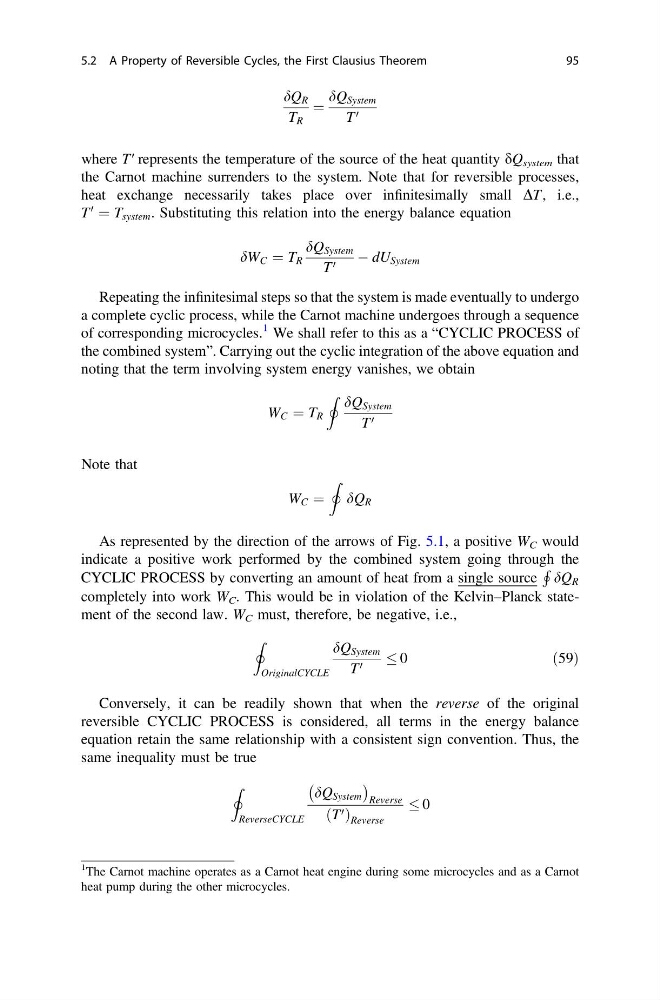
dQ R
T R
¼
dQ System
T 0
where T′ represents the temperature of the source of the heat quantity dQ system that
the Carnot machine surrenders to the system. Note that for reversible processes,
heat exchange necessarily takes place over infinitesimally small DT, i.e.,
T
0
¼ T system . Substituting this relation into the energy balance equation
dW C ¼ T R
dQ System
T 0 À dU System
Repeating the infinitesimal steps so that the system is made eventually to undergo
a complete cyclic process, while the Carnot machine undergoes through a sequence
of corresponding microcycles.
1 We shall refer to this as a “CYCLIC PROCESS of
the combined system”. Carrying out the cyclic integration of the above equation and
noting that the term involving system energy vanishes, we obtain
W C ¼ T R
I dQ System
T 0
Note that
W C ¼
I
dQ R
As represented by the direction of the arrows of Fig. 5.1, a positive W C would
indicate a positive work performed by the combined system going through the
CYCLIC PROCESS by converting an amount of heat from a single source
H
dQ R
completely into work W C . This would be in violation of the Kelvin–Planck statement of the second law. W C must, therefore, be negative, i.e.,
I
OriginalCYCLE
dQ System
T 0
0
ð59Þ
Conversely, it can be readily shown that when the reverse of the original
reversible CYCLIC PROCESS is considered, all terms in the energy balance
equation retain the same relationship with a consistent sign convention. Thus, the
same inequality must be true
I
ReverseCYCLE
dQ System
À
Á
Reverse
T 0
ð Þ Reverse
0
1
The Carnot machine operates as a Carnot heat engine during some microcycles and as a Carnot
heat pump during the other microcycles.
5.2 A Property of Reversible Cycles, the First Clausius Theorem
95
T R
¼
dQ System
T 0
where T′ represents the temperature of the source of the heat quantity dQ system that
the Carnot machine surrenders to the system. Note that for reversible processes,
heat exchange necessarily takes place over infinitesimally small DT, i.e.,
T
0
¼ T system . Substituting this relation into the energy balance equation
dW C ¼ T R
dQ System
T 0 À dU System
Repeating the infinitesimal steps so that the system is made eventually to undergo
a complete cyclic process, while the Carnot machine undergoes through a sequence
of corresponding microcycles.
1 We shall refer to this as a “CYCLIC PROCESS of
the combined system”. Carrying out the cyclic integration of the above equation and
noting that the term involving system energy vanishes, we obtain
W C ¼ T R
I dQ System
T 0
Note that
W C ¼
I
dQ R
As represented by the direction of the arrows of Fig. 5.1, a positive W C would
indicate a positive work performed by the combined system going through the
CYCLIC PROCESS by converting an amount of heat from a single source
H
dQ R
completely into work W C . This would be in violation of the Kelvin–Planck statement of the second law. W C must, therefore, be negative, i.e.,
I
OriginalCYCLE
dQ System
T 0
0
ð59Þ
Conversely, it can be readily shown that when the reverse of the original
reversible CYCLIC PROCESS is considered, all terms in the energy balance
equation retain the same relationship with a consistent sign convention. Thus, the
same inequality must be true
I
ReverseCYCLE
dQ System
À
Á
Reverse
T 0
ð Þ Reverse
0
1
The Carnot machine operates as a Carnot heat engine during some microcycles and as a Carnot
heat pump during the other microcycles.
5.2 A Property of Reversible Cycles, the First Clausius Theorem
95